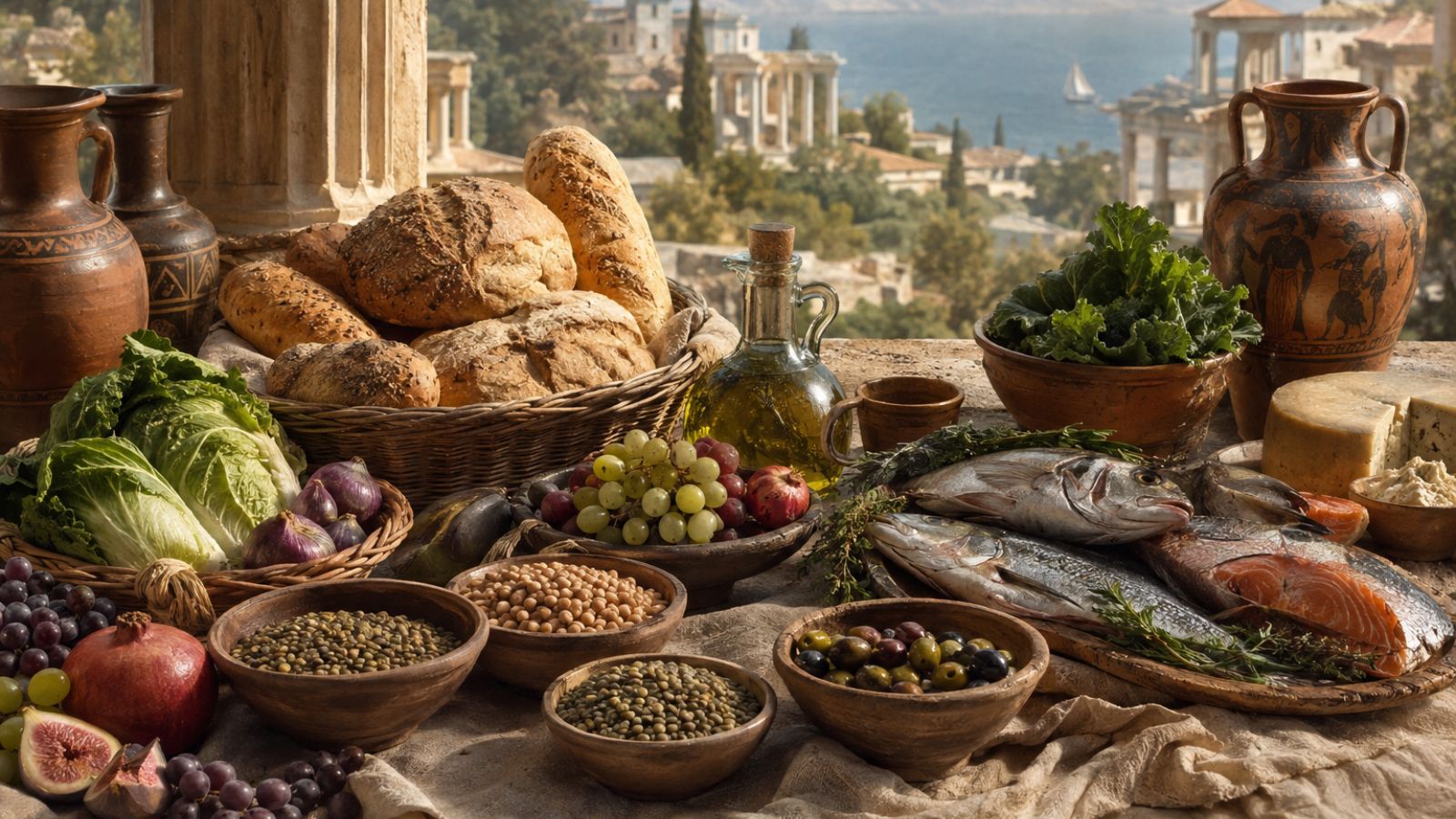


Sydney: The modern Mediterranean diet is often associated with olive oil, vegetables and fish. But historical accounts suggest that bread and other cereal-based foods were far more central to what many ancient Mediterraneans ate.
Roman emperor Julian (332–363 CE) described bread as the food that “among us is thought to be the most nourishing”.
Bread and other cereal-based foods formed the foundation of many ancient Mediterranean diets. They were supplemented by pulses, oil, wine and whatever seasonal produce people could obtain.
That picture is quite different from the modern idea of a Mediterranean diet centred on vegetables, olive oil and grilled fish.
Bread was fundamental to Julian’s Roman world, although it was not universally appreciated. Ethiopians, who lived largely on meat and milk, considered bread poor in nourishment and wondered how Mediterraneans could survive on what they called a “diet of dung”.
What Galen tells us about ancient diets
The physician Galen (129–216 CE) provides one of the fullest accounts of food in the ancient Mediterranean.
In his book On the Properties of Foodstuffs, he discusses cereals and pulses first, followed by plants, animal foods and fish. Wheat, he said, was the most widely used and “valuable” food.
Bread was not simply an accompaniment to a meal. For many people, it supplied a large share of their food. Galen distinguished between different types of bread, considering fine white bread the most nourishing, while ranking bran bread lower, although he believed it was more effective at emptying the bowels.
Preparation also mattered. Galen considered the best bread to be well leavened, thoroughly kneaded and baked at moderate heat.
An excessively hot oven, he wrote, could produce a crust that was “dry and like pottery” while leaving the centre raw. Completely unleavened bread, he believed, suited almost nobody.
Galen also learnt the importance of processing wheat through an unpleasant personal experience. During a journey, a poor peasant woman served him and his companions boiled whole grains after her household ran out of bread.
He recalled suffering indigestion, headaches, bloating and a loss of appetite afterwards.
The same grain became more nourishing, in his view, after being milled, sieved, kneaded, fermented and baked.
What else did ancient Mediterraneans eat?
Ancient people certainly ate fruit and vegetables. Galen discusses lettuce, cabbage, onions, gourds, figs, grapes, apples, pears and pomegranates.
But he did not necessarily regard these foods as the foundation of a healthy diet. Many plants were valued mainly for their medicinal effects, such as aiding digestion or stimulating urination.
A plant-heavy diet could also reflect poverty rather than a conscious pursuit of health. Galen described oats as “food for draught animals, not for men”, except when extreme hunger forced people to make bread from them.
Pulses were much more important than modern images of Mediterranean cuisine might suggest. Lentils, chickpeas, lupins and other legumes provided substantial nourishment.
Galen even described an Alexandrian physician who lived largely on pulses for four years. His diet may sound familiar today, except that he seasoned the pulses with fish sauce.
Fish, meanwhile, was not necessarily an everyday staple. Access depended heavily on location and wealth, and fresh fish could be expensive.
Fish caught near Rome could also be contaminated by waste flowing into the River Tiber from “latrines, bathhouses or kitchens”.
Was there one ancient Mediterranean diet?
The Greek writer Athenaeus offers another reason to be cautious about speaking of “the” Mediterranean diet.
Writing around 200 CE, Athenaeus imagined an extended dinner party where guests discussed food, wine and dining customs. His descriptions show how strongly diets differed according to geography and wealth.
In Lusitania, in modern Spain, seafood was abundant and highly regarded. Wheat, barley, wine, figs and meat were also relatively cheap, while wild game could be so inexpensive that sellers sometimes gave it away.
Elsewhere, fish could command extraordinary prices. Athenaeus quotes a diner complaining about how expensive fish had become.
Fish was not always prepared in the simple way associated with today's Mediterranean diet, either. Athenaeus preserves a recipe by the fifth-century BCE Sicilian cook Mithaecus that involved covering ribbon fish with cheese and oil.
The fish and olive oil may sound familiar, but the heavy use of cheese and oil differs sharply from the modern image of lightly grilled Mediterranean seafood.
The ancient diet was not the modern Mediterranean diet
For many ancient Mediterraneans, bread was indispensable. Cereals supplied a large share of their calories, while pulses, oil, vegetables, fruit and fish varied according to region, season and wealth.
There was therefore no single ancient Mediterranean diet.
There were different diets shaped by geography and social class: one for regions where food was plentiful, another for people struggling to survive, and another for wealthy diners who could afford expensive delicacies.
The modern Mediterranean diet is not an ancient menu preserved unchanged. It is a selective reconstruction that highlights olive oil, vegetables and seafood while largely leaving out the substantial quantities of bread and cheese that featured in many ancient diets.