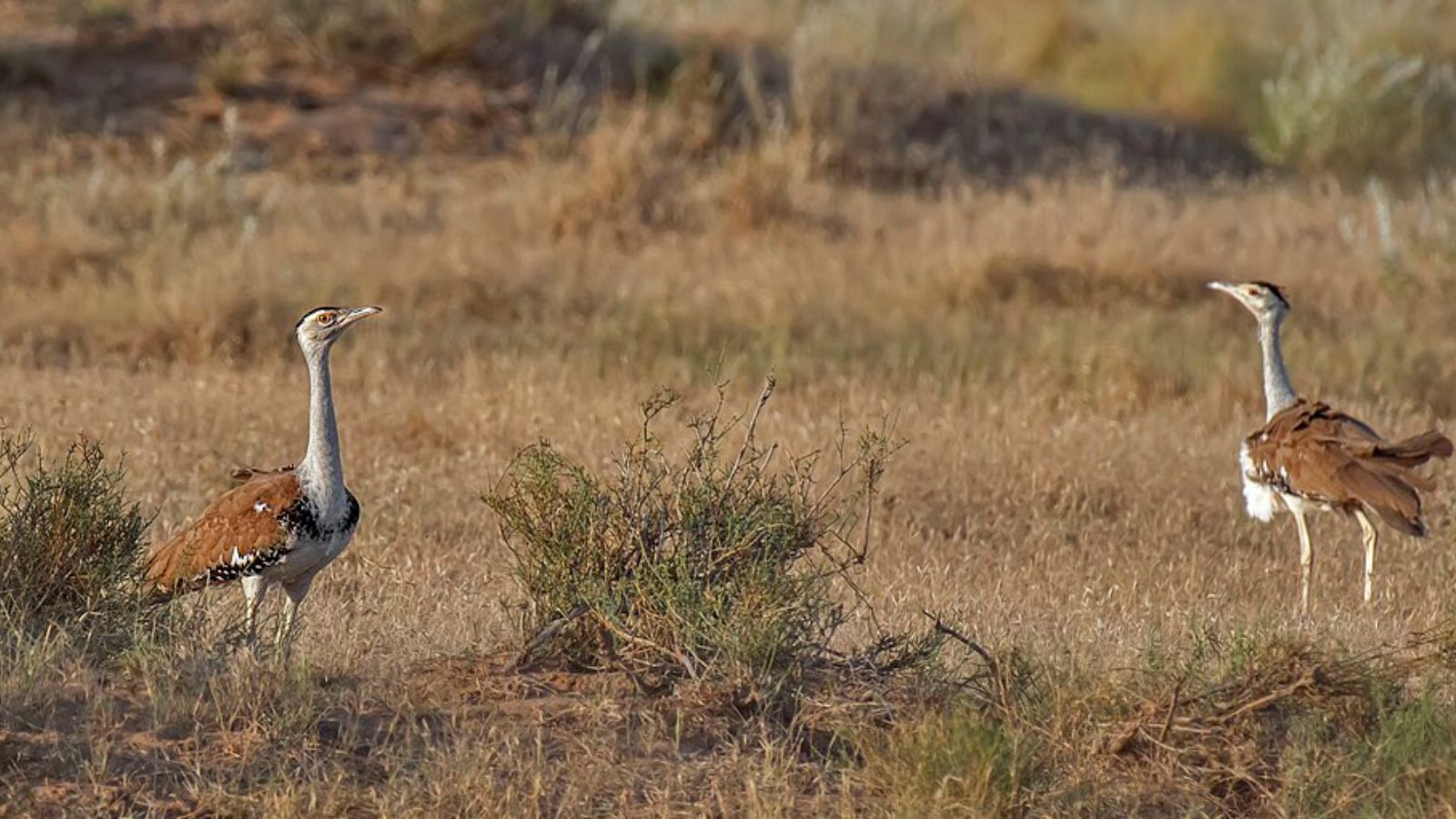


New Delhi: A study has identified 16 sites as priority conservation areas for the critically endangered Great Indian Bustard in the country's Deccan landscape. Totalling about 18,000 square kilometres in area, the sites are distributed across 35 districts -- 22 in Maharashtra, six each in Karnataka and Telangana and one in Andhra Pradesh -- and mapped in the study published in the journal PLOS One.
Also Read:

The Deccan landscape is a semi-arid region of India that receives significantly less rain than other parts of the country, making it suitable for the Great Indian Bustard, researchers from the Wildlife Institute of India in Dehradun said. They added that information in the study will help understand the effort and management intervention required for each of the 16 sites to ensure existence of the Great Indian Bustard in the region.
The bird species is among the heaviest flying ones in the world, and one individual can weight up to 15 kilograms. A critically endangered species as per the International Union for Conservation of Nature (IUCN) Redlist, the Great Indian Bustard was once found throughout India and southern Pakistan; only 100-150 of them are left in the wild, the team said.
"We have identified priority conservation areas from different regions of the Deccan landscape, ranging from 144-8496 (square kilometres) at 16 sites," the authors wrote. The sites are a mix of grassland and agricultural fields, and the future of the areas will depend on the revival of traditional farming systems and on maintaining the ecological integrity of remnant grassland patches, the researchers said.
They added that restoring habitat and traditional farming patterns across the areas is recommended to protect the species from extinction. Southernmost populations of the Great Indian Bustard in Maharashtra, Karnataka, Telangana, and Andhra Pradesh are teetering on the brink of total disappearance, driven by rapid land transformation over recent decades, according to Research Matters, a science communication initiative by Gubbi Labs, an Indian research collective aimed at improving scientific literacy in the country.
The researchers performed a species distribution modelling and found that factors contributing the most to determining potential habitat suitability in the Deccan landscape were precipitation of warmest quarter (over 40 per cent). The Deccan landscape's climate varies from semi-arid in the north to tropical in most areas, with distinct wet and dry seasons and rainfall generally occurring from June to October.
"Our study demonstrates an effective approach for identifying priority conservation areas for species persisting largely in human-dominated landscapes, thereby supporting conservation planning beyond the protected area network," they wrote.