


Imagine being forced to live in a world that misinterprets you for things you were born with, calling you naive and inefficient, without even letting you try to learn. For centuries, deaf people faced humiliation and discrimination. Even world-renowned scholars such as Aristotle made claims that were used to portray deaf people as incapable of learning or analytical thought. This eventually contributed to deaf people being denied legal recognition and civil rights in various societies. Roman legal concepts, including the Justinian Code of 529 AD, have also been cited in discussions of how speech and legal capacity were historically linked. Deaf people faced restrictions on property ownership, marriage, employment and other rights.
The tides began to turn during the Renaissance, when intellectuals made efforts to educate deaf people and contributed to the development of systems of signed communication.
Although there were attempts to communicate through gestures as early as the 5th century BC, Spanish monk Pedro Ponce de León is credited with teaching deaf students in the 16th century and establishing an early school for deaf children. Later, Juan Pablo Bonet published a book on deaf education that included a depiction of a manual alphabet system for reading and writing, which influenced later developments in sign language education.
Every year, September 23 is observed as the International Day of Sign Languages. The 2026 theme is ‘Declaring Deaf People’s Human Rights’. The theme calls for greater recognition, protection and promotion of the rights of deaf people, including access through national sign languages.
As part of the observance of the International Day of Sign Languages, Reporter World spoke to a sign language interpreter who wishes to remain anonymous but is open to sharing her thoughts on the importance of building a more inclusive society.
1. There is a misconception that everyone signs the same. Can you tell us more about that?
Just like there are different spoken languages and dialects, there are different varieties of sign language too; they are not universal. For example, Indian Sign Language (ISL) is used in India, whereas American Sign Language (ASL) is used in the United States, and so on. There are more than 300 different sign languages worldwide.
When there is an international-level summit or conclave, or when communication takes place between people who use different sign languages, International Sign may be used. It has a different set of signs and can facilitate communication among a wider audience.
2. Why is it important to consider the implementation of sign language from the school level?
Just as we teach other languages at school, sign language can also be introduced at that level. It is not merely a means of communication; it can also sow the seeds of inclusivity among younger generations. It can allow children to learn more about the deaf community and Deaf culture.
A deaf person may face barriers in accessing spoken-language communication, but others can make an effort to accommodate sign language in their everyday communication.
3. Can you explain ‘Deaf culture’?
Deaf culture is a distinct way of life associated with people who are deaf and use sign language as their primary means of communication. They consider themselves a vibrant linguistic and cultural minority.

4. What should one do to learn sign language?
If the goal is to become a sign language interpreter in India, one can pursue the two-year Diploma in Indian Sign Language Interpretation (DISLI), a programme approved by the Rehabilitation Council of India (RCI). The course is designed to train interpreters in Indian Sign Language interpretation in educational, professional and other settings.
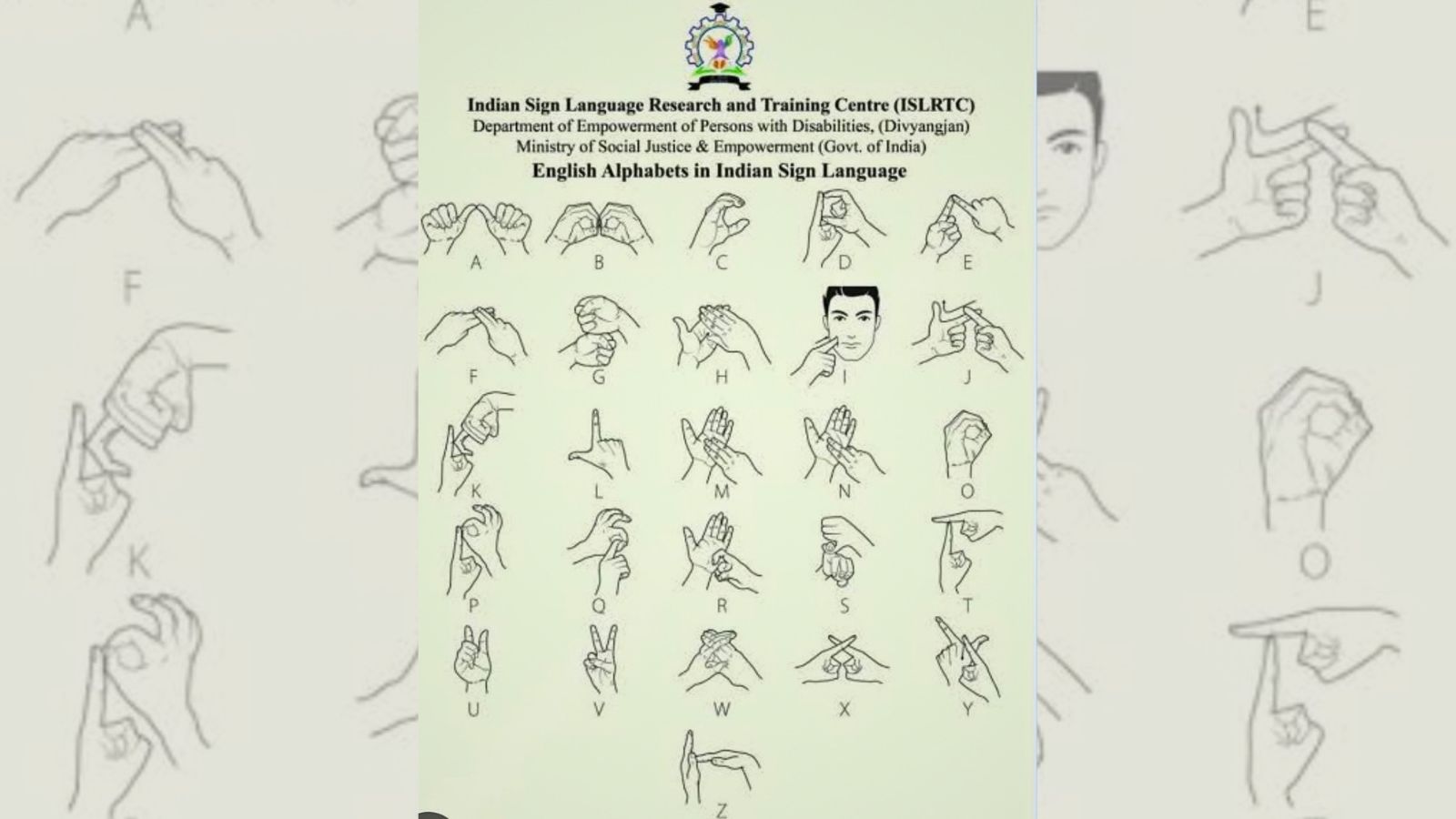
If sign language is being learnt for communication purposes or to understand the community better, the basics can also be learnt through online resources. The Indian Sign Language Research and Training Centre (ISLRTC) provides learning resources, including its ISL Dictionary and training programmes.
One can use these resources as a foundation for communicating with deaf people and continue learning from members of the community.
5. How can workplaces and public spaces be more accommodating towards the deaf community?
It would be helpful if employees in workplaces could learn at least the basics of sign language so that deaf employees do not feel excluded. If a workshop or seminar is being conducted, it would also be ideal to have a sign language interpreter.
Along with that, we as a community should make efforts to learn the basics of Deaf culture. For example, we usually call each other by name; among deaf people, getting someone's attention may involve a light tap on the shoulder or another visual cue.
In public spaces, visual cues can also be used to get the attention of a deaf person. These subtle changes in communication can help make spaces more inclusive.
Some news organisations provide sign language interpretation to make news more accessible to people with hearing disabilities. The Rights of Persons with Disabilities (RPwD) Act, 2016, and related accessibility guidelines provide a framework for accessibility for persons with disabilities, although the specific requirements applicable to broadcasters should be checked against the latest regulations and guidelines before publication.

6. How does the advent of modern technology aid the deaf community?
For the deaf community, technology is a major enabler. People can now easily text or make video calls to communicate with each other and access information. There are also apps that provide the corresponding meaning in a particular language when a sign is selected, and vice versa.
There are many deaf content creators who regularly make videos on a wide range of subjects. Technology, therefore, is making communication and access to information more adaptable for deaf people and other disabled communities.