

Melbourne: In some parts of the world, the sea rises and falls only slightly with the tides. Elsewhere, the difference between high and low tide can be dramatic. Along Western Australia’s Kimberley coast, for example, the tidal range can exceed 10 metres, roughly the height of a three-storey building.
Ocean tides shape coastlines and marine ecosystems, affect coastal communities, and can even influence the melting of Antarctic ice shelves. But why are tides so large in some places and so small in others? And as the oceans change, will tides change with them?
The pull of the Moon and Sun
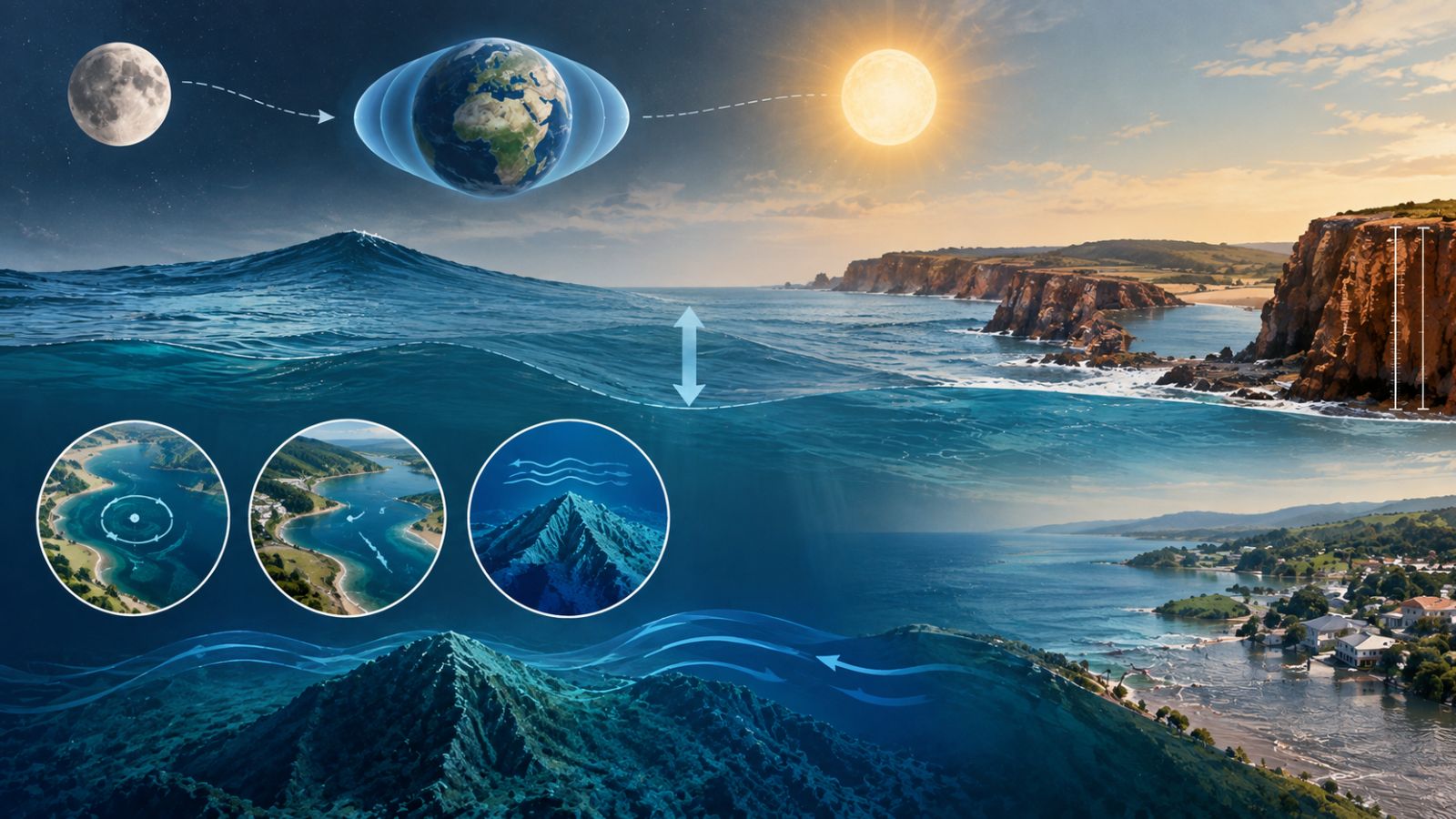
The Moon and the Sun both create tides through their gravitational pull. Although the Sun is far more massive, the Moon is much closer to Earth and therefore has a stronger influence on ocean tides.
The Moon’s gravitational pull weakens with distance. It is strongest on the side of Earth facing the Moon and weakest on the far side. This difference stretches both the solid Earth and the oceans, but because water moves much more freely than rock, the effect is most visible in the oceans.
In a simplified model, this creates two broad tidal bulges. One forms on the side of Earth facing the Moon. The other forms on the opposite side because the Moon pulls more strongly on Earth’s centre than on the water farther away.
As Earth rotates, different locations move through these areas of higher sea level. This helps explain why many places experience two high tides and two low tides each day.
The Sun creates a similar, though weaker, effect. When the Sun, Moon, and Earth align, their gravitational effects reinforce each other, producing larger tidal ranges known as spring tides. When the Sun and Moon are at right angles as viewed from Earth, their effects partly offset each other, producing smaller tidal ranges known as neap tides.
More than gravity
Tides recorded by coastal gauges and satellites look very different from the simple two-bulge model. Continents divide the oceans, meaning seawater moves back and forth within individual ocean basins.
In many ocean basins, tides rotate around points where the change in sea level is almost zero. These are known as amphidromic points. Tidal ranges generally increase farther from these points.
The shape of coastlines can amplify tides further through a process known as resonance. Every bay has a natural rhythm at which its water moves back and forth, determined by its shape and depth. When that rhythm matches the local tidal cycle, successive movements reinforce one another.
Resonance contributes to the exceptionally large tides along the Kimberley coast and in Canada’s Bay of Fundy, where the tidal range can reach 16 metres.
The seafloor also plays an important role. Underwater mountains and ridges can alter the movement of tides.
When tidal currents flow over a rough seafloor, some of their energy is converted into waves within the ocean, known as internal tides. The complex seafloor of the Indonesian archipelago, for example, generates powerful internal tides. When these waves break, they can drive ocean mixing and help distribute heat and nutrients.
Some internal tides break close to where they form, while others travel thousands of kilometres. During this journey, they exert forces on surface tides. Depending on their timing, these forces can act like either a brake or a spring, removing energy from the tide like a brake, or taking energy from one part of the cycle and returning it later like a spring.
Also Read:
Most tide models do not account for this spring-like effect.
A recent study found that including the effect allows models to reproduce observed tides accurately without directly simulating internal tides, a process that can require significant computing power.
The improvement could make models more efficient and reliable for reconstructing past tides, providing clues about how Earth’s rotation and the Moon’s orbit have changed over time. It could also improve predictions of future tides.
Tides in a changing ocean
Isaac Newton explained tides through gravity in 1687. More than three centuries later, scientists are still finding new ways to understand how tides evolve as the oceans change.
Climate change is raising sea levels and altering coastlines. It is also warming the upper ocean and increasing ocean stratification. These changes can affect the size of tides.
Measurements already indicate that tides are changing.
Also Read:
Changes in ocean stratification may help explain some of these shifts. At the same time, improved ocean models are capturing internal tides in greater detail, while new satellites can measure tides in complex coastal areas that were previously difficult to observe from space.
Understanding how tides are changing is becoming increasingly important for coastal communities.
At Lakes Entrance, one of Victoria’s most climate-exposed coastal communities, changes in tidal range have been the main cause of increased flooding. The local council is seeking $4 million for drainage upgrades to protect homes and businesses and support future development.
Better predictions of future tidal changes could help communities prepare for flooding, limit damage and make safer decisions about future coastal development.