




“...and you are gonna see some crazy stuff!”
That was what Elon Musk promised. And what followed looked like something out of a James Bond film: a sports car launching into the air and flipping mid-flight.
Tesla has unveiled its second-generation Roadster, featuring cold-gas thrusters and a multi-mode suction system designed to lift the car into the air and perform aerial manoeuvres. But while the demonstration has raised expectations, the company says consumer production will not begin until 2028.
Here is what Tesla has shown, how the different versions are described and what stands between the Roadster and public-road use.
What does the demonstration show?
At an event on Thursday at SpaceX’s rocket testing and development centre in McGregor, Texas, Tesla demonstrated the Roadster driving upside down along a curved ramp using a suction system, launching into the air, flipping 180 degrees and using air jets to land.
The system combines underbody suction with cold-gas thrusters positioned around the vehicle. Tesla executives said the company had borrowed technology from SpaceX to develop the system.
“Turns out the future does have flying cars,” Musk wrote on X shortly after the demonstration.
Turns out the future does have flying cars https://t.co/6fexPp6SXI
— Elon Musk (@elonmusk) October 16, 2026
What are the three Roadster versions?
There are three configurations: Performance, Thrust and Rocket.
1. Performance
The two-seat variant is described as a road-ready model with active aerodynamics and a multi-mode suction system designed to maximise downforce. Tesla says it can accelerate from zero to 60 in under 1.6 seconds.
The reported starting price is around $2,00,000, with a $50,000 reservation deposit.
2. Thrust
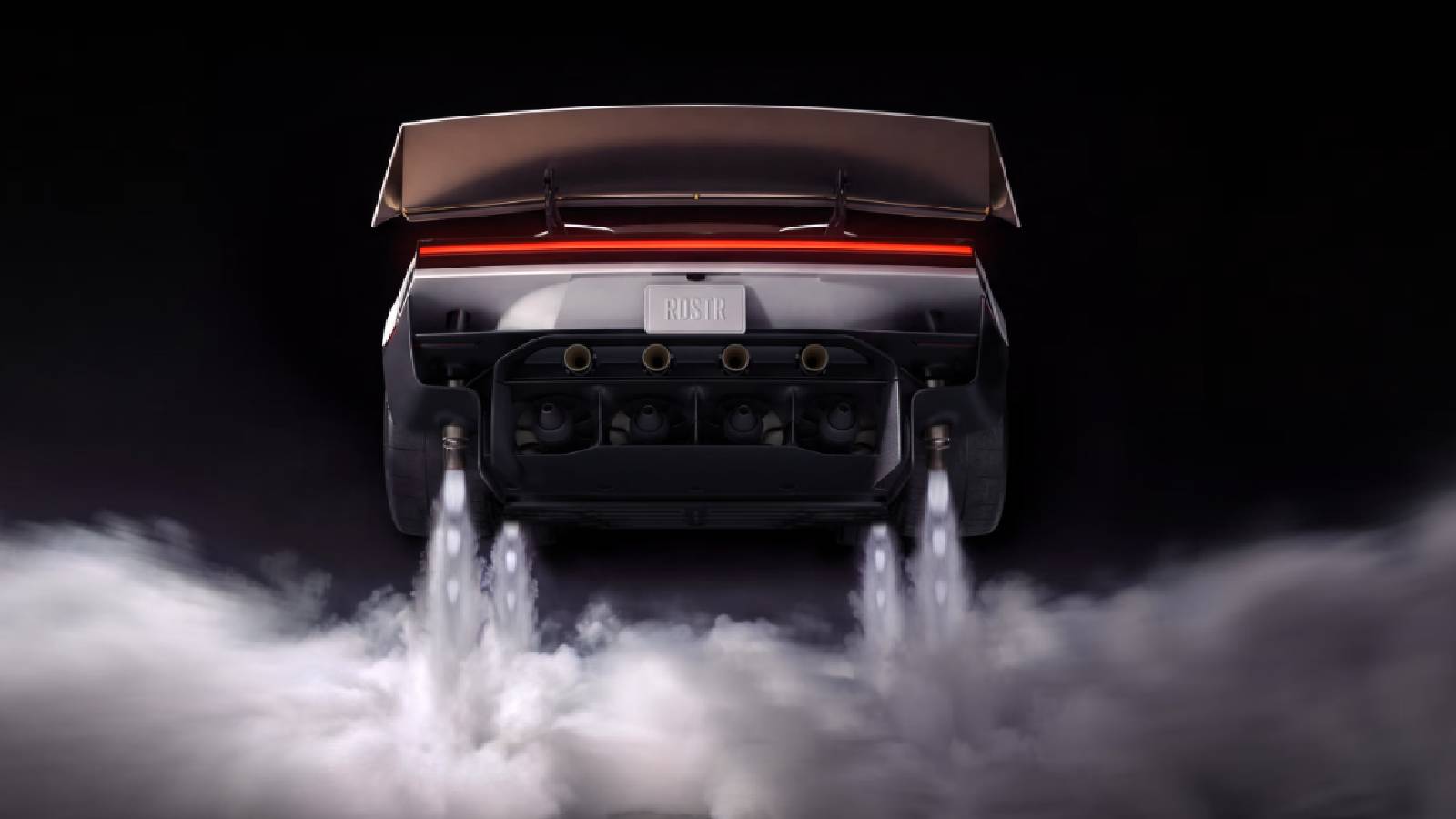
This two-seat configuration retains the suction system and adds a 200-litre compressed-air tank feeding four primary cold-gas thruster nozzles built into the rear bumper.
According to Tesla, the multi-mode suction system and rear thrusters help propel the Roadster from zero to 60 mph in less than one second.
The reported reservation deposit is $2,50,000.
3. Rocket
The Rocket version is described as a single-seater with a full flight system and is available strictly by invitation. The supplied specifications claim acceleration from zero to 60 mph in 0.59 seconds.
Its passenger area is replaced by a 600-litre carbon-fibre tank holding highly pressurised air. The version is described as having 10 cold-gas thruster nozzles around the car’s perimeter, including downward-pointing jets behind each wheel and nose thrusters for directional control.
The Rocket model’s price has not been announced.
How does the Roadster’s technology work?
The system uses high-pressure compressed gas, primarily nitrogen, rather than combustion. Cold-gas thrusters release the pressurised gas through nozzles to generate force.
It has carbon-fibre overwrapped pressure vessels (COPVs), similar to those used in rocket systems, for storing the gas at pressures of up to 10,000 PSI. The stated combined capacity ranges from 600 to 1,600 litres, depending on the configuration.
The system reportedly takes six to seven hours to refill empty tanks.
Tesla also describes a multi-mode fan and ground-sealing system that pulls air from beneath the vehicle to generate downforce. The company says the suction can hold the car upside down even when stationary.
Powered fans and active wings are designed to maximise traction and cornering speeds. A steer-by-wire system provides steering feedback, while Track Mode can lower the car’s suspension. Tesla says drivers can select high-downforce or low-drag modes for track use.
Can it be driven or flown on public roads?
The Roadster’s flight features are not currently approved or permitted for public-road use. The supplied information states that neither the National Highway Traffic Safety Administration nor the Federal Aviation Administration has certified it as a legal flying vehicle or standard aircraft.
The vehicle also faces regulatory hurdles and differing state rules.
“I'm not sure every state is going to allow a driver in the middle of traffic to suddenly elevate himself and fly,” said David Vladeck, a Georgetown Law professor and former director of the Federal Trade Commission’s Bureau of Consumer Protection.
Bryant Walker Smith, a law professor at the University of South Carolina and former vice chair of a Department of Transportation advisory group on innovation, said there would be a long process before such a vehicle could be allowed on roads.
A report from the US Federal Aviation Administration on urban air mobility says initial operations would use existing regulatory frameworks, including visual and instrument flight rules, as a foundation for greater aircraft performance and autonomy. It also raises questions about noise, pollution, security, sustainability, costs and the effects of low-altitude vehicles and vertiports on neighbourhoods.
The questions extend beyond whether the Roadster can perform the stunts shown in the demonstration. Who would be allowed to operate such a vehicle? Would passengers or drivers need additional licences? And which jurisdiction would be responsible if a crash occurred in mid-air?
When can customers expect delivery?
Musk said consumer production would not begin until 2028, following years of delays and anticipation around the redesigned model.
Tesla was accepting reservations on its website on Friday morning, but the reservation terms reportedly offered no guarantee of when the vehicle would be delivered, or whether it would be delivered at all.
Tesla’s first Roadster was launched in 2008. In 2018, Musk placed one on a rocket and launched it into space, with a mannequin called “Starman” in the driver’s seat.
(This copy is compiled by Mariya)