


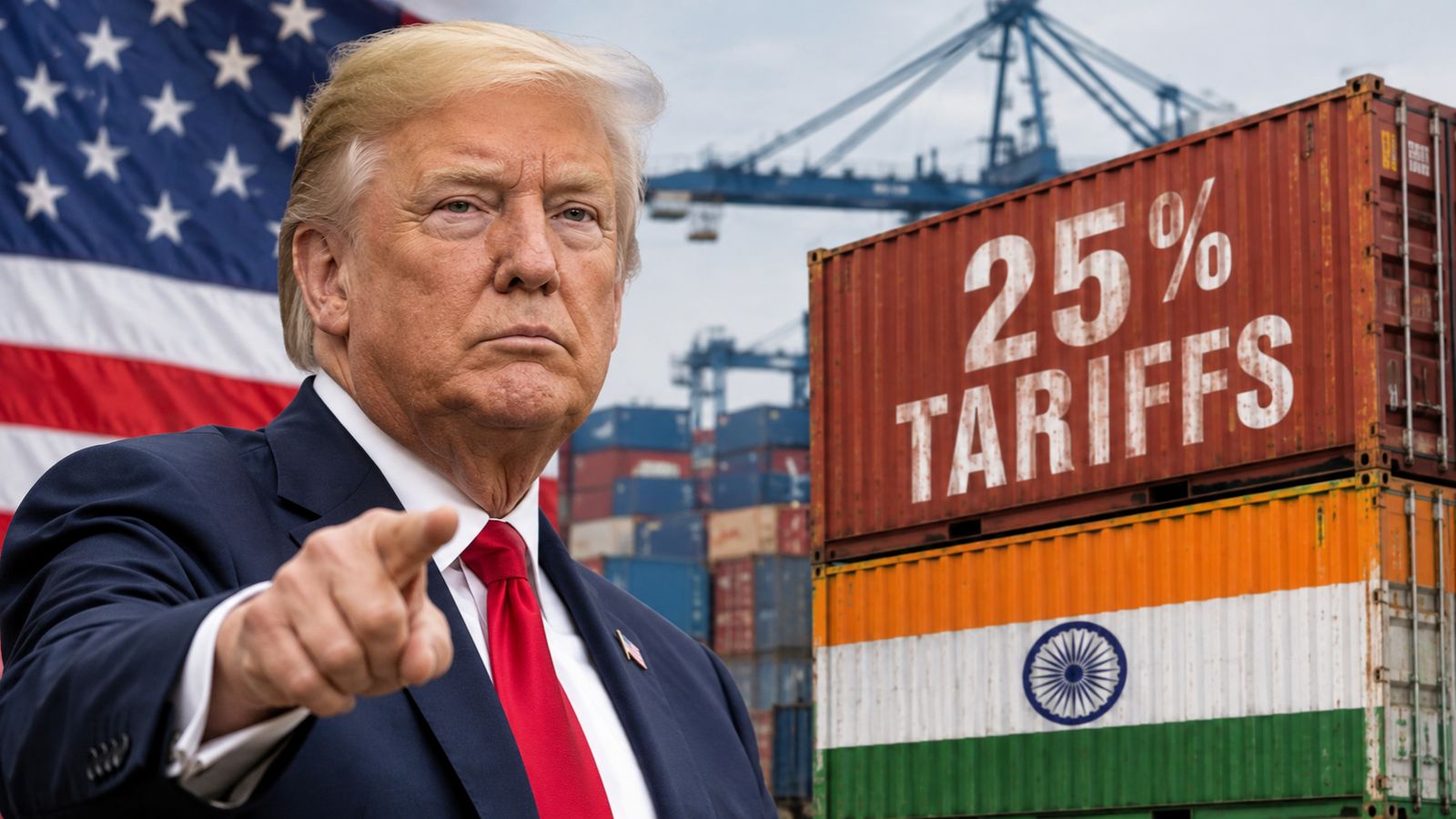


Washington: The US on Wednesday proposed 25 per cent tariffs on Indian goods in the absence of a trade deal, citing excess industrial capacity, sustained market access barriers and inadequate labour protection that harm American companies.
The US Trade Representative (USTR) said the tariffs on India would amount to 17 per cent if it agrees to an Agreement on Reciprocal Trade with Washington that addresses the findings of its investigation into structural excess capacity and production in manufacturing sectors.
The proposed duties would apply to all Indian goods, net of existing Section 301 tariffs, with exemptions for certain products. The USTR also proposed considering adjustments to the additional duties to account for tariffs imposed under existing Section 301 and Section 232 actions.
Also Read:
The fresh tariff proposal follows Section 301 investigations launched by the USTR on March 11, 2026, targeting 16 economic jurisdictions.
The USTR proposed tariffs of up to 20 per cent to 35 per cent on other targeted economies, though lower rates apply to trading partners with deals in place.
Among other trading partners, Vietnam faces proposed tariffs of up to 35 per cent, while China and Singapore face 20 per cent. Bangladesh, Cambodia, Indonesia, Malaysia and Thailand face rates of up to 18 per cent. The EU, Japan, South Korea, Taiwan and Switzerland face 15 per cent tariff rates, inclusive of standard import duties. The USTR has also proposed considering lower rates of 20 per cent for Vietnam and 10 per cent for Singapore, subject to trade agreements or commitments addressing the findings of the respective investigations.
“For decades, many of our trading partners have adopted industrial strategies built on targeting manufacturing, wage and labour suppression, financial and other support, non-market economy inputs, and other market-distorting practices that tilt the trade balance in their favour while eroding America's manufacturing base,” said USTR Jamieson Greer.
“India generates trade surpluses in sectors such as pharmaceuticals, steel, and ICT goods, revealing dependencies on Indian manufacturing in certain key sectors,” the USTR said in its report on ‘India's Acts, Policies, and Practices Relating to Structural Excess Capacity and Production in Manufacturing Sectors’.
The USTR also flagged India's industrial plans to expand manufacturing, inadequate labour protections, financial repression policies and an alleged failure to address global excess capacity, including through imports and foreign direct investment from non-market economies. It said these practices reduce commercial opportunities for US producers and exporters in India and third-country markets, contribute to losses in US manufacturing production, exports, jobs and investment, and increase economic security risks.
The investigation identified sectors including pharmaceuticals and medical devices, steel, solar energy, and information and communications technology (ICT) as areas of particular concern.
These new tariffs would not be added to existing ones aimed at combating forced labour or certain sector-specific tariffs, a senior US official said.
The USTR has decided to schedule public hearings on its proposals on January 25, 2027, and sought written comments from interested persons by January 5, 2027.
The Office of the USTR has been analysing for several months whether 16 jurisdictions have policies that favour surplus production, a practice that drives down prices and harms US industry.
The investigation began last March, after the Supreme Court overturned the indiscriminate trade levies imposed by the Trump administration invoking the International Emergency Economic Powers Act (IEEPA).
After that reversal, the USTR opened two investigations based on Article 301: one directed at 60 jurisdictions (about a hundred countries) for violating export regulations on forced labour; and the other against 16 jurisdictions for promoting surplus production.
India and the US are negotiating an interim bilateral trade agreement after the framework they had finalised in February went back to the discussion board with the Supreme Court striking down the IEEPA tariffs imposed last year.
India is seeking lower tariffs for its goods in the US market than its competitors such as Bangladesh, Vietnam and Cambodia.
Earlier, on November 15, Union Commerce and Industry Minister Piyush Goyal said Washington had assured New Delhi of preferential trade access with lower duties than those imposed on competing countries.
"India will get preferential trade access in the US with lower duty than our competitor countries," Goyal had said while addressing the media in Cairo, Egypt.
He said the commitment was part of a broad framework agreement reached between Prime Minister Narendra Modi and US President Donald Trump.
"This was already agreed between the leaders, President Trump and Prime Minister Modi, when they announced that we have both come to a broad framework agreement a few months ago," Goyal had said.
“USTR is applying to India a diagnosis built for a very different economy. India consumes most of what it produces and buys more goods from the world than it sells, so it is not exporting a domestic glut,” said Abhik Sengupta, a Task Force Observer on the Committee on Strategic Trade and Market Access, Helsinki Geoeconomics Society.
Sengupta said India’s reliance on Chinese inputs points to gaps in its industrial base, not a surplus. “Penalising India for closing those gaps risks pushing supply chains back toward the very economies Washington is most concerned about,” he said.
(With agency inputs from ANI, PTI)