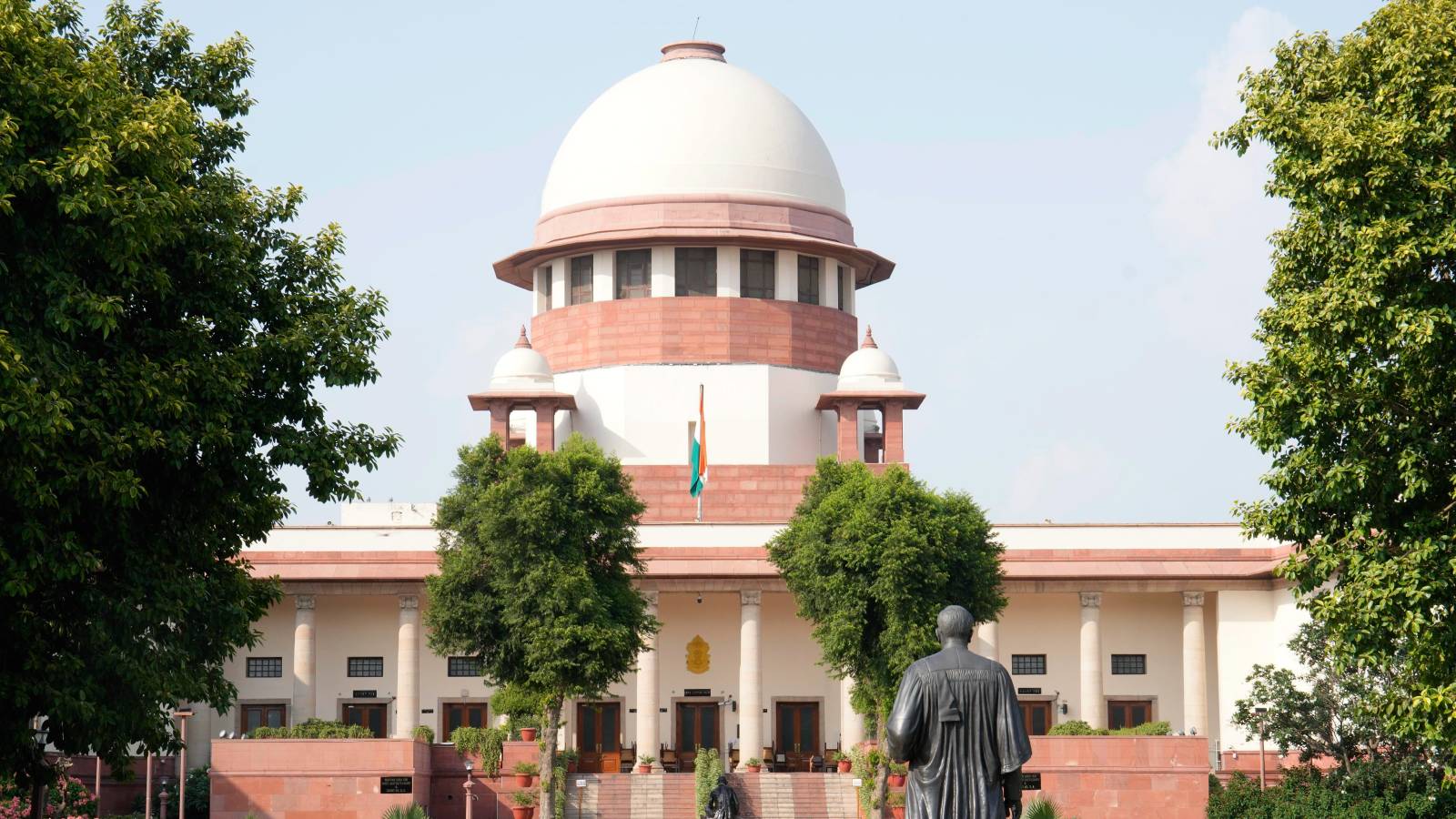


New Delhi: The Supreme Court on Friday orally reiterated that deletion from the electoral roll following the Special Intensive Revision (SIR) exercise does not automatically result in the loss of citizenship.
The court observed that it had already clarified in its Bihar SIR judgment that the Election Commission of India (ECI) is not the authority empowered to determine citizenship and that removal from the electoral roll, by itself, cannot deprive a person of citizenship.
A bench comprising Chief Justice Surya Kant and Justices Joymalya Bagchi and V. Mohan was hearing a petition filed by Prasenjit Bose, chairperson of the SIR Committee of the West Bengal Pradesh Congress Committee.
The plea, filed through advocate Neha Rathi, sought constituency-wise data relating to the West Bengal SIR process, including the number of Forms 6 and 7 filed, accepted and rejected, as well as details of pending and disposed appeals before the appellate tribunals.
After hearing preliminary submissions, the apex court sought responses from the Election Commission of India, the West Bengal government and the State Election Commission.
Senior advocate Gopal Sankaranarayan, appearing for Bose, argued that the functioning of the 18 appellate tribunals dealing with claims and objections by deleted voters had resulted in delays and inconsistencies.
He submitted that people whose names had been deleted from the electoral rolls were being denied access to welfare schemes such as the Public Distribution System (PDS) and the Annapurna Scheme, besides facing difficulties in obtaining caste certificates.
Referring to its Bihar SIR judgment, the bench observed:
"There is a corresponding duty on the Election Commission that when a tribunal says a person cannot be on the SIR list, the EC has to refer the case to the Union Ministry for determination of citizenship under the Citizenship Act."
The bench further clarified:
"The Election Commission is not the constitutional authority for determining citizenship. There is no confusion in law. The Election Commission has control and superintendence over the electoral roll."
Sankaranarayan informed the court that 33.5 lakh appeals were still pending and that nearly 70 per cent of the disposed cases had been decided in favour of the applicants.
"So, until these appeals are decided, they remain excluded from the PDS and other welfare schemes," he submitted.
SC to hear Mamata Banerjee's plea on August 25
The Supreme Court agreed to hear the fresh petition along with pending pleas, including one filed by former West Bengal Chief Minister Mamata Banerjee, on August 25.
The petition seeks enforcement of the fundamental rights guaranteed under Articles 14, 19 and 21 of the Constitution.
According to the plea, the West Bengal SIR exercise resulted in the exclusion of more than 58 lakh electors during the enumeration phase. While 9.64 lakh applications for inclusion (Forms 6 and 6A) and over 99,000 applications for deletion (Form 7) were received during the claims and objections phase, only around 1.82 lakh additions were reflected in the final electoral roll published on February 28.
The petitioner alleged that the Election Commission had failed to disclose constituency-wise data on applications received, accepted and rejected, limiting public scrutiny of the revision exercise.
The PIL also contended that the non-publication of formats prescribed under the Election Commission's Manual on Electoral Rolls, 2024, along with the absence of detailed data, undermined transparency and accountability.
It further questioned the process used to identify more than 60 lakh "logical discrepancy" cases, alleging that criteria such as parent-child age gaps, multiple family linkages and name mismatches had no basis in the Representation of the People Act, 1950, or the SIR notifications.
According to the petition, these criteria led to notices and large-scale deletions without adequate transparency regarding the reasons for such action.
The plea also raised concerns over the functioning of the 18 appellate tribunals constituted pursuant to the Supreme Court's earlier directions.
It pointed out that although a three-member judicial committee prepared a Standard Operating Procedure (SOP) on April 7, the document has not been made public.
The petitioner has sought directions to publish the SOP and issue simplified appeal guidelines in Bangla, Hindi and English to improve accessibility, particularly for rural and economically weaker voters.
The petition further argued that many excluded voters are poor, illiterate or otherwise unable to navigate the appellate process without legal assistance, making the lack of procedural clarity especially burdensome for marginalised communities.