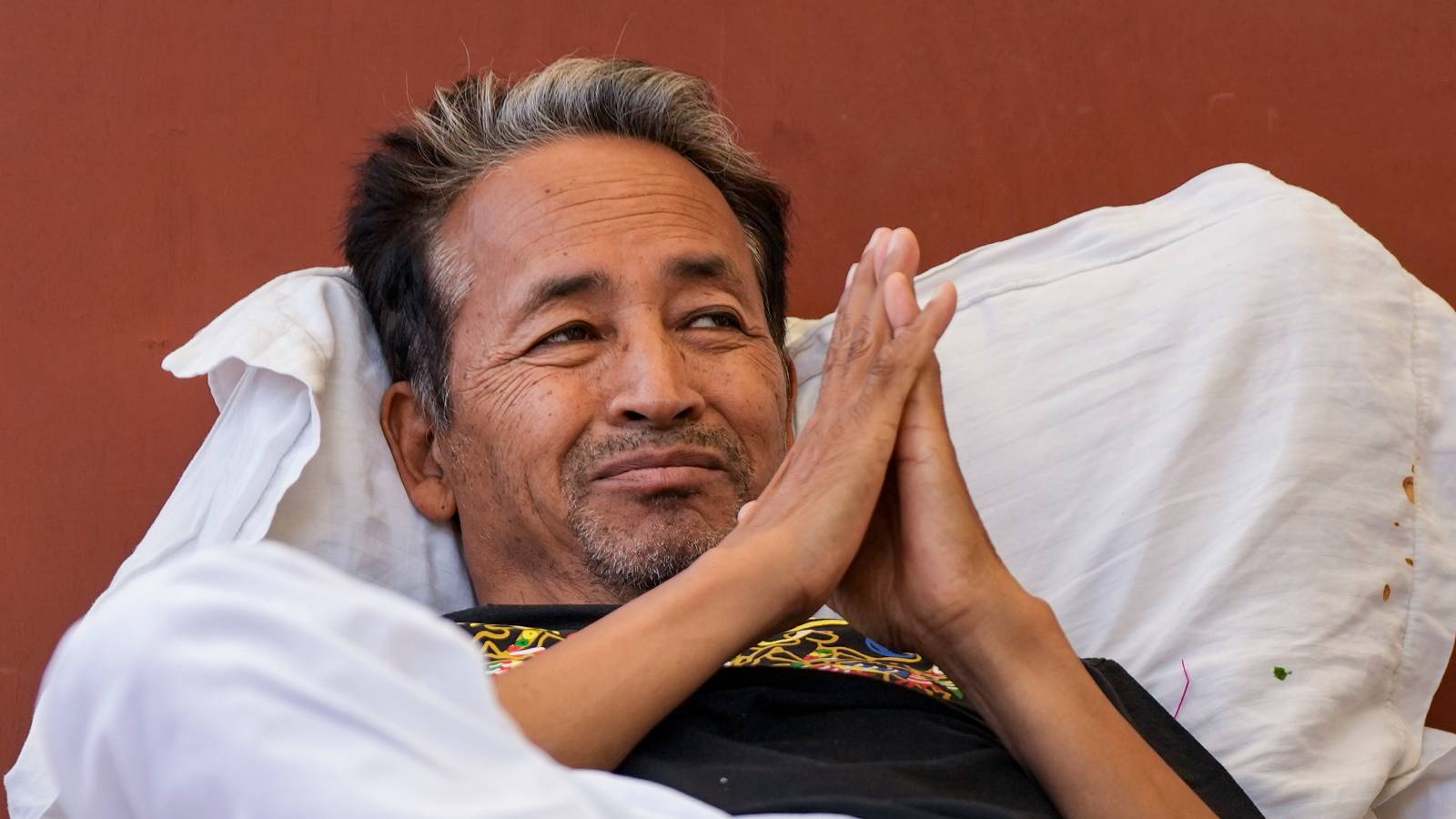


Sonam Wangchuk has grabbed national attention after joining the protest led by the Cockroach Janata Party (CJP) and beginning a hunger strike. The 59-year-old activist's fast, which began on June 28, 2026, completed 20 days on July 19.
The CJP, a satirical movement led by Gen Z, launched the protest on June 6, demanding the resignation of Union Education Minister Dharmendra Pradhan over the alleged NEET exam paper leak. However, the agitation gathered momentum after Wangchuk joined the movement and began his indefinite fast. He has vowed to continue the hunger strike until Pradhan resigns, even after doctors declared his condition critical.
Apart from being an activist, Wangchuk is an engineer and educator who has made remarkable contributions to the education system of Ladakh and Jammu and Kashmir.
Early life
Born in 1966 in Leh, Jammu and Kashmir, Wangchuk began formal schooling only at the age of nine because of the lack of proper educational facilities in his village. Before that, he learned basic lessons from his mother in his native language, Ladakhi.
According to Wangchuk, his school days in Srinagar were among the darkest periods of his life, as he was treated as stupid simply because he could not understand Kashmiri. The situation became so unbearable that he eventually fled Srinagar alone. In 1977, he enrolled at a Kendriya Vidyalaya in Delhi.
In 1987, Wangchuk graduated in Mechanical Engineering from the National Institute of Technology (NIT), Srinagar. He later completed higher studies in Earthen Architecture in France in 2011.
Education reformer
His difficult childhood and struggle for quality education inspired him to establish the Students' Educational and Cultural Movement of Ladakh (SECMOL), a non-governmental organisation. He founded SECMOL in 1988 along with a group of friends after graduating from college.
For Wangchuk, SECMOL was more than an organisation—it was a movement to reform the government school system, support students from rural areas, and create awareness among young people about the shortcomings of an insensitive education system. Through its work, he emerged as one of Ladakh's most celebrated education reformers.
In 2005, the Government of India appointed Wangchuk as a member of the National Governing Council for Elementary Education under the Ministry of Human Resource Development. He also served on the Jammu and Kashmir Board of School Education and was part of committees involved in framing education policy.
His reforms played a key role in improving the pass percentage in Class 10 examinations in Ladakh from just 5% to nearly 75%.
Continuing his work in education, Wangchuk co-founded the Himalayan Institute of Alternatives, Ladakh (HIAL) in 2017 with social entrepreneur Gitanjali J Angmo, his wife. The institute focuses on experiential learning and equips students with skills suited to life in the Himalayan region.
Innovations as an engineer
To tackle the water crisis faced by farmers in Ladakh, Wangchuk launched the Ice Stupa project in 2014. The cone-shaped artificial glaciers can store around 150,000 litres of winter stream water. During summer, the ice gradually melts, providing irrigation water to agricultural fields.
Following the project's success, dozens of Ice Stupas were built across Ladakh. According to available data, they now supply nearly 25 million litres of water in the region.
The innovation received global recognition in 2016, when Wangchuk was invited to Switzerland to build Ice Stupas in the Swiss Alps.
Another of his major innovations was the development of solar-powered tents for the Indian Army in high-altitude regions. According to Wangchuk, the tents trap solar heat during the day and retain it throughout the night, keeping the interiors warm.
Political movement for Ladakh
Wangchuk's political activism has never been about seeking power. Just as he used his engineering knowledge for public welfare, his political campaigns have focused on protecting the interests of the people of Ladakh.
In 2023, he launched a movement demanding autonomy for Ladakh while highlighting the impact of climate change on its fragile ecosystem. Authorities allegedly prevented him from beginning a hunger strike and placed him under house arrest.
Undeterred, Wangchuk returned in March 2024 with a fast-unto-death demanding constitutional protection for Ladakh under the Sixth Schedule.
On September 30, 2024, he began a foot march from Ladakh to Delhi to press for these demands. However, Delhi Police detained him at the Singhu border before he could enter the national capital.
Why is he backing the CJP protest?
The Cockroach Janata Party (CJP) emerged as a satirical movement following controversial remarks made by Chief Justice Surya Kant. During the hearing of a contempt plea on May 15, 2026, he allegedly compared unemployed youth and activists to "cockroaches" and "parasites."
Former social media strategist Abhijeet Dipke founded the CJP as an online campaign. It soon evolved into a mass youth movement as students and young people united to question the government over the alleged NEET exam irregularities.
Wangchuk joined the CJP protest at Jantar Mantar, describing himself as an "honorary cockroach." He urged the government to address the concerns raised by young protesters and ensure accountability in the conduct of national examinations.
According to the latest medical bulletin, Wangchuk has lost more than nine kilograms and remains under close medical supervision. Doctors have warned of increasing muscle loss and the risk of organ damage if the fast continues.
Despite his deteriorating health, Wangchuk has maintained that his resolve remains unshaken.
"I am weak from the outside but very strong inside. I am sure all of you are strong from the inside, and outside too. We need this energy for July 20, when we will take out a peaceful march to Parliament. We will go together and present our plea in the temple of democracy."
"I will stay alive till July 20 at any cost. If you don't come and July 20 is not successful, I will come back as a ghost," he told supporters at Jantar Mantar.
Although politicians and celebrities have urged him to end his fast, Wangchuk has vowed to continue the protest until Dharmendra Pradhan steps down as Union Education Minister.
People from different sections of society have called on the Union Government to intervene and end the hunger strike. However, neither Prime Minister Narendra Modi nor any member of the Union Cabinet has publicly responded to the agitation, which has sparked debate across the country and gained the attention of international media.