


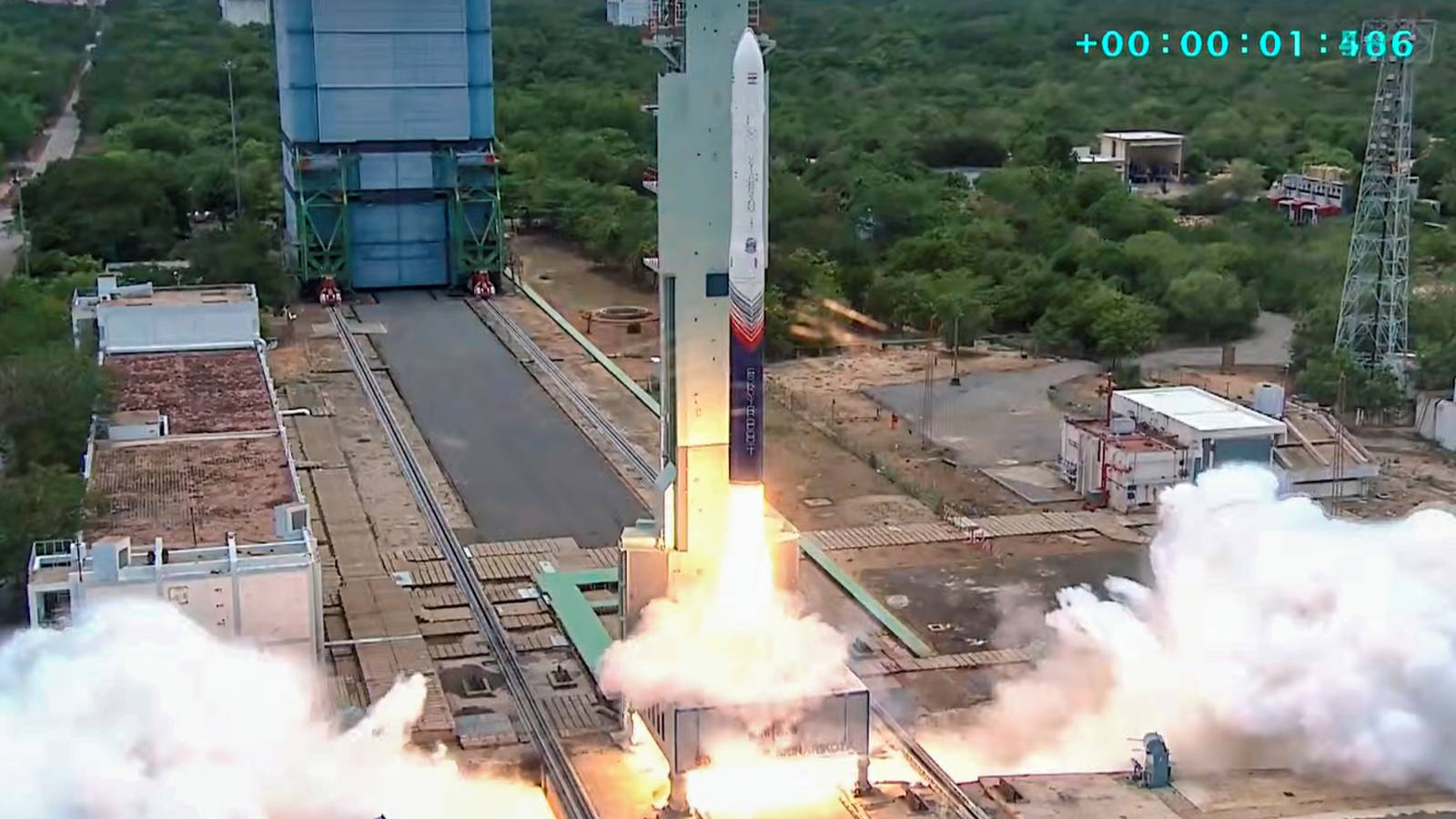


Sriharikota (Andhra Pradesh): In its maiden flight, India's first privately developed orbital rocket, Vikram-1 Test Flight-1, on Saturday successfully placed multiple technology demonstration payloads, along with postcards from Prime Minister Narendra Modi and others, into low-Earth orbit. Calling the mission a "defining moment" in the country's space journey, the Prime Minister hailed the achievement as a milestone for India's private space sector.
Dubbed 'Mission Aagaman' (Arrival), the launch marks the entry of India's private space industry into the orbital launch market, spearheaded by Hyderabad-based Skyroot Aerospace.
The mission was a "grand success", the company said.
The four-stage, seven-storey-tall Vikram-1 rocket lifted off majestically at 12.05 p.m. amid cloudy skies from the first launch pad at ISRO's Satish Dhawan Space Centre, leaving behind plumes of orange smoke and ushering in a new era for India's private space industry.
A planned hold due to an apparent navigation issue delayed the launch to 12.05 p.m. from the originally scheduled 11.30 a.m.
Following liftoff, the primary payloads — technology demonstrators from Grahaa Space, Cosmoserve, DCubed, and Skyroot's SCOPE satellite — were sequentially deployed into a 450-km low-Earth orbit (LEO).
The launch vehicle also successfully deployed a micro-art payload, an 18-karat gold miniature rocket, and a handwritten postcard from Prime Minister Narendra Modi bearing the message "Vande Mataram", along with postcards from engineers, scientists and Indian astronauts.
The miniature micro-art payload, carrying micro-sculptures of Dr Vikram Sarabhai, Sir C V Raman, and former President A P J Abdul Kalam, was created as "a tribute to three visionaries who shaped India's scientific and space journey," the company said.
"Skyroot proudly named its rockets and engines after these icons," it added.
PM Modi hails 'defining moment'
Prime Minister Modi hailed the successful launch, saying it demonstrated India's growing self-reliance in the space sector.
Speaking over the phone to Skyroot Aerospace CEO and co-founder Pawan Kumar Chandana and co-founder Naga Bharath Daka, Modi congratulated the team on the successful mission.
Both founders were present at ISRO's Mission Control Centre (MCC) during the launch.
The Prime Minister extended his "heartiest congratulations" and said he hoped Mission Aagaman would pave the way for many more successes.
The mission "proves we can be Atmanirbhar (self-reliant)," he said, after Chandana informed him that the rocket had been entirely designed and built in India.
Referring to his handwritten postcard carried aboard the rocket, Chandana told the Prime Minister, "Your card has successfully reached orbit. 'Vande Mataram' is now in orbit."
Modi noted that India is celebrating 150 years of 'Vande Mataram', adding that the national song had inspired countless freedom fighters.
Later, in a post on X, the Prime Minister described the launch as "a defining moment in India's space journey."
"The growing participation of our private sector is opening new frontiers and accelerating innovation. This achievement will encourage countless youngsters to dream bigger and innovate fearlessly," he wrote.
'100% built in India'
Skyroots CEO said the company was proud that government reforms had enabled private participation in the space sector.
"We are very proud that the government has enabled us and opened up the sector to private players. Today, we stand as India's first private company to launch a rocket into orbit and create a global milestone — all from India, with a fully Indian team and a rocket that is 100 per cent built in India," he said.
Daka said India had become only the third country, after the United States and China, with private-sector orbital launch capability.
ISRO chief credits space reforms
ISRO Chairman V Narayanan credited Prime Minister Modi's 2020 space sector reforms for enabling the rapid growth of India's private space ecosystem.
"In 2020, the space sector reforms were announced. Today, within six years, a startup company has successfully placed satellites into orbit on its very first attempt. It is truly a satisfying moment," he said.
Praising Skyroot's young workforce, Narayanan said the team's average age was just 28 years.
"When the reforms were announced, India had only one space startup. Today, we have more than 400 startups working across multiple domains. Launch vehicle development is one of the most challenging areas, and I am extremely happy that the first attempt has been successful," he added.
Technology validated
According to Skyroot Aerospace, engineering data collected during the mission will be analysed to validate the rocket's guidance and navigation systems and support future refinements for commercial satellite launches.
With Mission Aagaman, Skyroot has successfully demonstrated orbital launch capability, advancing beyond its Vikram-S suborbital mission conducted in 2022.
The maiden flight also validated the performance of the rocket's all-carbon composite structure and 3D-printed engines in an operational flight environment.
Both founders, Chandana and Daka, are former ISRO scientists. They were present at the Mission Control Centre along with ISRO Chairman Narayanan. Former ISRO chairmen, astronaut Shubhanshu Shukla, and Andhra Pradesh minister Nara Lokesh also witnessed the launch.
The milestone is expected to strengthen India's position in the rapidly growing global small satellite launch market, expanding the country's commercial space capabilities alongside ISRO.
The payloads aboard Vikram-1 included Cosmoserve Space's Embrace mission, an in-orbit demonstration of robotic arms designed to remove space debris; Solaras by Grahaa Space, a compact satellite developed to demonstrate new capabilities in low-Earth orbit; Skyroot's in-house experimental SCOPE satellite; Cosmic Bloom, an artistic lab-grown diamond by Cosmos Diamonds; and the German technology demonstration payloads uD3PP and mD3RN developed by DCubed.