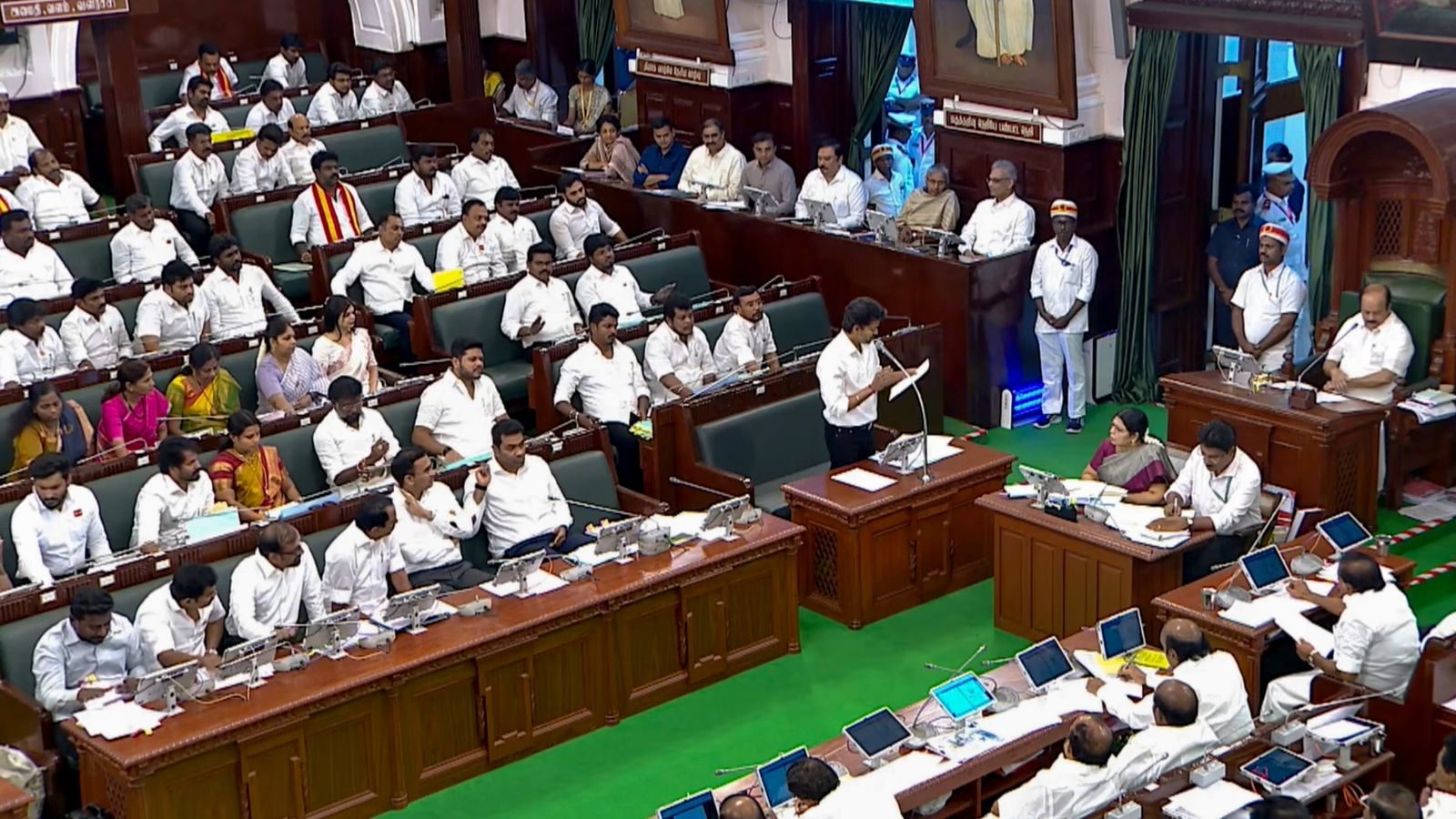


Chennai: Tamil Nadu Chief Minister C Joseph Vijay on Monday announced major policy decisions regarding a further hike in milk procurement price, and also unveiled a multi-crore infrastructure push spanning power, semiconductors, and logistics.
Making a statement in the Assembly, Vijay announced further increase in the Aavin (government-run dairy cooperative) milk procurement prices, raising it from ₹ 41 to ₹ 44 per litre, which is aimed at providing a crucial relief for the dairy farmers across the state.
The announcement on enhancing the government's procurement prices comes closely on the heels of an earlier hike announced on August 19 in the Assembly, that had raised the procurement price from ₹ 38 to ₹ 41.
He said the decision to address dairy farmers' growing concerns over rising cattle feed costs and maintenance expenses would entail the state government an additional financial outlay of ₹ 60 crore monthly, translating to an annual expenditure of ₹ 720 crore.
Apart from the relief to boost rural economy, Vijay unveiled major multi-crore infrastructure push spanning power, semiconductors, and logistics across the state.
Unveiling major investments to boost the state's power grid, manufacturing base, and tech ecosystem, he said ₹ 33,066 crore has been earmarked for the Tamil Nadu Transmission Improvement Scheme to set up 196 new substations and lay 15,000 km of power lines.
A 1,600 MW Super Critical Thermal Power Station will be set up in Tuticorin through Public-Private Partnership (PPP) model, involving an investment of ₹ 20,800 crore, he said.
On combating urban flood resilience and high load demands, the CM said Chennai's distribution network will receive upgrades worth ₹ 1,762 crore.
A Semiconductor and Electronics Manufacturing Park will be set up at Maduramangalam in Kanchipuram district at a cost of ₹ 175 crore. Further, Coimbatore is slated to get a ₹ 400-crore FinTech Hub to accelerate digital financial services.
CM Vijay also announced plans to establish a multi-modal logistics hub in Tiruchirapalli region to strengthen industrial supply chains.
Vijay said "considering the growing economy of Tamil Nadu and increasing power consumption, a world-class power infrastructure with comprehensive advanced technology in the power generation, power transmission and power distribution sectors is necessary."
As electricity consumption continued to increase, it is necessary to improve the power transmission system to effectively transport the electricity generated in power plants to major power consumption centers like Chennai. For this, the government is going to implement the "Tamil Nadu Transmission Improvement Scheme," he said.
On the new Supercritical Thermal Power Station in Tuticorin, Vijay said, though Tamil Nadu is a leading state in the renewable energy sector and is continuously focusing on sectors like wind power, solar power and battery storage, these energy sources are not available in a balanced manner.
"Although the technology to store surplus electricity generated from renewable energy generation in batteries and use it as needed at night is currently being installed in Tamil Nadu, the existing infrastructure cannot meet the power demand at all times. Therefore, it has to rely heavily on thermal power generation to provide uninterrupted power during times of high demand. Hence, it is very necessary to improve the infrastructure for this," he said.
In the last five years, there has been no significant investment in setting up new thermal and hydro power plants in Tamil Nadu. To effectively handle the ever-increasing power load and meet the power demand, it is essential to make investments in the power generation sector, he stressed.
Tuticorin Thermal Power Station is one of the major thermal power stations in Tamil Nadu, having five coal-fired generating units of 210 MW each, with a total installed capacity of 1,050 MW. These units have been gradually commissioned since 1979. There are plans to gradually upgrade the existing units to comply with the environmental norms applicable to coal-fired thermal power stations.
The new Supercritical Thermal Power Station, along with two units of 800 MW each, will be established by gradually replacing the existing five 210 MW units.
He highlighted that a robust distribution infrastructure was essential to meet the power demand of Chennai, which faced challenges due to power outages during the monsoon season due to floods and high power demand during the summer season.
"Considering this, the construction of 36 new 33 11 kilovolt substations, installation of new power distribution transformers, replacement of damaged and obsolete cables, insulators, pillar boxes, circuit breakers and other equipment will be carried out at an estimated cost of ₹ 1,762 crore," the Chief Minister said.