

Who gets to protest? What student politics teaches us about democracy | Makes Sense
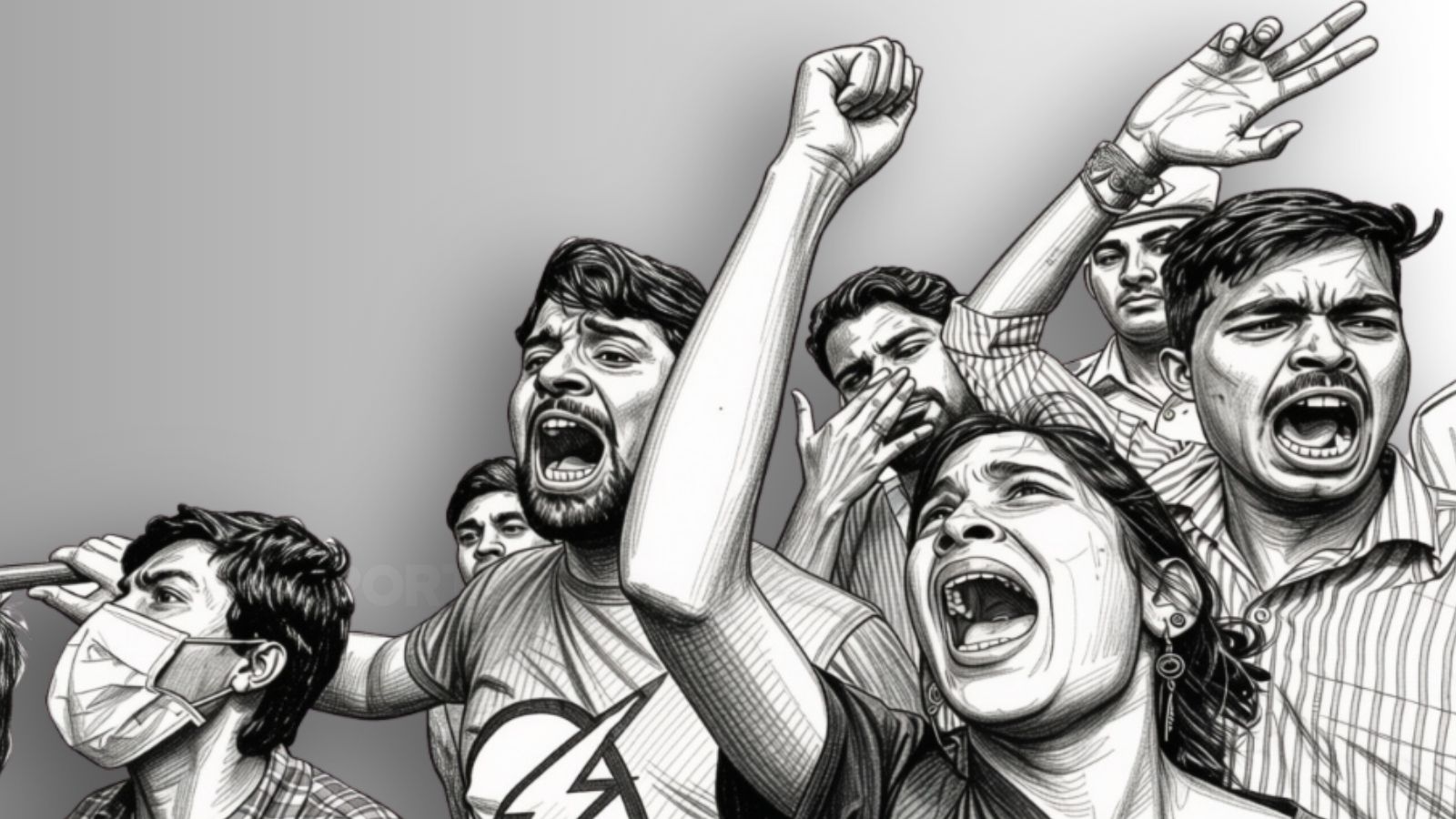
A draft code of conduct about politics on campuses for students of the University of Kerala and its affiliated institutions has brought an old argument back into focus: how much political activity should be allowed on a campus?
The draft proposes restrictions on organising students or gatherings for political purposes. Political strikes, dharnas, gheraos and the raising of political slogans in classrooms, offices and other campus spaces would be treated as breaches of discipline. The provisions also extend to political activity on digital platforms, with penalties ranging from suspension to fines.
The document is still a draft. The University of Kerala has said it is under discussion and revision, while the Higher Education Minister of Keralam, Roji M John, has said that the government has taken no decision to ban student politics.
But the argument behind the proposal is familiar. Student politics can become disruptive. It can become coercive. And, in its worst forms, it can become violent. That concern cannot simply be dismissed.
The more difficult question, however, is whether removing or severely restricting political activity is an effective response to those problems.
There is another function that student politics performs, one that is often overlooked when campus politics is discussed primarily through the lens of violence.
It teaches young people how politics works. It introduces them to the value of accountability and an understanding of their rights.
A university is not only a place where students acquire professional knowledge. It is also one of the first places where many of them encounter organised disagreement, institutional authority and collective action.
A student learns to question a decision, organise around a grievance, argue with someone holding a different position and negotiate with an authority that may not agree with them.
But political participation and political violence cannot be treated as part of the same discussion. Political organisations should not be allowed to intimidate other students or hold academic life hostage.
The violent turn
On July 2, 2018, M Abhimanyu, a 21-year-old second-year BSc Chemistry student and SFI unit secretary at Maharaja's College in Ernakulam, was stabbed to death inside the campus.
The attack followed a dispute over welcome graffiti for incoming students. According to the prosecution, activists of the Campus Front of India, the student wing of the now-banned Popular Front of India, arrived on campus with members of the SDPI. Other SFI activists were also seriously injured in the confrontation that ensued.
Sixteen men were charged with direct involvement. The police filed a chargesheet running to around 1,500 pages.
Abhimanyu's murder became part of a larger legal debate over aggressive campus politics. Petitioners approached the Kerala High Court, which directed universities including Kerala University, Calicut University, and MG University to frame regulations governing campus activity.
The concern, therefore, is real. Universities have a responsibility to protect students from violence and to ensure that academic life can continue without intimidation.
But Abhimanyu's case also raises another question.
What happens when the mechanisms meant to deliver accountability do not work?
Eight years to frame charges
Abhimanyu was killed in July 2018. Charges were framed against the first 16 accused only on July 6, 2026. Eight years and four days after his death.
All 16 pleaded not guilty. In the intervening years, 11 prosecution documents went missing, including the chargesheet, post-mortem certificate and wound certificate. They had reportedly been missing since January 2019, but the court was informed only in September 2023. Reconstructed copies were subsequently submitted on the High Court's direction.
The case was also delayed by procedural issues, the court's time being taken up by another high-profile case, difficulties in securing witnesses and allegations of attempts to influence them.
In January 2026, the Kerala High Court directed the Ernakulam Principal Sessions Court to complete the trial within nine months. After Abhimanyu's mother Bhoopathy approached the court, the deadline was extended by four months in August, with the court indicating that there would be no further extension.
The response
The proposed response to campus violence includes treating political gatherings and other forms of political activity as serious indiscipline.
But in a case involving the killing of a student, the criminal justice system took eight years merely to reach the stage of framing charges. The failure of institutions to deliver timely accountability is another part of the case that deserves attention.
The politics students inherit
There is a problem of inheritance in this case. Student organisations affiliated with political parties do not develop in isolation from the political culture around them. They absorb the language, rivalries and methods of the larger political system.
Students see political parties strike, demonstrate, campaign and confront one another. They also see political opponents treated not merely as people with different views, but as enemies. And that culture finds its way onto campuses.
If a political party wants a student organisation to recruit, mobilise and represent its interests, doesn't it have the responsibility to teach its members a democratic way of functioning?
If political parties reproduce their own confrontational culture through student organisations and then ask universities to manage the consequences, the institution is left dealing with a problem it did not create.
When political influence becomes coercive
The case of Sidharthan JS raises a different aspect of the same problem.
Sidharthan, a 20-year-old second-year student at the College of Veterinary and Animal Sciences at Pookode in Wayanad, was found dead in his hostel in February 2024.
His parents alleged that he had faced prolonged assault and intimidation from seniors and classmates. The accused included members of the Students' Federation of India (SFI), which denied the allegations. The Kerala government sought a CBI investigation, and the agency subsequently took over the case.
The then Leader of the Opposition, VD Satheesan, described the episode as evidence of what he called an SFI "political chokehold" on campuses, referring to what he characterised as students being subjected to pressure over dissent and contrary views. It is an argument about what happens when political influence becomes destructive, not an argument against student politics itself.
A campus does not become democratic simply because it has student organisations. Political participation becomes meaningful only when more than one voice can exist, organise and challenge another.
If one organisation has acquired excessive influence, eliminating political space for everyone does not necessarily remove that influence. It may also remove one of the mechanisms through which other students can organise against it.
Rohith Vemula and unequal access to power
The case of Rohith Vemula shows another dimension of power imbalance and what it can do. Vemula was a PhD scholar at the University of Hyderabad and a member of the Ambedkar Students' Association (ASA).
In 2015, tensions between the ASA and the Akhil Bharatiya Vidyarthi Parishad (ABVP) escalated after the ABVP's campus president alleged that he had been assaulted. The university initiated an inquiry.
On August 17 that year, Union Minister of State Bandaru Dattatreya wrote to the then Union Human Resource Development Minister Smriti Irani, describing the university as a den of casteist, extremist and anti-national politics. The ministry subsequently wrote to the university three times, according to Scroll.
Vemula and four other ASA members were suspended. The suspension was revoked following protests and later reimposed. In January 2016, the five students were evicted from their hostel. Unable to afford private accommodation, they established a protest camp outside the campus shopping complex. They called it 'Velivada', a term associated with a Dalit settlement or outcaste quarter.
They described themselves as being under a social boycott and began a hunger strike. Vemula also wrote to the vice-chancellor about caste discrimination. He died by suicide on January 17, 2016. His note did not blame anyone. Dattatreya has said his letter had no connection to the death.
But the political structure of the dispute is still worth examining.
One student organisation had access to a Union minister. A ministerial letter travelled to the education ministry and from there to the university.
The other students were occupying a tent outside a shopping complex.
That is not a story about too much politics on a campus. It is a story about unequal access to institutional power. And that matters when discussing restrictions on student politics.
A protest camp and a hunger strike are forms of collective political action. Under a code that treats such activity as serious indiscipline, the students' means of organising could itself become subject to disciplinary action.
A restriction on student politics does not prevent political power from operating outside the campus. It can, however, reduce the political space available to students who have fewer routes into that power.
What happens on a campus without student politics?
There is another case that complicates the assumption that removing student politics necessarily removes the problems associated with political pressure.
Amal Jyoti College of Engineering at Kanjirappally is a self-financing institution run by the Kanjirappally Diocese of the Syro-Malabar Catholic Church. The Week has reported that student politics is not permitted there.
On June 2, 2023, Sradha Satheesh, a 20-year-old second-year food technology student, was found dead in her hostel room.
According to her friends, college authorities had confiscated her phone the previous day after accusing her of using it in the laboratory. They said she was asked to bring her parents from Ernakulam to retrieve it and was subsequently summoned to the head of department's office. Afterwards, her friends said Srada had told them about her suicidal thoughts.
The circumstances surrounding her death triggered a protest by students.
They alleged sustained mental pressure from the administration and questioned the college's account of what had happened. The management shut the college indefinitely and ordered students to vacate the hostels. The students refused to leave. The Higher Education Minister, R Bindu, intervened on June 7 and announced a Crime Branch investigation supervised by a superintendent of police. The protest ended after the intervention.
This was a campus where political activity was already not permitted.
Students still organised when they believed they had a grievance that demanded attention.
The case points to the fact that removing formal student politics does not remove disagreement, grievance or the desire to organise around them.
And when students did organise, they did so through precisely the kind of collective political action that the proposed code would classify as serious indiscipline.
The argument that returns
Kerala has had this debate before, and the most important precedent comes from the Supreme Court-directed Lyngdoh Committee.
In December 2005, the Union government constituted a committee headed by former Chief Election Commissioner JM Lyngdoh to frame guidelines for student union elections. The exercise followed the University of Kerala case before the Supreme Court.
That list came from the State of Kerala, under a Congress-led UDF government. Among its 14 points was this one: no political activity to be allowed on the campus.
The Lyngdoh Committee heard arguments about violence and disruption associated with student unions. But it also examined what happened on campuses where student politics was restricted or absent. The report recorded instances of harassment of students by faculty and administrators, including sexual harassment. It also referred to exorbitant fees and unusually harsh rules imposed in the name of discipline.
The committee noted that a large number of colleges were directly or indirectly controlled by politicians who were satisfied with not holding student elections, possibly to prevent what it described as "errant" political ideologies from entering students' minds.
Its recommendation was not to eliminate student politics. It said that universities and colleges across the country should ordinarily conduct elections for student representative bodies.
The committee also examined Maharashtra, where the 1994 Maharashtra Universities Act prohibited student union elections across the state. The ban had been introduced in the context of the murder of a student in 1989.
The committee noted that the prohibition had never been challenged in court, even though, "prima facie, it appeared" to be contrary to the constitutional right of association.
The existence of violence in student politics does not automatically lead to the conclusion that student politics itself should disappear. There is another possible response: establish rules for political participation, hold organisations accountable and draw a clear line between legitimate political activity and violence or coercion. The Supreme Court ordered implementation of the Lyngdoh recommendations in full in September 2006.
Politics needs rules
Educational institutions can recognise political activity and establish clear rules for demonstrations, meetings, and protests. They can distinguish those activities from violence, intimidation and coercion. They can require student organisations to identify representatives who are accountable for their members' conduct.
They can also create permanent forums where administrators and student leaders meet before disagreements become confrontations.
And there is another constituency that any campus policy must protect: students who want nothing to do with politics.
Student politics should not become an obligation. A student who does not want to join an organisation should be free to remain outside it without intimidation or pressure.
Political parties have a responsibility too.
The students recruited into political organisations now will become political workers, journalists, lawyers, administrators, teachers and elected representatives tomorrow. The habits they acquire in political life do not necessarily remain confined to the campus.
If those habits include negotiation, dissent and respect for an opponent's right to participate, they become part of democratic political culture.
If they include intimidation, coercion and the belief that political power entitles one organisation to dominate others, those habits can travel in the opposite direction.
And when a campus murder takes eight years merely to reach the stage of framing charges, the answer cannot simply be another rule about slogans.
The institutions responsible for accountability have to work.
The question is what kind of citizens a campus produces
Supporting student politics does not mean every student should join a political organisation. Nor does it mean every action undertaken in the name of student politics deserves protection.
The narrower point is that politics has a legitimate place in student life.
A university should be able to say no to violence without saying no to disagreement. It should be able to regulate political activity without treating political participation itself as a disciplinary problem.
Because a democracy depends on more than people who know how to vote. It depends on people who understand how to question power, how to organise around a grievance, how to argue with an opponent and how to accept that the opponent has a right to be heard.
Those habits have to be learned somewhere, and a campus is one of the places where they can be learned. The real question, then, is not whether Kerala's campuses should have politics.
It is whether they can create a political culture in which participation is protected, power is accountable, dissent remains possible, and violence and coercion have clear consequences. That is a more demanding task than simply banning politics. It is also a more democratic one.
(In Makes Sense, Sajesh Mohan explores the politics, ideas and cultural forces that shape the stories and conversations around us — from public affairs to popular culture.)