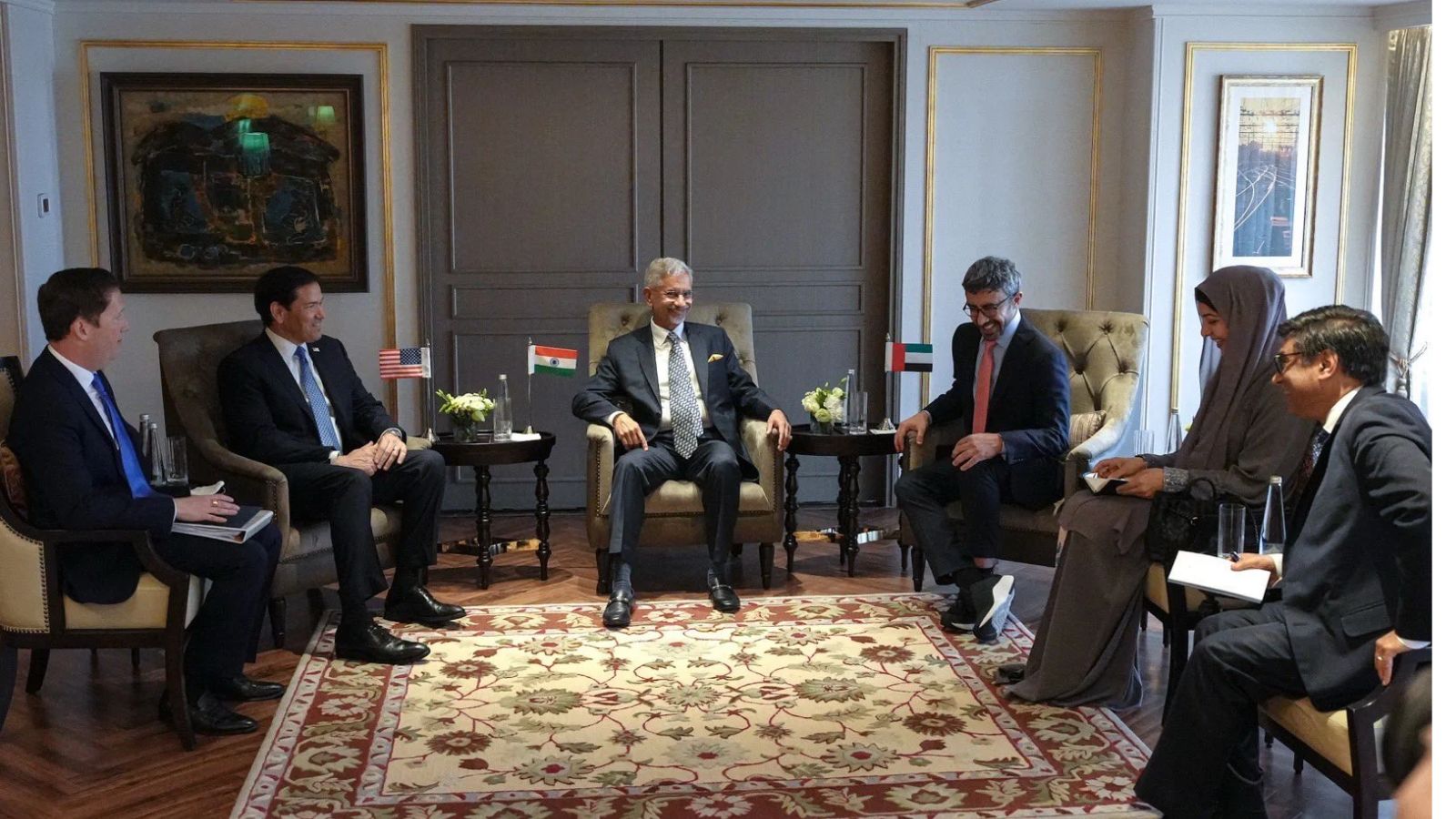


Mumbai: External Affairs Minister (EAM) S Jaishankar, UAE Deputy Prime Minister and Foreign Minister Sheikh Abdullah bin Zayed Al Nahyan, and US Secretary of State Marco Rubio held a trilateral meeting in Mumbai on Tuesday, exchanging views on regional energy security, connectivity, shared economic priorities and contemporary developments.
Following the meeting, Jaishankar said the three leaders had a useful exchange of perspectives on energy, connectivity and contemporary developments. In a post on X, he wrote, “Held a trilateral meeting with DPM and FM UAE Sheikh Abdullah bin Zayed and US Secretary of State Marco Rubio. A useful exchange of perspectives on energy, connectivity and contemporary developments.”
Held a trilateral meeting with DPM & FM UAE @ABZayed and US @SecRubio.A useful exchange of perspectives on energy, connectivity and contemporary developments.🇮🇳 🇦🇪 🇺🇸 https://t.co/Nh88ngrM1Q
— Dr. S. Jaishankar (@DrSJaishankar) October 20, 2026
Rubio also took to X to describe the discussions as an opportunity to advance regional energy security and shared economic priorities. “It was great to meet with Indian External Affairs Minister S Jaishankar and UAE Foreign Minister Sheikh Abdullah bin Zayed Al Nahyan to discuss regional energy security and advance our shared economic priorities,” he said.
It was great to meet with Indian External Affairs Minister @DrSJaishankar and UAE Foreign Minister @ABZayed to discuss regional energy security and advance our shared economic priorities. https://t.co/8GNOibFzR7
— Secretary Marco Rubio (@SecRubio) October 20, 2026
US Ambassador to India Sergio Gor highlighted the potential for closer cooperation among the three countries in energy, trade, technology and regional connectivity. In a post on X, he said the US, India and the UAE had real opportunities to advance cooperation in these areas, adding that the Mumbai meeting was aimed at translating their close ties into concrete results.
Productive discussions between @SecRubio and External Affairs Minister @DrSJaishankar on deepening U.S.-India cooperation across defense, energy, emerging technologies, and trade, as we continue to build the unrivaled momentum in our bilateral partnership. https://t.co/Ro5raWVb3h
— Ambassador Sergio Gor (@USAmbIndia) October 20, 2026
Rubio calls India-US ties ‘extraordinary’ at Freedom 250 reception
At the Freedom 250 reception in Mumbai, Rubio described the strategic relationship between India and the United States as ‘extraordinary’, saying the two countries had an opportunity to shape the course of the 21st century through closer cooperation.
Acknowledging that Washington and New Delhi would not agree on every issue, Rubio emphasised that their alignment on fundamental national interests could influence geopolitics, economics, trade and commerce for decades to come.
“No two nations on Earth will ever be perfectly aligned on every issue, and there will be times and points of disagreement,” Rubio said.
“But on the core issues that matter, the core issues that define the national interests of both India and the United States, the alignment between our countries is extraordinary,” he added.
Highlighting the demographic and economic significance of the two countries, Rubio referred to India's population approaching 1.5 billion and the United States' position as the world's largest economy. He said their partnership presented a distinct opportunity to shape the history of the 21st century by working together on issues that would determine the future.
#WATCH | Mumbai, Maharashtra: At the Freedom 250 reception, US Secretary of State Marco Rubio says, "No two nations on Earth will ever be perfectly aligned on every issue, and there will be times and points of disagreement. But on the core issues that matter, the core issues that define the national interests of both India and the United States, the alignment between our countries is extraordinary, especially for two countries of this size and magnitude. That doesn't mean smaller countries don't matter. Of course, they do. But when you're talking about a country approaching 1.5 billion people and the largest economy in the world, the United States, when two powers like that can be aligned on these issues that are going to define the 21st century, we have an opportunity together to write those pages in the history of the 21st century..."
— ANI (@ANI) October 20, 2026
Rubio also said the US should engage more frequently with India, describing the country as one of Washington's most important geopolitical partners. Responding to journalists who asked about his return to India after an interval of just four months, he said, “I actually think we don’t come enough.”
He said regional developments would play a decisive role in shaping the 21st century, adding that decisions on geopolitics, trade and economic cooperation would have consequences for generations to come.
“One day, someone will write a book about the history of the 21st century, and there will be a chapter about other regions in the world, but the 21st century will be defined, for better and for worse, by what happens in this region,” he said.
“We know that, we can sense it, we can feel it,” he added.
#WATCH | Mumbai, Maharashtra: At the Freedom 250 reception, US Secretary of State Marco Rubio says, "... I truly believe the relationship between the United States and India is defining, in many ways, in a positive way what the 21st century can look like... The United States and India are aligned, perfectly aligned. We have the same talented people working on it, from engineers to creative thinkers and innovators. We are aligned, and we want to see a world in which superintelligence is used for the betterment of humanity and one in which the harms it could cause are mitigated... If you look at geopolitics, no matter what you make or what you innovate, it has to get from you to the places you're sending it to, unless you only want to sell to your own economy. That requires the free and unfettered ability to trade. That requires open sea lanes, for example, and, in particular, for the United States and India, a free and secure Indo-Pacific..."
— ANI (@ANI) October 20, 2026
Rubio said American diplomatic personnel stationed in India had an opportunity to help shape the future alongside a powerful, influential and advanced partner.
“What I'm excited about, and what I challenge our team at the Department of State to be excited about, as well as our team at the consulate here in Mumbai, is the fact that today you are assigned to and working in a place where the United States, in partnership with another powerful, influential, and advanced country, is helping to write the story of the 21st century in a way that upholds the values we share in common,” he said.
He added that these values were rooted in individual dignity, democratic principles and the rule of law, and stressed the responsibility of public officials to leave the next generation better off.
“We are here to celebrate what we can achieve together over the next 250 years,” Rubio said, referring to the future of US-India cooperation.
#WATCH | Mumbai, Maharashtra: At the Freedom 250 reception, US Secretary of State Marco Rubio says, "We are here to celebrate what we can achieve together over the next 250 years. We are making decisions now in geopolitics, economics, trade, and commerce that will impact people who have not even been born and will define the world in ways we cannot even fully comprehend or appreciate. What I'm excited about, and what I challenge our team at the Department of State to be excited about, as well as our team at the consulate here in Mumbai, is the fact that today you are assigned to and working in a place where the United States, in partnership with another powerful, influential, and advanced country, is helping to write the story of the 21st century in a way that upholds the values we share in common. These values are rooted in the dignity of the individual, democratic principles, the rule of law, and the belief that our job, for those who serve in public office, is to leave the next generation better off than ourselves..."
— ANI (@ANI) October 20, 2026
US targets $500 billion in bilateral trade with India
Addressing the Freedom 250 reception, US Ambassador to India Sergio Gor said President Donald Trump had given him a direct mandate to deliver tangible results in bilateral relations.
“When President Donald Trump sent me to India, he gave me a direct mandate: deliver results. Don't just talk about the future. Make it happen,” Gor said.
He added that Trump and Prime Minister Narendra Modi had reaffirmed their commitment to strengthening bilateral ties during their recent discussions.
Gor said bilateral trade had reached more than $240 billion and outlined an ambitious target of increasing it to over $500 billion in the next three years.
“We have an ambitious goal. We are laser-focused on driving that number past $500 billion in the next three years,” he said.
Highlighting opportunities for commercial cooperation, Gor identified semiconductors, critical minerals, energy, defence and superintelligence as key sectors for future collaboration.
He described the partnership as one that continued to expand across several levels, from critical data infrastructure and manufacturing to laboratories, research centres and commercial space exploration.
“The U.S.-India partnership does not move in a flat line; it climbs,” Gor said, describing the alliance as firmly rooted in shared fundamentals and expanding at a rapid pace.
#WATCH | Mumbai, Maharashtra: At the Freedom 250 reception, US Ambassador to India Sergio Gor says, "When President Donald Trump sent me to India, he gave me a direct mandate: deliver results. Don't just talk about the future. Make it happen. In their recent discussions, President Trump and Prime Minister Modi reaffirmed that commitment. Today, our bilateral trade has shattered records, reaching over $240 billion. We have an ambitious goal. We are laser-focused on driving that number past $500 billion in the next three years. The commercial frontier ahead of us is unmatched, spanning semiconductors, critical minerals, energy, defense, and, of course, superintelligence. The U.S.-India partnership does not move in a flat line; it climbs. It begins in the ocean depths with critical data infrastructure. It rises through our factories, labs, and research hubs, and it extends into deep space through commercial exploration. That is the trajectory of our alliance, rooted deep in fundamentals, accelerating upward at record speed, and heading straight for the stars..."
— ANI (@ANI) October 20, 2026
Jaishankar highlights expanding partnership and cooperation
Speaking at the same reception, Jaishankar said India-US relations had evolved significantly over the years, contributing to India's development across infrastructure, education, food, agriculture and technology.
“Our ties have indeed come a long way. History records that many Americans were supportive of India's struggle for independence,” he said.
He noted that Indian talent and skills had also helped shape the technology sector in the United States.
Acknowledging that the two countries had experienced differences in their approaches to international affairs and global challenges, Jaishankar said the partnership had steadily expanded over the past few decades, acquiring new dimensions.
#WATCH | Mumbai, Maharashtra: At the Freedom 250 reception, EAM Dr S Jaishankar says, "Our ties have indeed come a long way. History records that many Americans were supportive of India's struggle for independence. After that, whether it was infrastructure and education or food, agriculture, and technology, our partnership has made a real difference to India's development. Indian talent and Indian skills have helped shape the tech era in the United States. Of course, we've had our share of issues, including the manner in which we approach the world and its challenges. But in the last few decades, our partnership has steadily expanded, acquiring new dimensions and new facets. The Quad, Mission 500, Pax Silica, and the Forge Initiative are among some of the notable examples. Growth in the fields of energy, defense, and civil aviation has actually been striking..."
— ANI (@ANI) October 20, 2026
He cited the Quad, Mission 500, Pax Silica and the Forge Initiative as notable examples of growing cooperation between the two countries.
“Growth in the fields of energy, defence, and civil aviation has actually been striking,” Jaishankar said, highlighting the expanding scope of bilateral engagement.
He also emphasised the contribution of the partnership to India's development and the growing importance of cooperation across strategic and economic sectors.
#WATCH | Mumbai, Maharashtra: At the Freedom 250 reception, EAM Dr S Jaishankar says, "Secretary Rubio, all of Mumbai, and indeed all of India, appreciate your laying a wreath today at the Taj Hotel's 26/11 Memorial. India also welcomes this administration's decision to extradite Tahawwur Hussain Rana, who was one of the key culprits. We are clear on our right to defend ourselves against terrorism and expect our partners to show zero tolerance toward terrorism as well. As we mark this anniversary together, it is natural to reflect on the way ahead. The world order is clearly in transition, and countries are responding accordingly. Each one of us will naturally pursue our national interests. In such an era, expanding our convergence is key to deepening our ties. There are new opportunities in our partnership in trade, investment, technology, and energy, and these await us. We have a shared stake in strengthening peace and stability in the Indo-Pacific. Engaging regularly and identifying common interests will certainly help provide a pathway..."
— ANI (@ANI) October 20, 2026
Rubio, Jaishankar pay tribute to 26/11 victims
US Secretary of State Marco Rubio and External Affairs Minister S Jaishankar on Tuesday laid a wreath at the 26/11 memorial at Mumbai’s Taj Mahal Palace Hotel, paying tribute to the victims of the 2008 Mumbai terror attacks.
Rubio arrived in Mumbai earlier in the day on an official visit to India, accompanied by his wife, Jeanette Rubio, and US Ambassador to India Sergio Gor. The Ministry of External Affairs (MEA) welcomed Rubio on his second visit to India, stating that the visit offered an opportunity to further strengthen cooperation across various pillars of the India-US Comprehensive Global Strategic Partnership.
At the Taj Mahal Palace Hotel, I laid a wreath honoring the victims of the horrific November 26, 2008 terrorist attacks, including six American citizens. We remember those lost, honor the courage of those who responded, and reaffirm the enduring U.S.-India partnership and our shared commitment to combating terrorism.
— Secretary Marco Rubio (@SecRubio) October 20, 2026