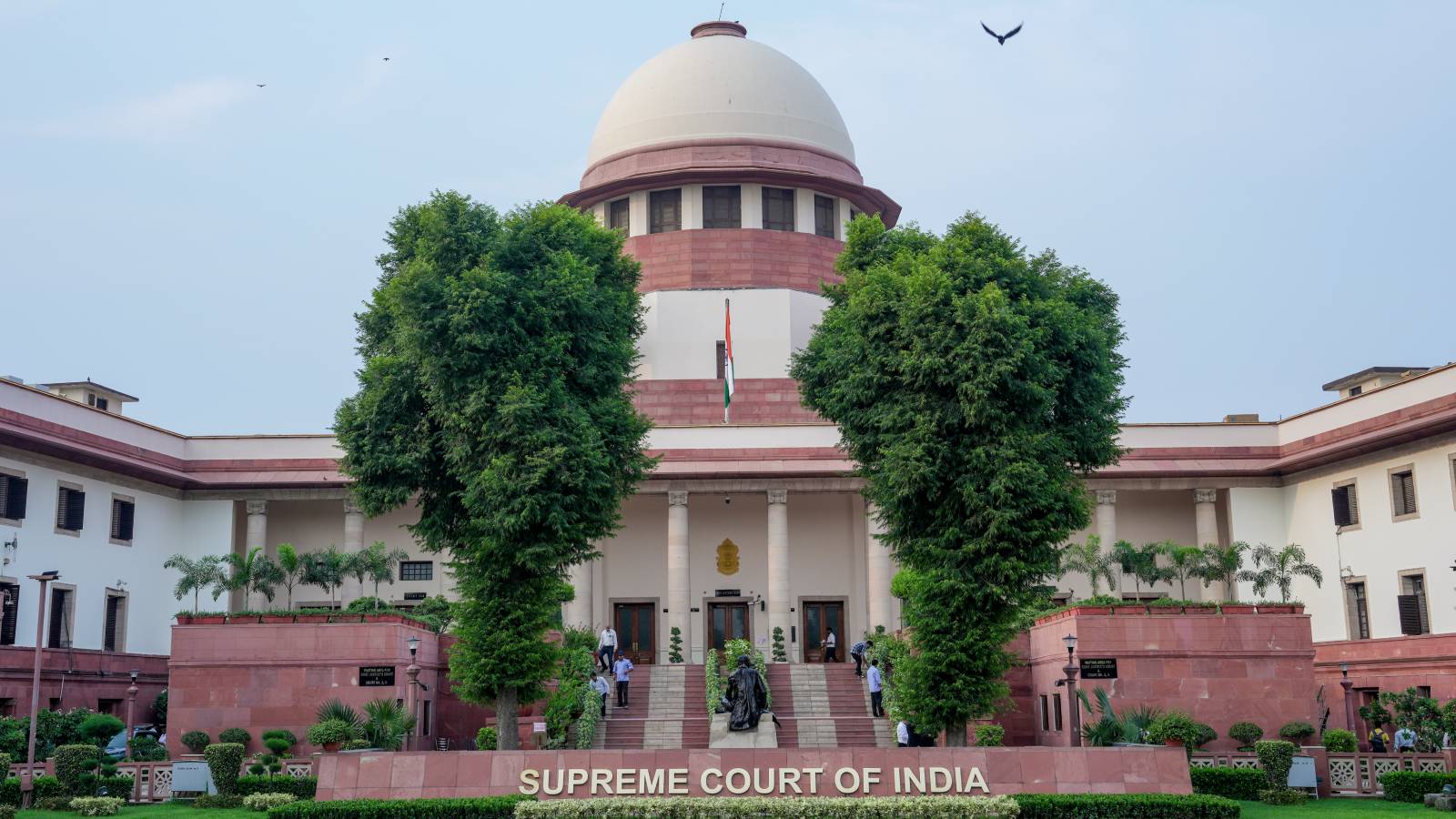


New Delhi: The Supreme Court on Friday permitted the lighting of the Karthigai Deepam lamp at the disputed Deepathoon stone pillar on Thiruparankundram hill in Madurai on November 24, but restricted the exercise to a one-time arrangement under strict conditions.
A bench of Justices Aravind Kumar and Vipul M Pancholi stayed the challenged findings of the Madras High Court's January 6, 2026, Division Bench judgment while allowing the ceremony to take place this year.
The court made it clear that the permission should not be treated as recognition of an established religious custom at the disputed location. Neither the ceremony nor the interim arrangement can be cited as proof of a customary right or used to seek similar permission in subsequent years, reported Live Law.
The Supreme Court directed that access to the stone pillar be restricted to an authorised team organised by the temple administration, along with government officials required to supervise the arrangements.
Also Read:
The Madurai District Collector will decide the team's size and composition in consultation with the temple's Executive Officer, the Archaeological Survey of India (ASI) and the Madurai Commissioner of Police. The Collector will also act as the nodal officer.
The district administration will determine the timing and route for the ceremony. The team must leave the location immediately after lighting the lamp.
The general public will not be permitted to access the Deepathoon. The court also prohibited processions, public gatherings, demonstrations and slogan-raising at the site.
Authorities have been directed to make adequate security arrangements. Central force assistance may be deployed if required, according to reports of the order.
The court further prohibited excavation, construction, structural alterations or the erection of permanent structures at the disputed location. Access to and worship at the dargah and mosque must continue without interference.
Supreme Court does not decide religious rights dispute
The bench said the case raised important legal questions concerning the scope of religious freedom under Articles 25 and 26 of the Constitution. It clarified that these questions would be examined at an appropriate stage and were not being decided through the present interim arrangement.
The court also cautioned that its decision should not be interpreted as endorsing the reasoning adopted by the Madras High Court.
The judges said the approaching festival was a significant consideration. If permission to perform the ceremony on November 24 were denied, the opportunity could not be restored through a later judgment. At the same time, the court recognised that once the ceremony was performed, it could not be undone.
It therefore opted for a narrowly defined arrangement, balancing the immediate festival-related request with the unresolved legal and property questions.
How the Thiruparankundram dispute reached the Supreme Court?
The dispute concerns the right to light the Karthigai Deepam lamp at a stone pillar known as the Deepathoon, located near the Sikandar Badusha Dargah on Thiruparankundram hill.
In December 2025, Madras High Court single-judge Justice GR Swaminathan directed the Arulmigu Subramania Swamy Temple administration to light the ceremonial lamp at the pillar in addition to the customary location near the Uchi Pillaiyar Temple.
A Division Bench of the Madras High Court upheld the direction on January 6, 2026. The Tamil Nadu government and other parties subsequently approached the Supreme Court, challenging the High Court's findings and directions.
The dispute involves competing claims over the history and religious significance of the pillar, the location of the dargah, and the rights of the temple administration. The Tamil Nadu government and the dargah committee have disputed the claim that lighting the lamp at the Deepathoon is an established custom.
The Supreme Court's latest order permits the ceremony this year without settling those underlying disputes. The matter is expected to be heard further in January 2027