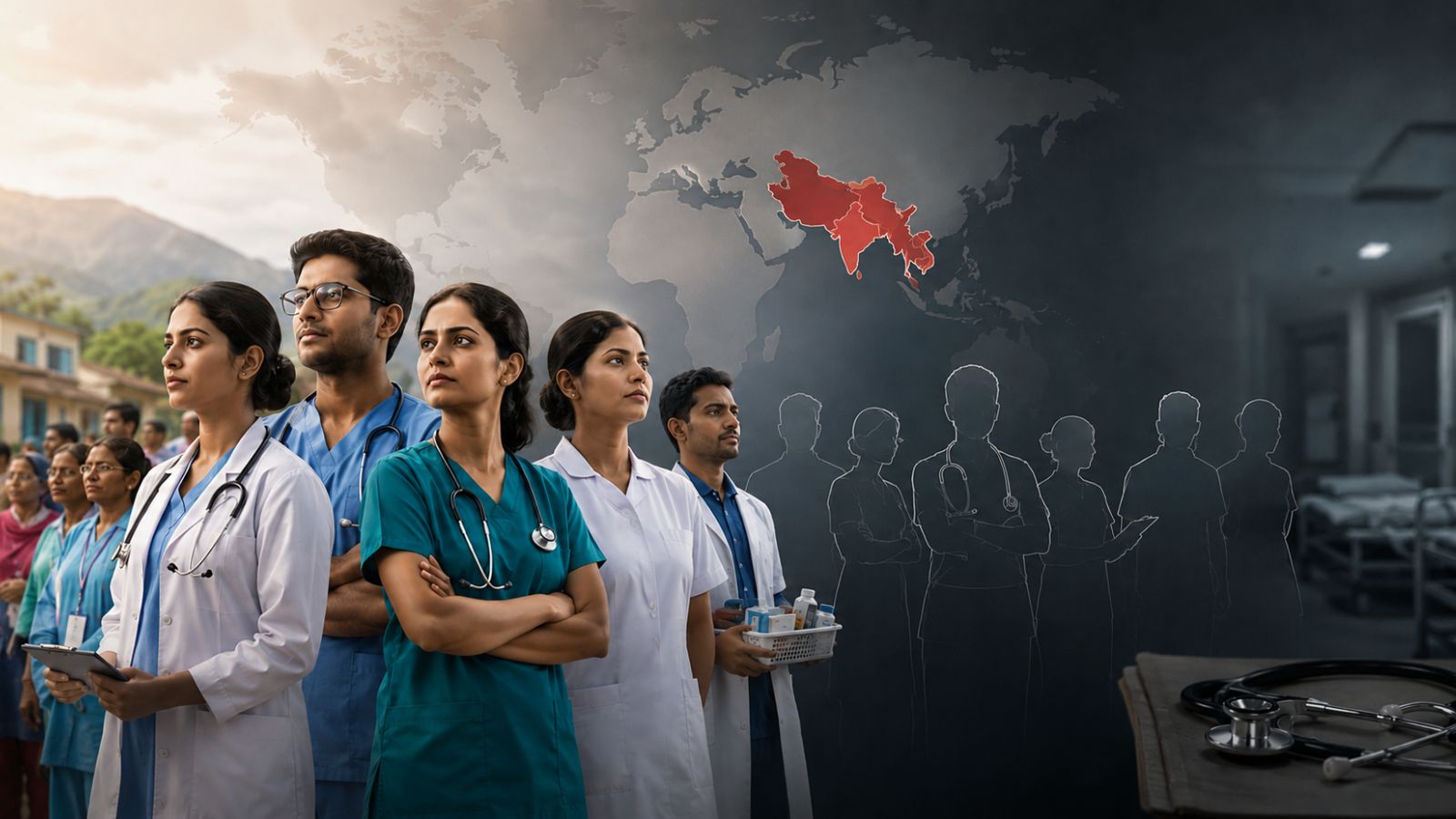


New Delhi: South Asia has the world's largest shortage of health workers needed to achieve moderate universal health coverage, with the region facing major gaps in doctors, nurses, midwives, dentists and pharmacists, according to a global study published in The Lancet Public Health.
Globally, about 34.4 million additional health workers were needed in 2023 to reach a universal health coverage (UHC) score of 80 or higher, researchers estimated.
The analysis, conducted by researchers from the Institute for Health Metrics and Evaluation at the University of Washington in the US, estimated that the global health workforce nearly tripled between 1990 and 2023, rising from 40.9 million to 122.1 million workers.
Women accounted for more than 70 per cent of the growth and represented about 70 per cent of the global health workforce in 2023.
However, the expansion was uneven across regions, with persistent shortages of doctors, nurses and midwives, dentists and pharmacists relative to the workforce required to achieve moderate UHC.
South Asia recorded the largest shortages, with an estimated deficit of 2.6 million doctors, 10 million nurses and midwives, 0.7 million dentists and 0.3 million pharmacists.
"Using the thresholds for an 80 or higher UHC score, we estimated a shortage of 34.4 million HRH (human resources for health) globally in 2023, including 7.1 million doctors, 23.9 million nurses and midwives, 1.8 million dentists, and 1.6 million pharmacists in 2023," the researchers said.
India had an estimated health workforce density of about 73 workers per 10,000 people. This included 10.5 doctors, 10.8 nurses, 8.1 pharmacists and pharmaceutical assistants, and 1.2 midwifery personnel per 10,000 population.
By comparison, China had an estimated density of about 130 health workers per 10,000 population, including more than 30 doctors and about 45 nurses per 10,000 people.
Lead author Megan Knight, a researcher at the Institute for Health Metrics and Evaluation, said women had transformed the global health workforce over the past three decades but remained concentrated in professions that generally offered lower pay and fewer leadership opportunities.
"Building stronger health systems will require not only expanding the workforce, but also creating equitable opportunities for career advancement, leadership, and safe, supportive working environments," Knight said.
The study also found significant differences in the gender composition of health professions. Women accounted for 43.9 per cent of doctors in 2023, while they represented 80.7 per cent of nurses, 96 per cent of midwives and 89.5 per cent of community health workers.
India was also among countries including Brazil, Thailand and Rwanda with the highest densities of community health workers in 2023, at 16.2 per 10,000 population.
Regionally, South Asia had the highest density of community health workers, at 13.6 per 10,000 population. Southeast Asia, East Asia and Oceania had a density of 13.5 per 10,000, followed by Latin America and the Caribbean at 10.8 and sub-Saharan Africa at 10.1 per 10,000.
In high-income countries, the density was below one community health worker per 10,000 population.
The researchers noted that the continued expansion of the global health workforce would need to be accompanied by more equitable distribution and better working conditions to address persistent shortages and support progress towards universal health coverage.