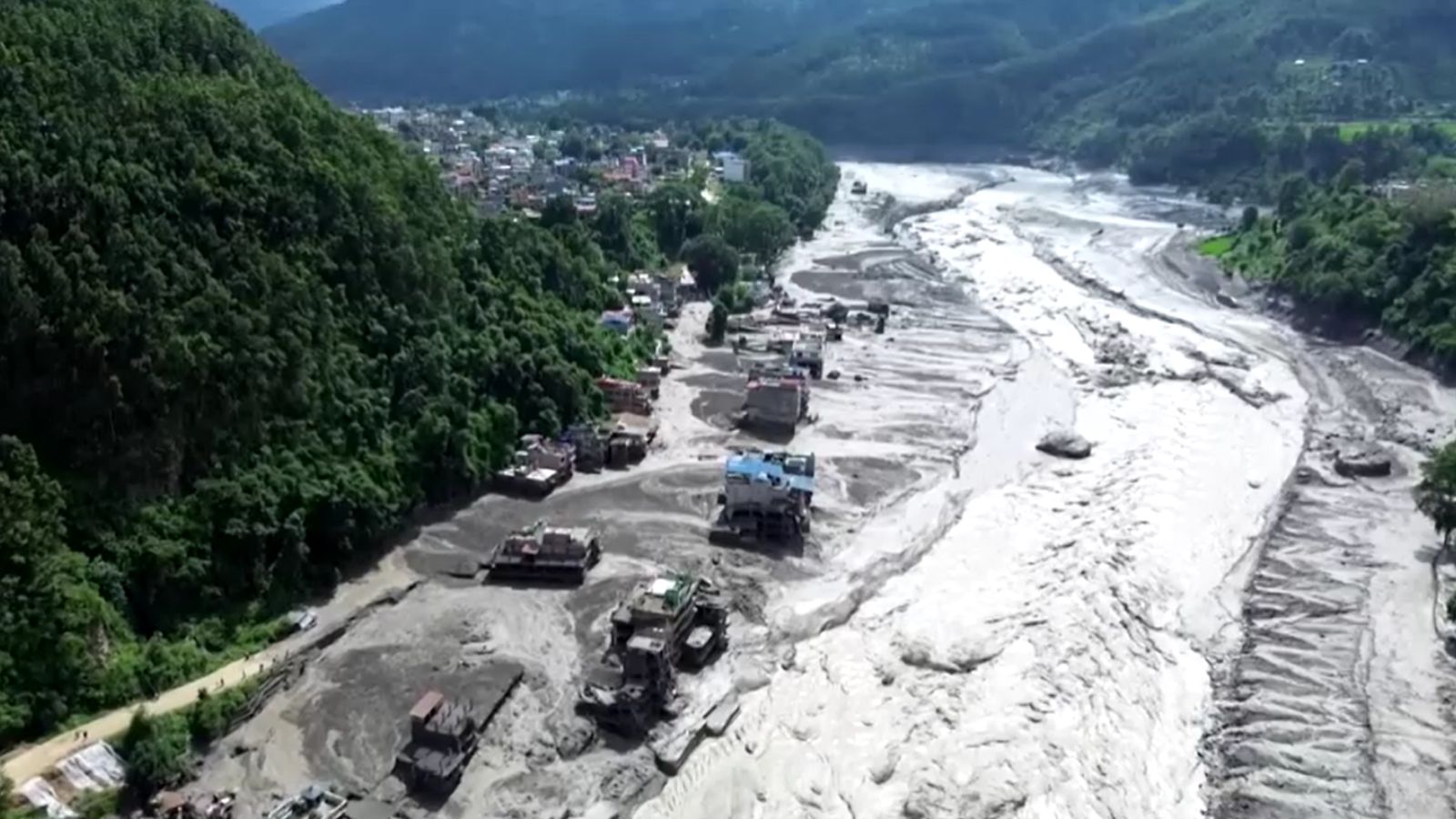


The catastrophic flooding that began in Tibet on Wednesday, August 26, left a trail of death and destruction in Tibet-Nepal border, mainly in Nepal's Rasuwa, Nuwakot and Dhading districts, and delivered a bigger climatic warning.
What was initially thought to be an earthquake was later identified by the US Geological Survey as a glacial collapse and debris flow. The Rasuwa disaster has exposed how quickly changes and instability in the high Himalayas can translate into catastrophic outcomes downstream.
‘It was no longer an earthquake..’
According to the US Geological Survey (USGS), the Nepal flash floods were triggered by a glacial collapse and debris flow, rather than the 4.4-magnitude earthquake initially reported.
“This event was initially reported as a magnitude 4.4 earthquake. Additional analysis of nearby seismic stations, long-period seismic waves, and satellite imagery led to the determination that the seismic event was instead a glacial collapse and debris flow, and that no earthquake had occurred,” the USGS said in an update to its note on the event.
Satellite imagery showed that a substantial section of a glacier broke away at an elevation of about 5,200 metres and fell roughly 1,200 metres onto the valley floor. The resulting ice-rock avalanche entered the Lhende Khola river in Tibet, temporarily blocking it before the natural blockage gave way and sent a destructive surge downstream into Nepal.
Daniel Shugar, an associate professor of geomorphology at the University of Calgary in Canada, examined satellite images of the region taken on Tuesday and Wednesday.
Shugar said the glacier appeared to have lost a significant amount of snow in the preceding 24 hours. He suggested that rapid snow and ice melt may have added water to the glacier and contributed to its instability, although the precise trigger is still being investigated.
Glacial Lake Outburst Floods (GLOF)
Nepal's devastating floods have renewed attention on the growing threat of Glacial Lake Outburst Floods, or GLOFs, across the Himalayas.
But the Rasuwa flood itself has not been confirmed as a GLOF.
A GLOF occurs when water stored in a glacial lake is suddenly released, often because the natural dam holding the lake fails or is overtopped. Such floods can send enormous volumes of water and debris downstream in a very short time.
In the Hindu Kush Himalaya, moraine-dammed glacial lakes are common. Many GLOF events have been associated with the failure or overtopping of these natural dams.
A moraine-dammed lake forms when a glacier retreats and leaves behind a ridge of rock and debris, known as a moraine. Meltwater can accumulate between the retreating glacier and this natural dam, forming a lake.
The reservoirs
As a glacial lake grows, the volume and pressure of water behind its natural dam can increase. But the dam can also be destabilised by external events.
An avalanche or landslide entering the lake can generate a large displacement wave, which may overtop or breach the dam. Internal drainage and seepage can also weaken the structure.
When the dam fails, the stored water can be released rapidly, producing a GLOF.
In 2018, ICIMOD released a report on the status of glacial lakes in the Hindu Kush Himalaya that mapped and classified 25,614 glacial lakes across five major river basins. The report found that 8.3 per cent of the mapped glacial lakes were located below 4,000 metres above sea level.
GLOFs are considered a significant hazard in mountainous regions of the Hindu Kush Himalaya.
Climate change does not automatically cause a GLOF. But rising temperatures are contributing to glacier retreat and, in many places, the formation and expansion of glacial lakes. As these lakes grow, the potential volume of water that could be released in a sudden outburst can also increase.
That does not mean every expanding glacial lake is about to burst. The actual risk depends on factors including the type and stability of the dam, the size and location of the lake, and the processes that could trigger a failure.
The glacial lakes
Glacial lakes can be classified according to what is holding the water back. Two important types in the Himalayas are:
1) Moraine-dammed lakes
These form when a glacier retreats and leaves behind a moraine — a deposit of rocks, soil and other debris carried by the glacier.
Meltwater can collect between the retreating glacier and the moraine, creating a lake.
Tsho Rolpa in Nepal is a well-known example of a moraine-dammed glacial lake. Research has documented its expansion over several decades and its potential GLOF risk.
2) Ice-dammed lakes
These are different from moraine-dammed lakes.
Here, the water is held back by ice rather than a moraine. Such lakes can form when a glacier blocks a drainage channel or when water becomes trapped against or within glacial ice.
Ice-dammed lakes can also produce outburst floods if the ice dam fails or the lake drains suddenly.
The warning from the Himalayas
As glaciers lose ice and glacial lakes expand, the risks to communities downstream are becoming harder to ignore.
What happens high in the Himalayas can have devastating consequences far beyond the mountains. Similar changes are also being observed in glaciers across the Arctic and other parts of the world.