

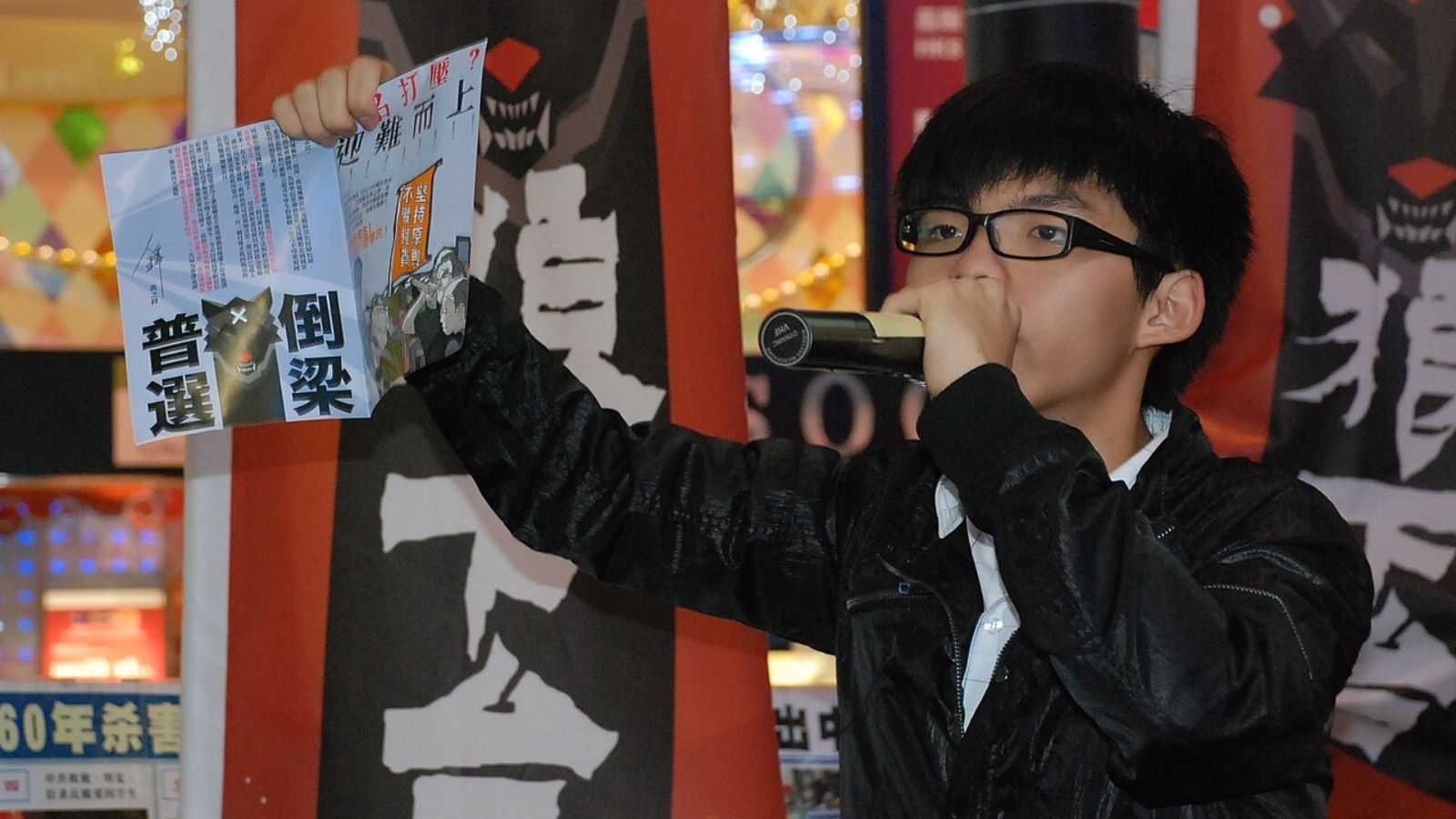


Joshua Wong was still a teenager when he began challenging the Hong Kong government. What started as a student campaign against a proposed school curriculum soon developed into a much larger political movement, placing him at the centre of the city's struggle for democratic representation.
Over the years, Wong became one of Hong Kong's best-known pro-democracy activists. He helped mobilise young people, co-founded a political party and sought international support for democratic reforms in the city.
His activism also brought him into conflict with authorities, particularly after Beijing introduced a national security law for Hong Kong in 2020. Wong is now serving prison sentences in two separate national security cases, including a 10-year term handed down on November 5, 2026.
How did a school student become such a prominent figure in Hong Kong's democracy movement?
The student activist who first challenged the government
Born in 1996, Joshua Wong Chi-fung grew up in Hong Kong in the years following its return to Chinese sovereignty in 1997.
His political activism began during his school years. In 2011, he co-founded Scholarism, a student activist group that opposed the Hong Kong government's proposed national education curriculum.
The campaign gathered momentum in 2012, when Wong and other students organised demonstrations against the proposed changes. Critics argued that the curriculum promoted a pro-Beijing political outlook and could encourage students to develop a more favourable view of the Chinese Communist Party.
Wong emerged as one of the campaign's most visible organisers. Thousands joined the protests, including students and parents. Following sustained public pressure, the government shelved its plans.
The campaign brought Wong national attention while he was still a teenager. It also established Scholarism as an important platform for young people participating in Hong Kong's political debate.
The Umbrella Movement and international recognition
Wong's profile grew significantly during the 2014 Umbrella Movement, one of Hong Kong's largest pro-democracy protest movements.
The demonstrations followed Beijing's decision on the framework for electing Hong Kong's chief executive. Although the framework proposed a popular vote, candidates would first have to secure approval from a nominating committee. Pro-democracy campaigners argued that this restricted voters' choices and fell short of genuine universal suffrage.
Protesters demanded open elections and greater democratic representation. Demonstrations spread across major parts of the city, with protesters occupying key roads for 79 days.
Umbrellas became the defining symbol of the movement as demonstrators used them to shield themselves from police pepper spray and other crowd-control measures.
Wong, then 17, became one of its most recognisable young leaders. His involvement brought him international attention, including appearances in global media coverage of the protests.
The movement did not achieve its central demand for electoral reform. However, it marked a significant moment in Hong Kong's pro-democracy movement and brought a new generation of activists into public life.
From street protests to organised politics
In 2016, Wong co-founded Demosisto with fellow activists Nathan Law and Agnes Chow. The political party sought to give younger activists a platform to pursue democratic self-determination for Hong Kong.
The party's name combined the Greek word demos, meaning people, and the Latin word sisto, associated with standing. Its formation marked an attempt to move beyond street protests and participate in the city's political process.
Law was elected to Hong Kong's Legislative Council in 2016, becoming one of its youngest members. Wong continued his activism and international advocacy.
The group also sought support from foreign politicians and institutions. Wong and other activists raised concerns about political developments in Hong Kong and called for international pressure on authorities. Their advocacy included support for sanctions and other measures against officials accused of undermining the city's freedoms.
Demosisto eventually disbanded on June 30, 2020, shortly before Beijing's national security law came into effect in Hong Kong. Law later left for the United Kingdom, while Wong remained in the city.
What changed in Hong Kong after the 2019 protests?
Hong Kong witnessed another major wave of protests in 2019, initially triggered by a proposed extradition bill that would have allowed criminal suspects to be transferred to mainland China and other jurisdictions.
The demonstrations expanded into a wider movement over police conduct, political accountability and demands for democratic reform. The unrest also intensified tensions between Hong Kong's pro-democracy camp and Beijing.
On June 30, 2020, Beijing imposed the National Security Law on Hong Kong. The legislation criminalises acts categorised as secession, subversion, terrorism and collusion with foreign forces.
Beijing defended the law as necessary to restore stability and protect national security after the 2019 unrest. Critics, including human rights organisations, argued that its broad provisions could be used to restrict political opposition and civil liberties.
The legislation had an immediate impact on Hong Kong's political environment. Several pro-democracy organisations disbanded, while prominent activists were arrested or left the city. Demosisto was among the organisations that ceased operations.
Why was Joshua Wong imprisoned?
Wong's legal troubles under the national security framework began with his involvement in an unofficial primary election organised by Hong Kong's pro-democracy camp in July 2020.
The primary was intended to select candidates for the Legislative Council election and help the pro-democracy camp secure a majority in the legislature.
Wong was among 47 activists charged in the case. Prosecutors alleged that the group planned to use a majority in the legislature to veto government budgets and force the chief executive to resign. Authorities treated the alleged strategy as a conspiracy to commit subversion under the national security law.
Wong pleaded guilty. In November 2024, he was sentenced to four years and eight months in prison. He had been expected to be released in January 2027.
The prosecution of the 47 activists became one of the most significant cases brought under Hong Kong's national security legislation. Rights groups and pro-democracy supporters criticised the case, arguing that the prosecution targeted political participation. Authorities maintained that the proceedings were based on evidence and conducted in accordance with the law.
Why was he charged again?
In June 2025, while Wong was already in prison, he faced another charge under the national security law. This time, it was for conspiracy to collude with foreign forces.
The prosecution alleged that Wong and Nathan Law had agreed to pursue international lobbying to advance their political objectives. It cited their efforts to seek sanctions and other measures against Hong Kong and China, including meetings with foreign politicians.
According to the prosecution, Wong continued to support these efforts after the national security law came into force, using foreign media outlets and social media to draw international attention to calls for sanctions and other hostile measures. Law and other activists pursued advocacy efforts from outside Hong Kong.
Wong pleaded guilty to the charge on September 2, 2026. During the mitigation hearing, his lawyer asked the court to consider the time he had already spent in custody. He said Wong had used his imprisonment to read, reflect and reassess his life, and hoped to care for his parents after his release.
Wong also maintained during the proceedings that he had never advocated Hong Kong independence or sought regime change in China.
What does his latest sentence mean?
On November 5, 2026, Hong Kong's High Court sentenced Wong to 10 years in prison for conspiracy to collude with foreign forces. Judge William Tam classified the offence as being of a grave nature.
The judge set a starting point of 13 years and reduced the term by three years, taking into account Wong's guilty plea and mitigation. Under the national security law, offences classified as grave carry prison terms of 10 years to life.
The new sentence will run partly concurrently with his existing prison term. Two months and two days will overlap with the earlier sentence, while the remainder will extend his time in prison.
The sentence has drawn criticism from human rights organisations, which argue that the national security law is being used to keep prominent pro-democracy activists behind bars. The Hong Kong government, however, maintains that its law enforcement actions are based on evidence and have nothing to do with the political positions of those charged.
From leading school protests as a teenager to becoming an internationally recognised figure in Hong Kong's democracy movement, Wong's political journey has unfolded alongside the city's changing relationship with Beijing. His successive prosecutions have also become part of the wider debate over the future of political freedoms and dissent in Hong Kong.
(With inputs from AP, Reuters and Hong Kong public broadcaster RTHK, Human Rights Watch)