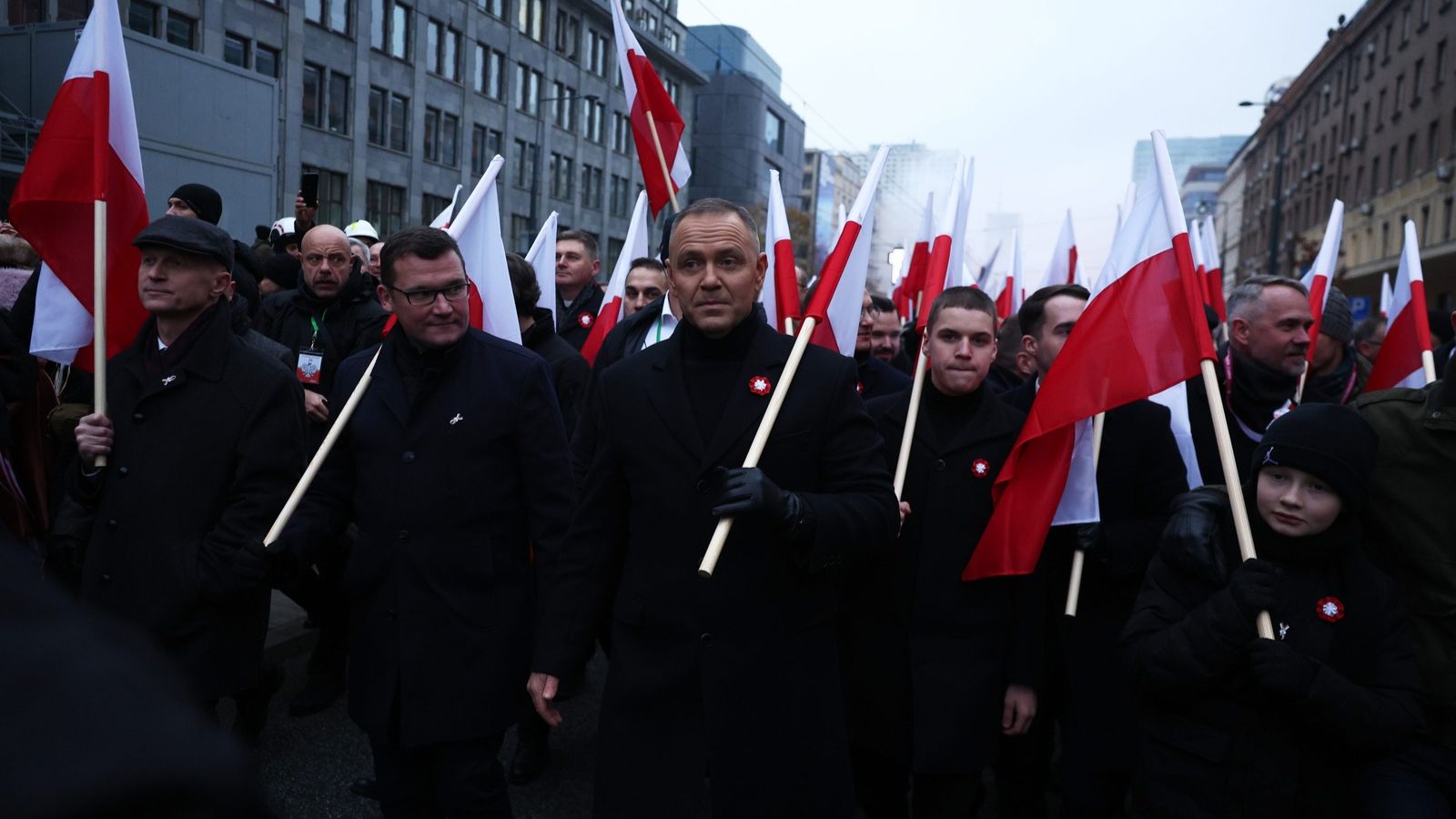


Warsaw: Polish President Karol Nawrocki joined hundreds of thousands of right-wing demonstrators waving red-and-white national flags and chanting slogans at an annual march on Wednesday to mark the country's Independence Day.
The demonstration, organised by nationalist groups, came amid concerns about violent extremism following a deadly shooting in Krakow on Saturday, which authorities attributed to a far-right gunman.
Speeches ahead of the march invoked historical and Christian themes, recalling Poland's past subjugation under Germany and the Soviet Union. One speaker denounced “toxic ideologies” circulating on the Internet, while messages of patriotism resonated throughout.
As the march got underway, Nawrocki — a staunch conservative and nationalist — joined the crowd from the back. He did not address the gathering. Horns blared, and demonstrators shouted slogans as orange flares sent smoke into the cloudy skies.
The PAP news agency cited Jaroslaw Misztal, director of the Warsaw Security Centre, as saying that around 250,000 people took part, with no major incidents reported. March organisers put the turnout at half a million or more.
The president had earlier delivered remarks at an official commemoration in Pilsudski Square, where he laid a wreath at the Tomb of the Unknown Soldier. He addressed security concerns and called for unity.
“Poland will be a solid, stable, and predictable ally when it comes to security, and Polish political elites will build our security not with political disputes in mind, but for the safety of Polish women and men,” Nawrocki said.
His chief political rival, pro-European Prime Minister Donald Tusk, attended a separate rally in the city of Szczecin, near the German border.
“Today, on November 11th, we were supposed to reach out to one another. Mr President, we were meant to meet,” Tusk said in comments in a video posted on his X account, appealing for unity between the country's two top political leaders.
Referring to Nawrocki, he later wrote that “on this one day, he could have tried to unite Poles rather than divide them. What a shame.”
Poland has become increasingly divided in recent weeks, though the country was largely united in grief over the Krakow shooting. Rival political factions have clashed over appointments to the Constitutional Court.
The crowds gathered as Poland marked the 108th anniversary of the restoration of its independence at the end of World War I, after more than a century of partition and rule by Russia, Germany and Austria-Hungary.
November 11 carries powerful significance for a nation where the loss of national sovereignty remains a deep historical trauma. The annual march organised by nationalist groups has sometimes been marred by violent clashes in previous years.