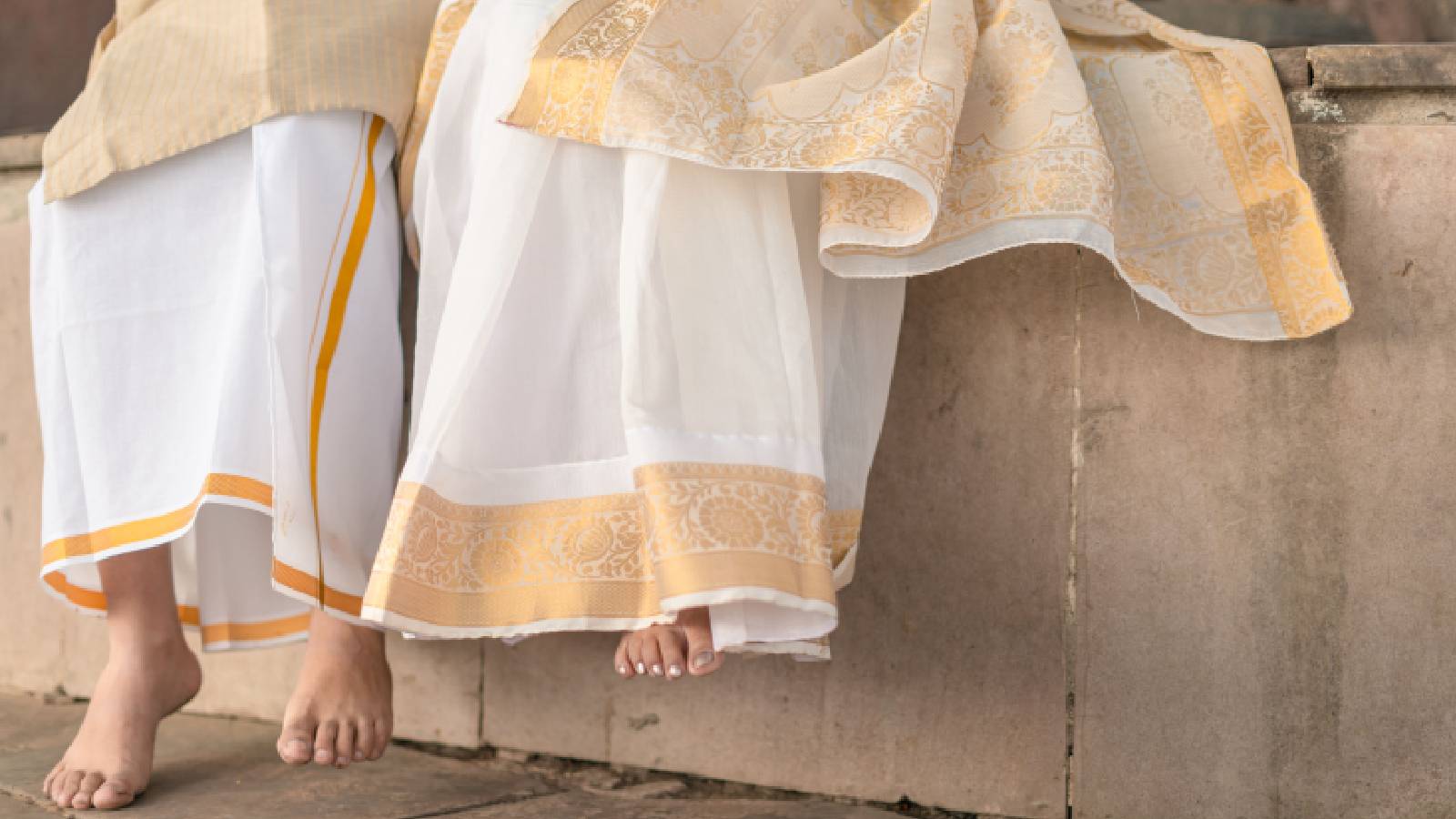


Every year, when it is time to welcome Mahabali, Kerala suddenly turns white and gold.
From kasavu sarees and set mundus to kurtas and shirts, the festive wardrobe glows with a familiar golden border. Fashion has evolved and shapeshifted over generations, but Kerala's kasavu has remained remarkably constant.
It has become the face of Kerala's celebrations, almost as recognisable as the pookkalam and the Onam sadya.
But why white and gold? And when did these colours become so closely associated with Onam?
The Onakkodi story
Onakkodi refers to the new clothes traditionally bought or gifted during Onam. It is an age-old custom associated with celebration, prosperity and renewal as families prepare to welcome their beloved King Mahabali.
Buying new clothes for family members remains an important part of the festival. Parents buy clothes for their children, families exchange gifts and relatives choose traditional Kerala garments for one another.
It is, in its simplest form, a way of saying: it is time for a new beginning.
Behind the white and gold
Kasavu, Kerala's traditional textile, provides much of the answer.
The classic Kerala saree, settu mundu and mundu are traditionally characterised by an off-white or cream body and a contrasting golden border. Today, variations have expanded beyond the classic cotton weave, including fabrics with metallic gold bodies, popularly known as tissue.
While festive fashion in many parts of India is often associated with vibrant colours, Kerala's traditional aesthetic has long favoured something more restrained, the natural white or cream set against the warm sheen of gold.
And there is a practical reason for the appeal too. Traditional cotton garments are light and comfortable, making them particularly suited to Kerala's warm and humid climate.
Yet somehow, this minimal palette became the main character of Onam fashion.
...and the all rounder Gold
Gold has always occupied a special place in Indian life, particularly in celebrations. It is associated with wealth, prosperity and auspiciousness.
Onam celebrates the return of Mahabali, whose legendary reign is remembered as a time of abundance, equality and happiness. The golden border of the traditional Kerala garment therefore sits naturally within the visual language of the festival.
But the story is not as simple as saying white means purity and gold means prosperity.
The visual identity of Onam has evolved over generations through Kerala's textile traditions, social customs and collective memory. The white-and-gold combination became familiar not because Onam came with a prescribed colour code, but because Malayalis gradually made it their own.
And they loved it.
The Onakkodi is changing
The traditional white-and-gold look remains classic, but Onakkodi is changing with the times.
Contemporary Kerala-inspired designs, colourful sarees, shirts, kurtas, dresses and fusion wear have all entered the Onam wardrobe. Floral prints and motifs inspired by the festival have become increasingly popular too.
Yet, when Onam arrives, many Malayalis still search for that familiar kasavu.
Because trends may come and go. The classic remains.
Not just a new dress
Onakkodi is not just clothing. It is not merely fashion.
It is about renewal, giving and togetherness.
A new saree bought for a mother, a mundu chosen for a father, a little dress bought for a child, these gestures are part of the ritual of giving that makes Onam a family celebration.
And perhaps that is why, every year, Kerala turns white and gold again.
Not because Onam comes with terms and conditions, but because it comes with nostalgia, with the warmth of an old story that generations of Malayalis grew up hearing, and the familiar feeling of coming home.