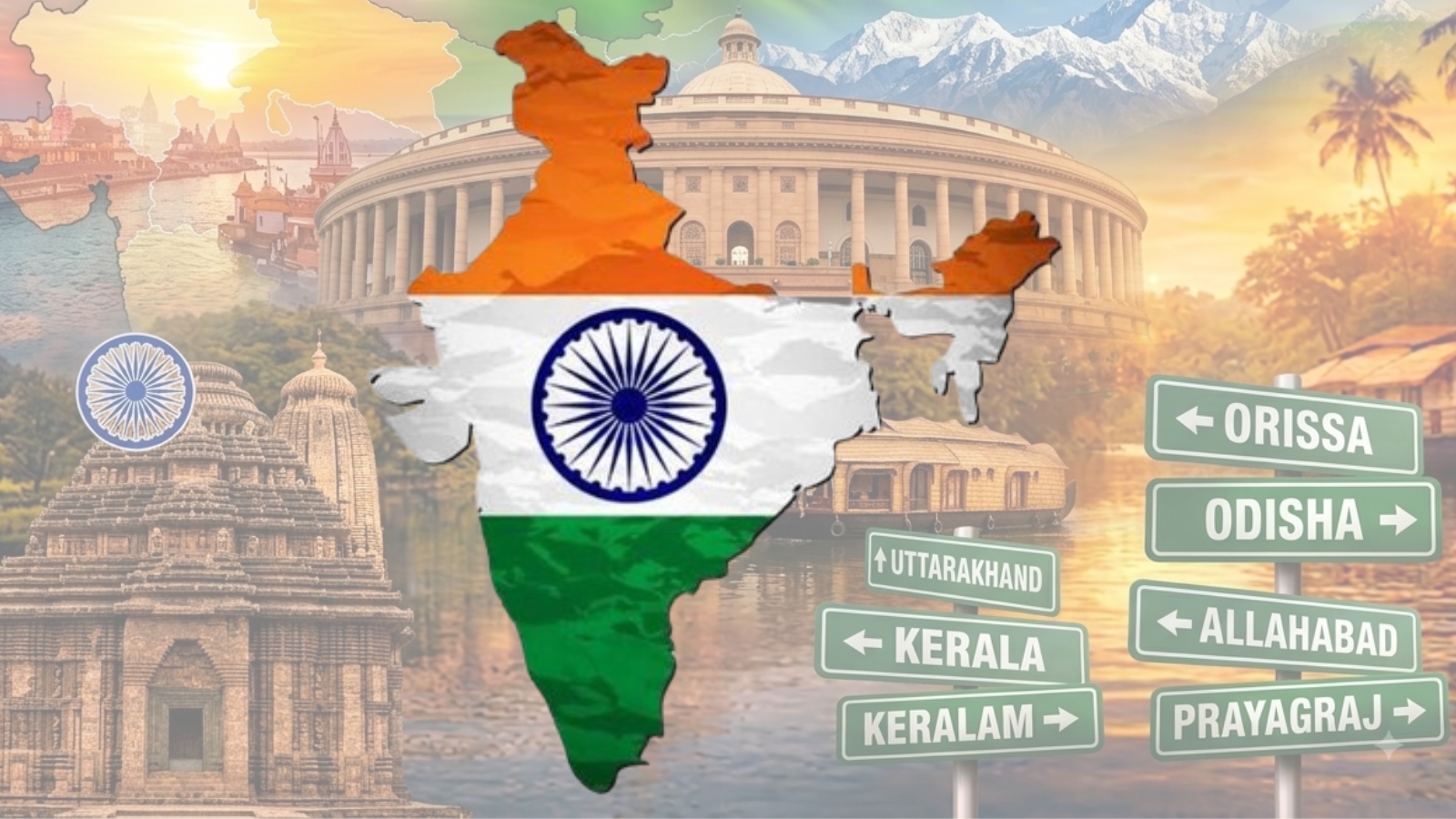


A place name can be more than a geographical marker, often reflecting a region’s language, history, cultural identity and, at times, its political past.
Hence, India's map has changed names many times since Independence.
Orissa became Odisha, Uttranchal became Uttarakhand, Mysore became Karnataka, Madras State became Tamil Nadu, Bombay became Mumbai, Bangalore became Bengaluru and Allahabad became Prayagraj.
The proposed change from Kerala to Keralam is the latest state-level move in this long history of renaming places in India.
The process to change a state or city’s name officially goes through several processes.
A state's name is part of India's constitutional framework and therefore requires Parliament. A city's name is generally dealt with through an administrative process involving the state government and the Union Ministry of Home Affairs.

HOW ARE INDIAN STATES RENAMED?
The Constitution has a specific provision for changing the name of a state.
Article 3 gives Parliament the power to alter the name, area or boundaries of an existing state.
This means a state cannot simply issue a government order and declare itself renamed. Parliament must ultimately pass a law.
1. The State sets the process in motion
A state government or Legislative Assembly may first pass a resolution asking the Union Government to change the state's name (as seen with Kerala, Karnataka, and Tamil Nadu). A proposal can also be initiated in Parliament, but where a state legislature makes the request, the resolution provides the starting point for the process.
The state government then formally forwards this resolution to the Union Ministry of Home Affairs (MHA).
2. The President refers the proposal to the state legislature
The Union Cabinet reviews the proposal and, if approved, recommends it to the President.
The President refers the proposal back to the concerned state legislature and asks it to express its views within a specified period. The President has the discretion to extend this time limit if necessary.
The state legislature can support, oppose or otherwise comment on the proposal. But its opinion does not amount to an absolute veto.
3. Parliamentary deliberation and passage
Once the state's views are received (or the time limit expires), the bill proceeds to Parliament. The bill is introduced in either House of Parliament (Lok Sabha or Rajya Sabha).
The bill is treated as ordinary legislation and requires only a simple majority (more than 50% of members present and voting) in both Houses to pass. Unlike a constitutional amendment under Article 368, an Article 3 Bill requires only a simple majority of members present and voting.
4. Presidential assent and implementation
After passing both Houses, the bill is sent to the President for final approval. The President signs the bill, converting it into an Act of Parliament. The First Schedule of the Constitution (which lists states and territories) is automatically amended to reflect the new name.
The new name then takes effect from the date specified in the legislation. The change can subsequently be reflected in constitutional and official records.
Also Read:

How are cities renamed?
Since independence, over 100 cities and towns have been renamed, primarily to shed colonial or Mughal-era names in favor of indigenous or historical ones.
Cities in India are renamed through an administrative process governed by 1953 Central Government guidelines, rather than a constitutional amendment like state renaming.
There is no Article 3 equivalent specifically governing city renamings.
Unlike a state name change, Parliament does not generally have to pass a separate law every time a city is renamed.
A city or town is generally renamed through an administrative process involving the state government and the Union Ministry of Home Affairs.
1. State-level initiation
A proposal may begin with the state government, local authority or state legislature, depending on the circumstances and applicable state laws.
A resolution is moved in the State Legislative Assembly (Vidhan Sabha) by an MLA or the state government proposing the name change. The resolution is debated in the assembly and put to a vote. It requires a simple majority (more than 50% of members present and voting) to pass.
Once passed, the State Government formally sends the proposal to the Ministry of Home Affairs (MHA) in New Delhi
2. Central scrutiny and NOCs
The MHA scrutinizes the proposal to prevent administrative confusion, such as duplicate names in postal or railway records.
The MHA seeks No Objection Certificates (NOCs) from at least five key central agencies:
- Ministry of Railways: To ensure no duplicate station names exist.
- Department of Posts: To verify no postal conflicts arise.
- Survey of India: To check geographical records and maps.
- Registrar General of India: To review census and demographic data.
- Intelligence Bureau (IB) or Ministry of External Affairs: For security or diplomatic sensitivity checks.
Proposals are often rejected if the new name sounds too similar to an existing city, a foreign country, or could cause logistical chaos.
3. Final approval and notification
Executive order: Once all NOCs are secured, the MHA issues formal approval. The MHA passes an executive order approving the renaming.
Gazette notification: The name change is published in the Gazette of India and the respective State Gazette.
Implementation: The administrative work then begins.
Railway boards may need changing. Government websites have to be updated. Municipal records, maps, databases, forms and official documents have to adopt the new name.
For a major city, that can mean changing thousands of references to the old name.
Also Read:
What does renaming actually cost?
There is no fixed national price tag for renaming a state or city.
The cost depends on the size of the place and how deeply its old name is embedded in government systems, physical infrastructure and private databases.
For a state, expenses can include:
- Government signboards and buildings
- Road and highway signage
- Railway and transport references
- Official stationery and seals
- Government websites and databases
- Land and property records
- Vehicle and municipal records
- Maps and geographical databases
- Other state and central government records
Banks, insurance companies, businesses, educational institutions and other organisations may also have to update their own records, websites, contracts and stationery.
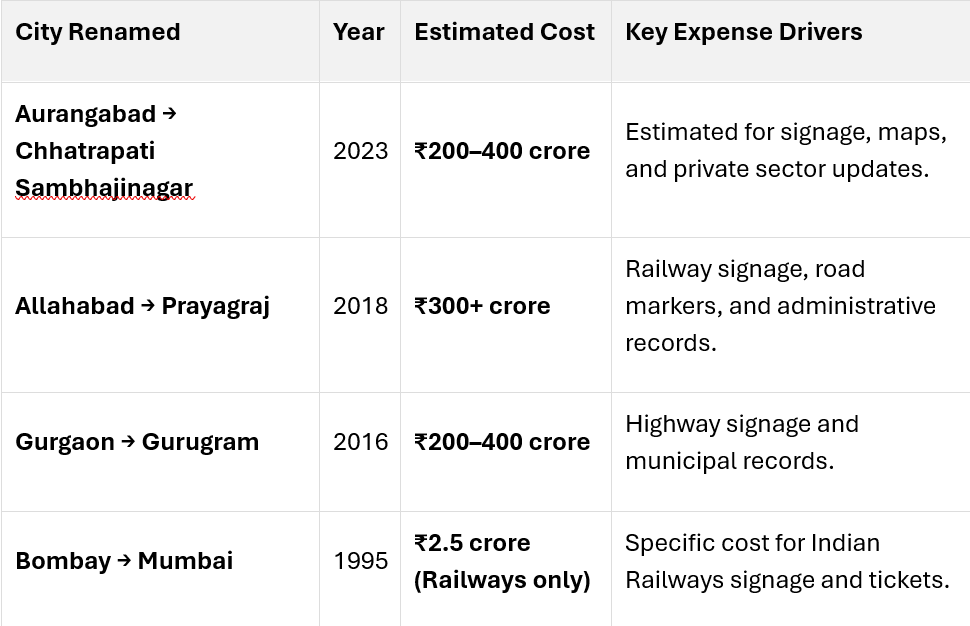
How much does renaming costs?
There is no universally accepted formula for calculating the cost.
One historical reference point is the Uttaranchal to Uttarakhand name change. During parliamentary discussions in 2006, an estimated cost of around ₹400–500 crore was cited for the exercise. That estimate is nearly two decades old and should not be treated as a current benchmark.
For Kerala, a 2026 estimate put the potential cost of changing the name at around ₹920 crore, calculated using a private-sector rebranding formula known as the “Olivier Formula”.
The actual cost will depend on what needs to be changed, how quickly it is done and which government department or organisation bears the expense.
Who pays for a name change?
There isn't one single bill.
The state government bears much of the cost of updating its own infrastructure, records, websites, documents and signage.
The Union Government incurs costs when central agencies such as Railways, Posts or Survey of India have to update their systems.
Local governments have to change municipal records, signs and databases.
And private institutions — including banks, businesses and insurance companies — bear the cost of updating their own systems.
So the cost of renaming a place is not simply the price of replacing a signboard. It is the cost of getting an entire administrative ecosystem to recognise a new name.
In the end, changing a name may take only a few words in a law or notification.
Making an entire country use that new name is a much bigger journey.