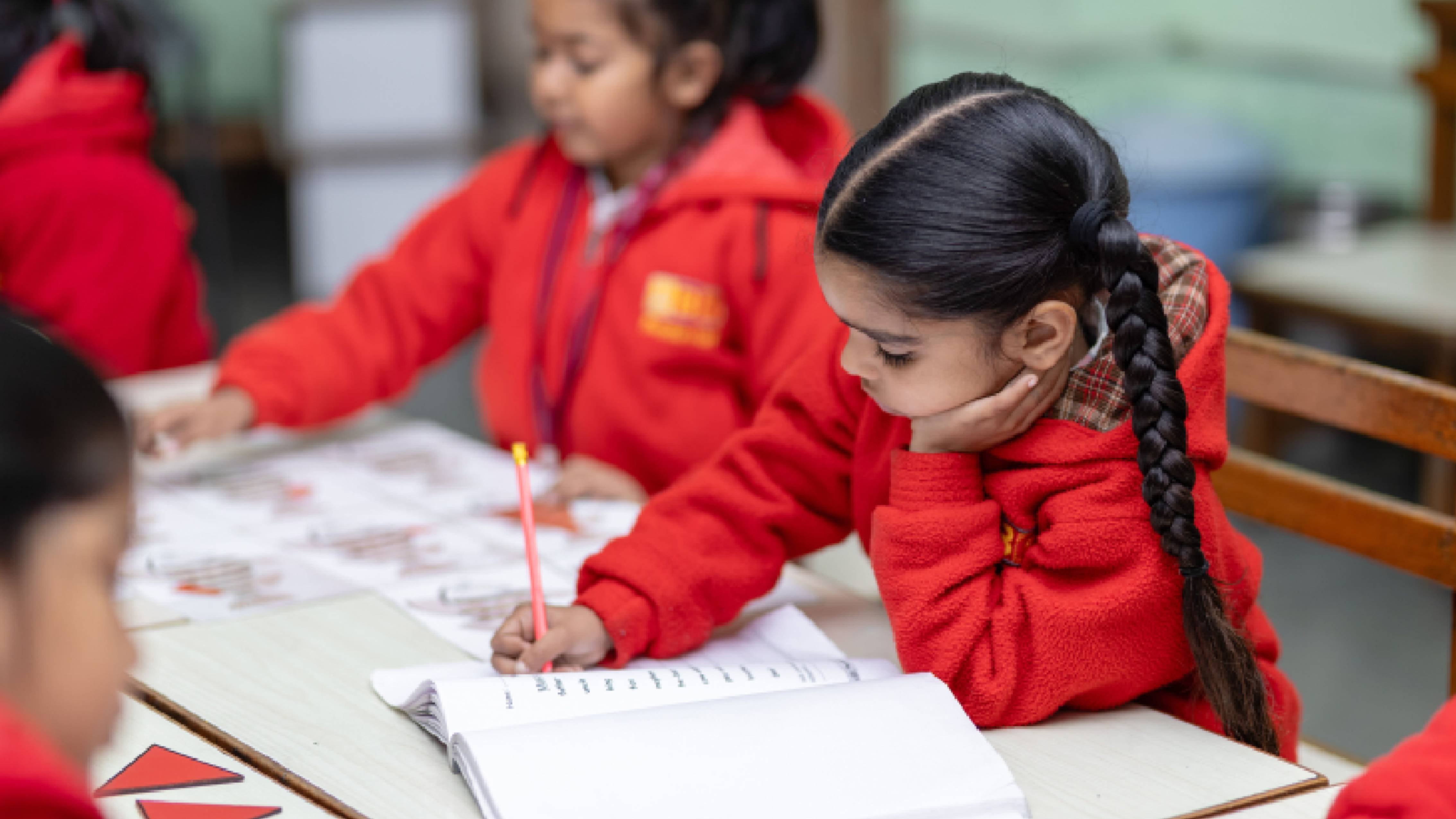


New Delhi: Observing that children should not come under any kind of pressure, the Supreme Court on Thursday stressed the need to find a solution to issues arising out of the CBSE policy mandating the study of three languages by Class nine students.
A bench of Chief Justice of India (CJI) Surya Kant and Justices Joymalya Bagchi and V Mohana observed there was nothing wrong in introducing the policy but the only concern raised by the petitioners was about the manner in which it was being introduced.
"Some of these problems, you may revisit. There is no doubt that sooner or later, it has to be introduced. There is nothing wrong with that. But how it is to be streamlined so that whatever impediments or blockades are coming up, you may find a solution to those," the bench told Additional Solicitor General Aishwarya Bhati.
The bench said one of the aspects that was required to be considered was how to build adequate human resource infrastructure with regard to the language options available.
"If you have chosen Class 6 as the starting point, you may consider giving a reprieve to Class six students of this year. You can introduce it from next year," it said.
"Another thing which needs to be looked into is where do you draw the line. Whether it is Class six, Class four or Class three. You can take a call depending on the curriculum and where the choice between two and three languages is first introduced," the bench said.
It said one of the concerns was whether we consider English a native language or a foreign language.
"As the Union of India, you will also have to see that other than the CBSE, what is happening in other boards," the bench told Bhati, adding that it has to be ensured that the roll-out of the policy is appropriately undertaken.
Bhati said she would take instructions on the suggestions and get back to the court.
"We don't want the children to come under any pressure," the CJI said.
The top court was hearing a batch of pleas challenging the CBSE's policy mandating the study of three languages, including two native Indian languages, for Class IX students from July 1.
At the outset, senior advocate Anand Grover, appearing for some of the petitioners, told the bench that the issue relates to three languages and they were concerned with Class VI.
He said for Classes VI to VIII, the CBSE has no jurisdiction or authority to frame the curriculum as this has to be done by the NCERT.
The CJI observed that learning any language is a big asset and something invaluable.
Grover said there have to be qualified teachers for this.
"If they are introducing a language, they will also have plan for teachers. It is their obligation," the bench observed, adding, it will take the schools to task if they are erring.
The bench observed that the CBSE has given options of 23 languages.
"Let us not have any impression of inferiority complex with respect to regional languages. We should respect all these languages as much as any other language," it said.
The bench said whenever a new concept is introduced, it is natural to have some apprehensions.
"We can constitute an expert committee ourselves or ask the government to constitute an expert committee so that as and when the difficulties arise, they can make recommendations and find solutions," it said.
Bhati said, "We want to support our children in the best possible manner".
She said thousands of experts were consulted in the process.
"The CBSE is one of of the boards in the country. There are 33,000 odd schools out of a total 7.5 lakh schools. Around 4.45 percent schools are CBSE schools in India and 99.19 schools are already compliant of the two native languages," she said, adding, "Language is a vehicle of a culture".
Justice Bagchi observed he personally had a serious reservation about the expression "native".
"It has a colonial connotation. It should be indigenous," he said, adding that framers of the policy should have been conscious of the words they have used.
It posted the matter for further hearing after 10 days.
Supreme Court agrees to examine plea challenging three-language policy
On May 27, the top court had agreed to examine a plea challenging the policy and issued notices to India government, the CBSE and the NCERT seeking their responses.
According to a circular issued by the Central Board of Secondary Education (CBSE), the study of three languages, including at least two native Indian languages, has been made compulsory for Class IX students beginning July 1.
The move is part of the CBSE's alignment of its scheme of studies with the National Education Policy (NEP) 2020 and the National Curriculum Framework for School Education (NCF-SE), 2023.
According to the circular issued on May 15, students opting for a foreign language may do so only as the third language after studying two native Indian languages, or as an additional fourth language.
"With effect from July 1, 2026, for Class IX, the study of three languages (R1, R2, R3) shall be compulsory, with at least two languages being native Indian languages," the circular said.
The board said till the dedicated R3 textbooks are available, Class IX students shall use the Class 6 R3 textbooks (2026-27 edition) of the chosen language.
The CBSE said to keep the focus on learning and reduce any undue pressure on students, no board examination shall be conducted for R3 at the Class X level.
The board also asked schools to update their R3 language offerings for Classes VI to IX on the OASIS portal by June 30.