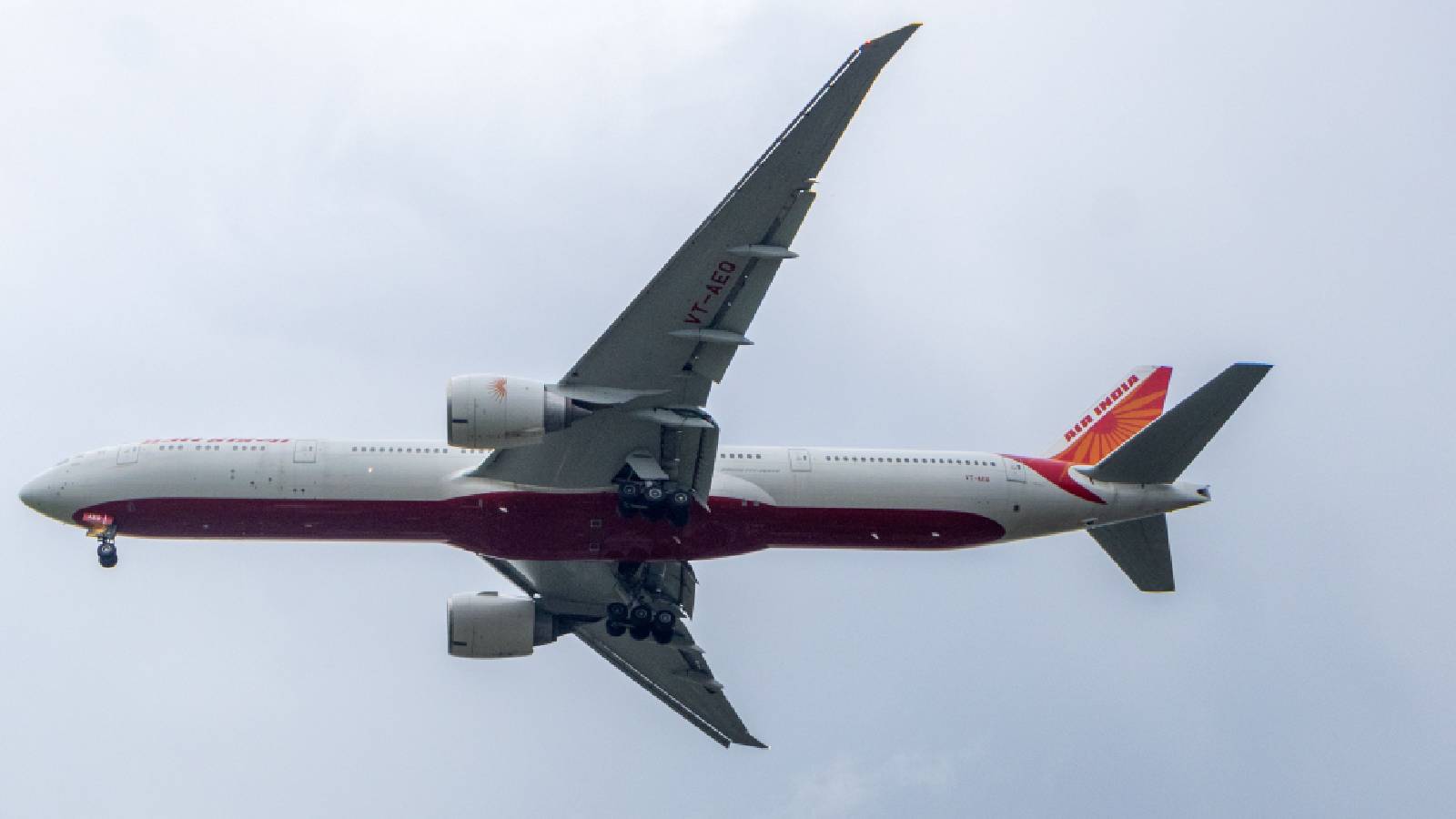


New Delhi: Hours after the Aircraft Accident Investigation Bureau (AAIB) released its preliminary report on an Air India Phuket-Delhi flight that encountered turbulence en route to Delhi, the airline terminated the pilot-in-command (PIC) after he tested non-negative for a psychoactive substance.
In a statement issued on Friday, Air India said it took the action in line with its zero-tolerance approach to violations of safety, fitness or regulatory requirements.
“In line with Air India's zero-tolerance approach to violation of safety, fitness or regulatory requirements, the pilot's employment has been terminated with immediate effect,” the airline said.
According to the AAIB report, both flight crew members were subjected to psychoactive substance detection tests. The sample of the pilot-in-command was found to be non-negative. Subsequently, blood samples of both crew members were sent to a pathological laboratory for confirmatory testing. The confirmatory test report of the pilot-in-command was also found to be non-negative, while the co-pilot's sample was found to be negative in both tests.
Also Read:
The report stated that a detailed investigation into the technical and other aspects of the incident was underway. “In this case, it has been observed that the PIC was found non-negative for psycho-active substance in the confirmatory test,” the AAIB said.
The AAIB said the confirmation of the use of psychoactive substances was a serious concern and recommended that the Directorate General of Civil Aviation (DGCA) take appropriate action on priority. It added that the investigation was in progress and the final report would be published in due course.
Acknowledging the report, Air India extended its full cooperation with the investigation, including providing access to all relevant operational, maintenance and technical records. In a social media post, the airline said its pilots undergo rigorous training, regular proficiency checks, medical examinations and other regulatory assessments in accordance with applicable national and international requirements.
Following the incident, Air India has started voluntary testing of all its pilots as a further step to reinforce its safety-first approach. The airline said safety remained its highest priority and that it maintained zero tolerance for any breach of safety, fitness or regulatory requirements. It added that appropriate action would be taken wherever warranted.
The incident
On August 4, 2026, while cruising at Flight Level 360 (FL360) in the Kolkata FIR at 04:02 UTC (09:32 IST), the aircraft experienced a sudden, sequential failure of its primary system. The Co-Pilot, who was the Pilot Flying (PF), initially responded before the PIC took over control. During the upset, the aircraft gained 372 feet before dropping 292 feet from FL360.
Because the seat-belt sign was switched OFF at the time of the sudden altitude fluctuation, 24 individuals (20 passengers and 4 cabin crew members) received medical attention upon arrival.
20 individuals were discharged after receiving initial treatment for minor injuries, while 4 people were hospitalised with serious injuries, added the report.
The cabin sustained significant non-structural damage, including cracked or dislodged overhead stowage bins (hatracks), dislocated ceiling panels, broken handrails, damaged Passenger Service Units (PSUs), an uprooted lavatory commode, and damaged crew seats. No overall airframe structural damage was reported.
Because the flight originated from outside India, both flight crew members were subjected to mandatory post-flight medical screening upon arrival at Delhi airport under Para 4.2.3 of DGCA CAR Section 5, Series F Part III.
Both crew members passed the post-flight Breath-Analyser examination for alcohol. Initial screening using a psychoactive substance detection kit returned a non-negative result for the PIC, while the Co-Pilot tested negative, the report added.
(This copy is compiled by Ranju Raj)