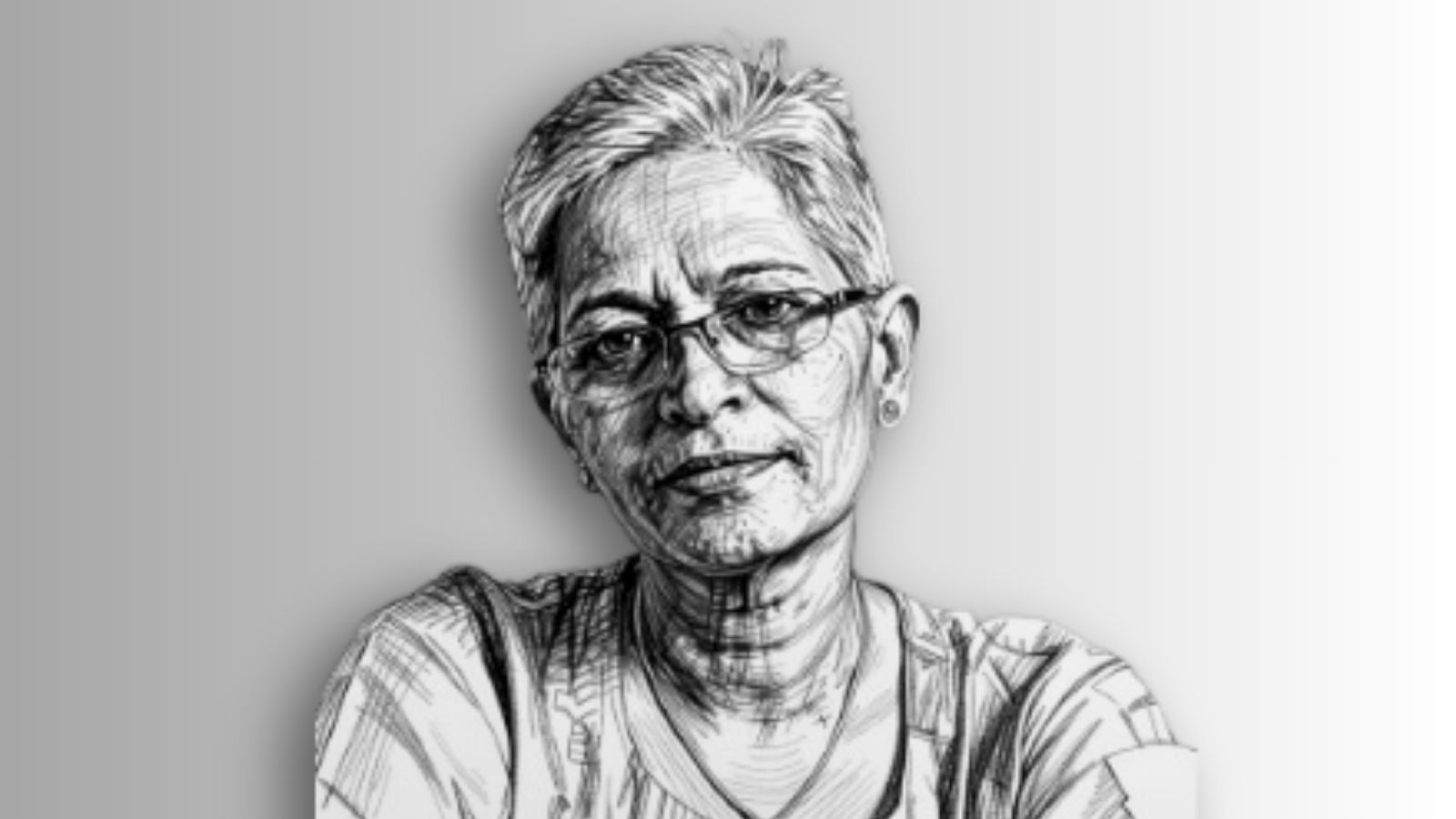


On September 5, 2017, journalist Gauri Lankesh was shot dead outside her home in Bengaluru. She was 55.
She had returned from her office that evening and was approaching her front door when a motorcycle pulled in behind her. She was shot in her own driveway.
It's been nine years since that fateful day, but there is still no verdict.
The Gauri Lankesh murder trial began only on 4 July 2022, almost five years after her killing. The chargesheet ran to 9,235 pages and named 18 accused. The case is still before the courts; nobody has been convicted, and nobody has been acquitted.
That is why this story is also about what happens after such a heinous crime is carried out — how a state investigates a killing, how a prosecution builds its case, what a court can establish and what remains unresolved when years pass without a verdict.
Who was Gauri Lankesh?
Before she became a symbol, Gauri Lankesh was a working editor.
She came from a journalism family. Her father, P Lankesh, was a poet and writer who founded the Kannada weekly Lankesh Patrike in 1980. The publication refused advertisements and relied on subscriptions.
Gauri did not begin her career in Kannada journalism. She spent around 16 years in English-language newsrooms, including The Times of India in Bengaluru, Mid-Day, Sunday magazine and Eenadu's Telugu channel.
After her father died in 2000, she and her siblings initially considered shutting the paper down. Instead, she took over as editor.
In 2005, a disagreement over the paper's approach to the Naxal question led to a split with her brother Indrajit. Gauri subsequently started her own weekly, Gauri Lankesh Patrike, carrying forward her father's no-advertisement model.
That is a crucial point because she was not simply a columnist commenting from a distance. She ran a newspaper. She made editorial decisions. She published articles that angered people.
Her weekly was sharply critical of Hindutva politics and communal violence. She wrote about caste and the Manusmriti, women's rights, and far-right groups. She wrote against hate speech and communal mobilisation, and often named the people and organisations she criticised.
In 2003, she campaigned against attempts by Sangh Parivar organisations to change the character of Baba Budan Giri, a shrine in Karnataka associated with both Hindu and Sufi traditions. She also worked on communal harmony through the Komu Souharda Vedike.
Lankesh was involved in efforts to bring Naxalites back into the mainstream, including negotiations with the state on surrender and rehabilitation. Critics used that work to describe her as a Naxal sympathiser. Her stated position was that people involved in armed struggle should be brought back into ordinary society.
That distinction became part of the political argument around her death. It also makes her difficult to place in a single political category. She had ideological opponents outside her circle and disagreements within it.
After her death, she was awarded the Anna Politkovskaya Award, named after the Russian journalist who was murdered for her reporting.
What does the prosecution allege?
The first significant arrest came in March 2018, when KT Naveen Kumar, described by investigators as an activist of the Hindu Yuva Sene, was taken into custody.
Later that year, the Special Investigation Team (SIT) filed an additional chargesheet running to 9,235 pages and naming 18 accused. The charges included murder and criminal conspiracy, along with provisions of the Karnataka Control of Organised Crime Act and the Arms Act.
The SIT alleged that an organised network with links to Sanatan Sanstha and associated organisations carried out the killing. Investigators alleged that the network had armed, trained and directed people to carry out targeted killings, and that Lankesh was selected because of her writings and public positions.
The SIT identified Parashuram Waghmore as the alleged shooter, with Ganesh Miskin allegedly accompanying him on the motorcycle.
The chargesheet also referred to a diary attributed to Amol Kale, which the SIT said contained the names of writers, activists and others identified as targets. We will come to that hit list later in this article.
These remain prosecution allegations, not findings by a court.
Sanatan Sanstha has denied involvement. Its spokesperson, Chetan Rajhans, said the organisation had been falsely implicated and was ready to cooperate with the investigation.
Nine years too long
The trial began on 4 July 2022, before a special court hearing cases under the Karnataka Control of Organised Crime Act (KCOCA).
Reports have described hearings taking place roughly one week every month. By June this year, the case had reached its seventh presiding judge.
A prosecution can file thousands of pages, name any number of accused and present a detailed theory of a conspiracy; but none of that amounts to a conviction.
The court still has to examine the evidence. Witnesses have to testify. The defence has to test the prosecution's case. And the court has to decide what has been proved beyond reasonable doubt. That remains an unfinished process in Lankesh's case.
The Committee to Protect Journalists has called on the Karnataka government to establish a fast-track court to conclude the trial.
And Lankesh is not the only case that raises the question of how long justice can take.
Four killings and hit list
When we discuss Gauri Lankesh, there are a few other names that have to be brought up in the same record.
- Narendra Dabholkar was shot dead in Pune in August 2013. He was 67 and had spent years campaigning against superstition.
- Govind Pansare was shot in Kolhapur in February 2015 alongside his wife, Uma. He died four days later. He was 82, a Communist leader, trade unionist, and rationalist.
- MM Kalburgi was shot at the door of his home in Dharwad in August 2015. He was 77, a scholar and former vice-chancellor of Kannada University, Hampi. Kalburgi had received threats after his remarks on idol worship. Police had posted armed guards at his house, but he later asked for them to be withdrawn.
Then, two years later, came Gauri Lankesh.
Four people. Four cities. Four killings between 2013 and 2017. Investigators found connections between the cases. Ballistic evidence was reported to link the murders. Several accused appeared in more than one investigation. Amol Kale, Amit Digwekar and Rajesh Bangera were named in both the Dabholkar and Lankesh investigations, with Bangera alleged to have provided firearms training.
In December 2018, the Supreme Court of India asked whether there was a common thread running through the cases and suggested that, if one existed, there could be reason to bring the investigations under a single agency.
The Kalburgi investigation was later transferred to the same SIT handling the Lankesh case. A special court in Kolhapur has also described the four murders as interconnected.
But an investigative connection is not the same as a judicial finding of a common conspiracy. No court has delivered a comprehensive verdict covering all four killings. The legal record is therefore more complicated.
In the Dabholkar case, a special court in Pune convicted Sachin Andure and Sharad Kalaskar in May 2024 for murder and conspiracy and sentenced them to life imprisonment. It acquitted three others, including Dr Virendrasinh Tawde, whom the prosecution had described as the mastermind, for lack of evidence. The court did not convict anyone of terrorist acts under the Unlawful Activities Prevention Act (UAPA).
Dabholkar's daughter, Mukta, has appealed against those acquittals, arguing that the murder was part of a larger conspiracy.
The two convictions have also not reached their final legal conclusion. In April this year, the Bombay High Court granted bail to Sharad Kalaskar and suspended his life sentence pending appeal. On August 18, 2026, it did the same for Sachin Andure.
Both men convicted in the Dabholkar case are now out on bail.
In the Pansare case, there is still no verdict. The Bombay High Court has granted bail to Tawde and two other accused.
There are no verdicts yet in the Kalburgi case and the Lankesh case.
Twelve years after the first of these killings, that is the accountability record.
Then there is the diary the SIT recovered from Amol Kale. According to the investigation team, it was a list of who was to come next.
The chargesheet says it named around thirty-five people, whom the group allegedly addressed as durjan (evil people).
Gauri Lankesh's last post on her Facebook wall on the day of her assassination.
Gauri Lankesh's name was on that list as the second one. The name at the top was Girish Karnad.
According to SIT officials, the group had surveyed Karnad's house to track his movements. They had planned to kill him a year before Lankesh, then deferred, and turned to her instead. Karnad died in June 2019, of illness. He was never attacked. He spent his last year knowing his name had been on that list.
There is a detail about how he learned it. The SIT made the hit list public on September 5, 2018, the first anniversary of Gauri's murder. Karnad attended the memorial that day wearing a placard around his neck. It read: "Me Too Urban Naxal."
The others allegedly named included the Kannada writer and translator KS Bhagawan in Mysuru, four men were arrested while allegedly planning to kill him. The rationalist Narendra Nayak in Mangaluru, who the SIT says was under surveillance in 2016. The pontiff Veerabhadra Channamalla Swamy of the Nidumamidi Mutt. The rationalist CS Dwarakanath. The writer and politician BT Lalitha Naik. The former MP and journalist Kumar Ketkar. The Konkani novelist Damodar Mauzo, who won the Jnanpith Award in 2022. The journalist Nikhil Wagle. And the Pune poet Ganesh Vispute, who was given police protection in 2018.
All of this remains the prosecution's case. None of it has been tested to a conclusion in court, which means something specific for the people whose names were in that diary. They have spent nine years knowing they were on a list, and waiting for a court to determine whether that list meant what the prosecution says it meant.
The part that complicates the story
There is something in this story that is easy to leave out. In the weeks after the murder, Lankesh's family asked investigators to examine every possible angle, including reports of her possible Naxal connection. They appealed to politicians not to give the killing a political colour and said they wanted justice rather than political exploitation.
There was another striking moment early in the investigation. Within a month of the murder, Karnataka's then home minister Ramalinga Reddy said the SIT had identified the killers but declined to provide details, saying investigators needed to gather evidence that would stand up in court.
The point is not that the government knew who the killers were and did nothing. The available record does not establish that. The point is, nine years ago, the state said the investigation had made progress, yet nine years later, the court is still hearing prosecution witnesses.
What nine years cost
Cases like this are not only discussed through the question, "who did it?" A different question runs underneath it. For Lankesh's family, these nine years are nine years without a final answer. For the accused, who remain accused, it is nine years under the shadow of a murder prosecution. For witnesses, memories fade, and circumstances change.
A justice system is not measured only by whether a case eventually reaches court. It is also measured by whether the process can carry a case to its conclusion once it gets there.
The article she never saw published
On the day she was killed, Lankesh arrived late at her office, the ground floor of a building on a residential street. She reviewed the coming issue of her weekly and put the finishing touches on her editorial, which she always wrote last.
The article was published after her death. Its final line reads:
I want to salute all those who expose fake news. I wish there were more of them.
Gauri Lankesh
More than five years later, the Paris-based network Forbidden Stories took up her unfinished work. It assembled more than 100 journalists from 30 outlets to investigate the global market in disinformation and named the project after the story she never got to see in print.
The last thing Gauri Lankesh wrote was about how lies travel, who spreads them and what it costs a society when they go unchallenged.
Nine years
Gauri Lankesh was killed nine years ago. The state investigated. A chargesheet was filed. The prosecution presented its case. The defence has contested it. The trial began. And nine years later, the legal question remains open. And that should concern us as a democracy. Because a democracy asks its people to trust its justice system, and nine years is a long time to wait for justice to be served.
(In Makes Sense, Sajesh Mohan explores the politics, ideas and cultural forces that shape the stories and conversations around us — from public affairs to popular culture.)