

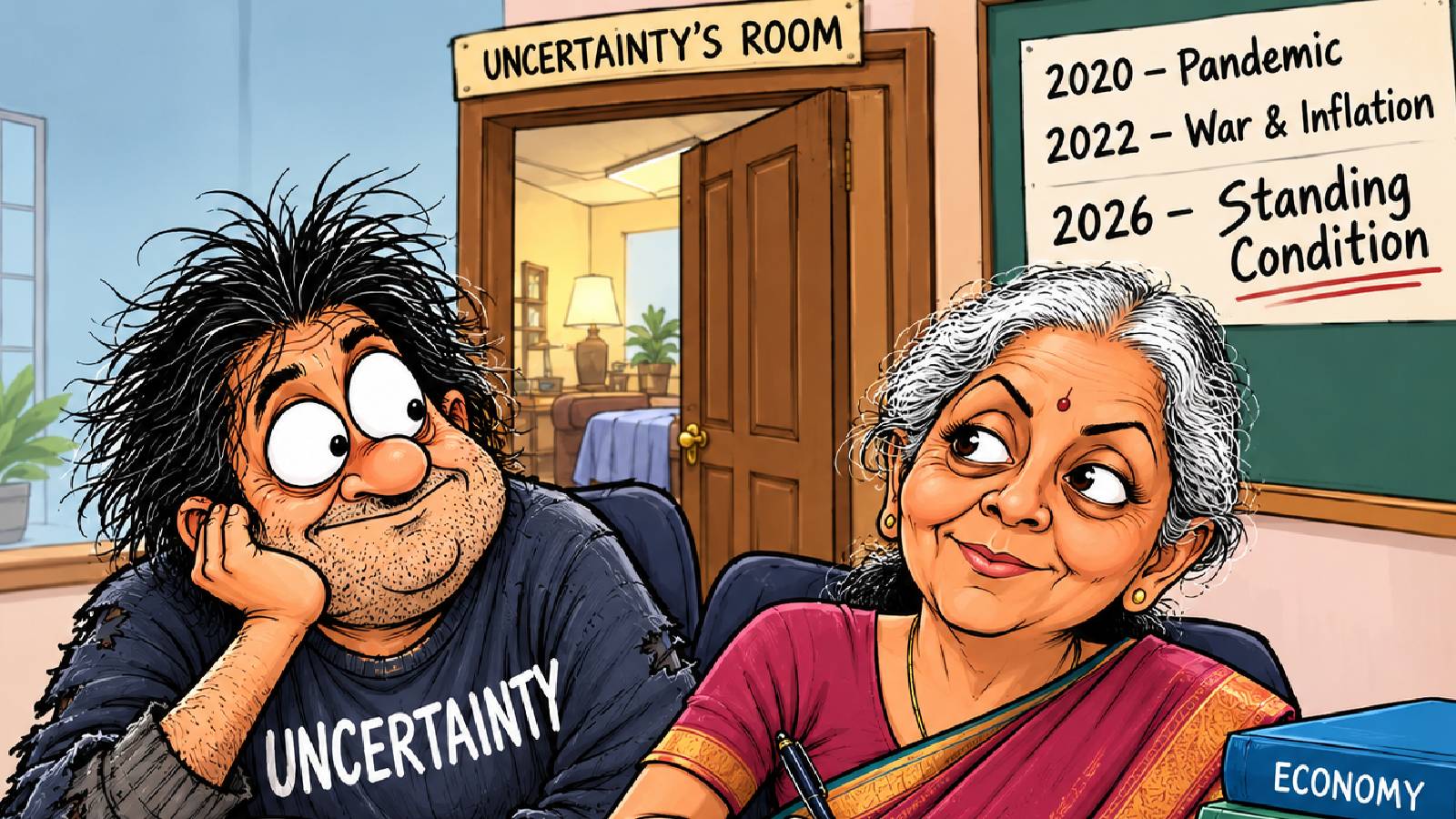


“Uncertainty is now a standing condition of the global economy, and policy must be designed around it.”
— FM Nirmala Sitharaman
Translation
What happens when economic volatility stops being an anomaly and becomes the norm?
And it has given ‘Nirmala Tai’ something new to discuss: ‘Uncertainty’.
Lakshmi, a student of 5B, and Mr. Abid, who is about to lose his job, have the same thing to discuss: ‘Uncertainty’.
There was a time when uncertainty in the global economy was a problem that occurred once in a blue moon. But the gaps between one uncertainty and the other are receding.
Things got bad. Then worse. And uncertainty started looking more permanent and less temporary.
We heard the warnings from our leaders multiple times. According to them, it is a ‘standing condition’.
Which is an interesting promotion for ‘uncertainty’.
All the blame is on the global economy and the geopolitical crisis. Uncertainty is now like that distant uncle who came for two days and has now been living in the house for six years.
Don’t ask me why nobody is asking the uncle to leave.
According to the legends, they are now a family.
And uncertainty is the ‘new normal’. Now master the art of coexisting.
But what does this uncertainty actually look like when it leaves the conference hall and enters our lives?
Take 2020.
A pandemic arrived, economies shut down, supply chains froze and nobody quite knew what was happening next. Governments responded with stimulus and relief measures, central banks cut rates and pumped liquidity into economies, and the word “uncertainty” became a regular feature of economic forecasts.
Then came 2022.
Russia invaded Ukraine. Oil prices shot up. Inflation became a problem. The Union Government cut excise duty on petrol and diesel, while the RBI raised interest rates as policymakers tried to contain the shock.
Gold had its own uncertainty story. Prices remained elevated, and the Union Government raised the import duty on gold as pressure mounted on the trade deficit and the rupee.
And then came the arguments.
Was the government doing enough? Should states cut fuel taxes? Was the RBI responding quickly enough?
Economists and former policymakers had their own answers. Former finance minister P Chidambaram questioned the pressure on states to cut fuel taxes, while former RBI governor Duvvuri Subbarao pointed to the limits of monetary policy when the shock was coming from global commodity prices.
In short, the uncertainty of 2022 came with the usual package: war, expensive oil, inflation, policy responses and people wondering what would become expensive next.
And then, somehow, we arrived at 2026.
The vocabulary has changed.
We are no longer simply talking about one war, one oil shock or one supply-chain disruption. Geopolitical tensions, trade disruptions, shifting energy markets and uncertainty over global growth have become recurring features of the economic conversation.
And now Nirmala Tai has given the situation a promotion.
“Uncertainty is now a standing condition of the global economy.”
Standing condition.
Not temporary. Not occasional. Standing.
The distant uncle is no longer visiting. He has apparently got his own room.
The funny thing is that uncertainty is supposed to mean that we don't know what is coming.
Economy: Uncertain.
Uncertainty: Standing.
Nirmala Ji: Taking notes.