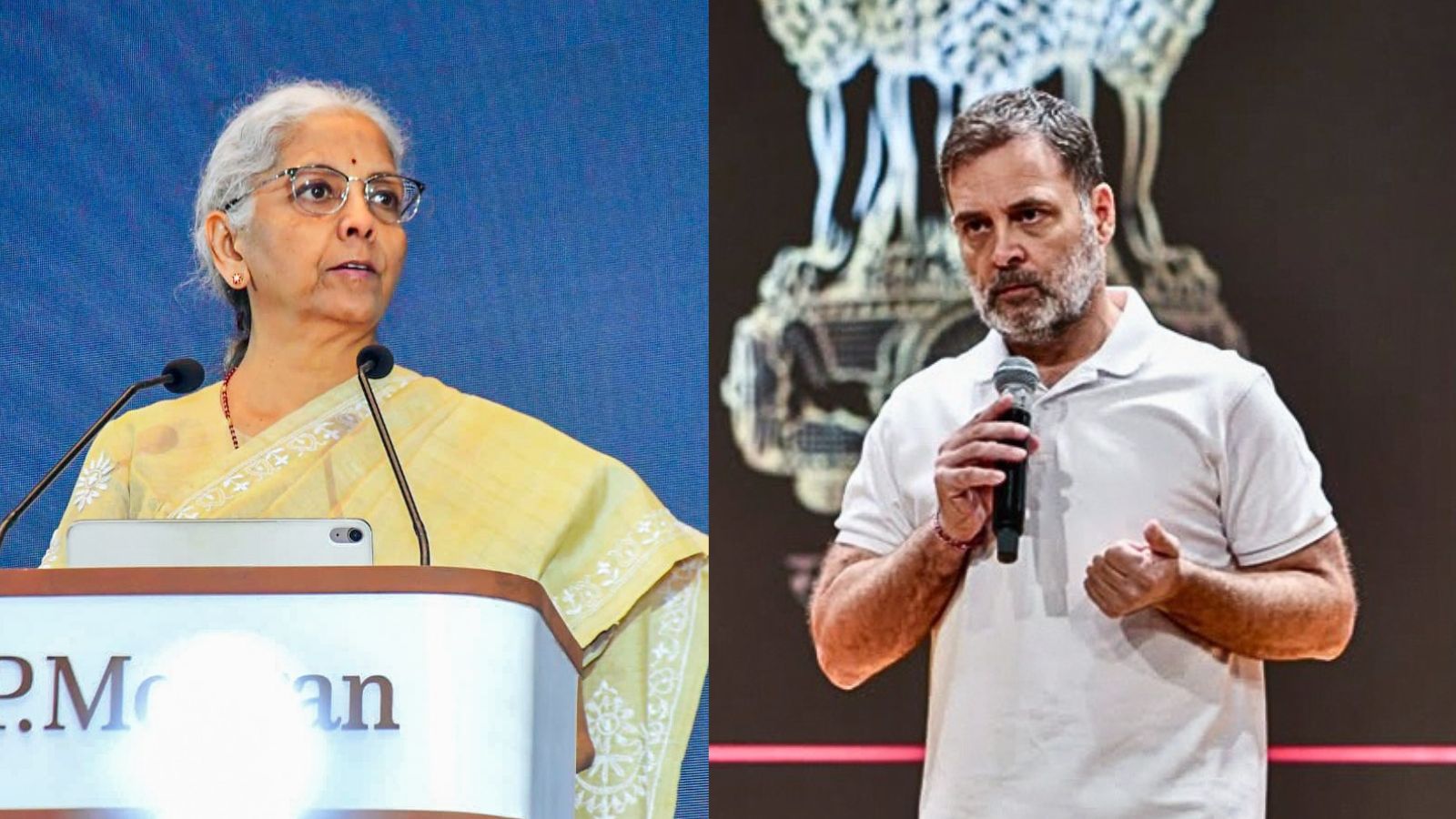


New Delhi: Congress leader Rahul Gandhi and Union Finance Minister Nirmala Sitharaman have traded charges over the proposed sale of a 60.72 per cent stake in IDBI Bank to Canada's Fairfax Financial Holdings, with Gandhi opposing the disinvestment and Sitharaman defending the government's decision.
In a letter addressed to members of the IDBI Bank family, the Leader of Opposition in the Lok Sabha expressed solidarity with the bank's employees and questioned the decision to sell the public sector lender.
Gandhi asserted that public banks are not assets to be sold off but tools to build the nation.
He recalled that a group of IDBI Bank employees had met him at Parliament House in March last year and asked why the government was selling a bank they had helped make profitable.
"I took that question to the Lok Sabha. I asked why a profitable public bank was being sold and how its employees and depositors would be protected. The government gave no reason. Now it has decided to sell IDBI Bank to Fairfax, a Canadian company," Gandhi said.
Also Read:
Noting that IDBI began as a pioneering development bank, he said its transition into a commercial bank had been challenging, but employees had helped turn it around.
"Seven years ago, IDBI was losing money. Last year, it earned a profit of over nine thousand crore rupees. That turnaround is your work," he said.
Gandhi argued that an institution built with public money belonged to the public. The government and the Life Insurance Corporation of India (LIC) currently own a combined 95 per cent stake in the bank. Their shareholding will fall to 34 per cent after the proposed sale, he said in the letter dated 29 October.
He also recalled that the government had promised Parliament in 2003 that it would always retain at least 50 per cent ownership of IDBI.
"That promise may not be written into law, but a promise made to Parliament is a promise made to the people of India," he said.
Gandhi further argued that privatisation would affect employment protections and reservation provisions for Scheduled Castes, Scheduled Tribes and Other Backward Classes.
"When IDBI is privately owned, reservation for SC, ST and OBC candidates will go with it. Your service conditions, already weakened, will lose their last protection. The Congress has always believed in a strong public sector working alongside the private sector. Public banks are not assets to be sold off, they are tools to build the nation," he said.
He pledged support for the employees' demands, urging them to remain united and determined.
In a post on X accompanying the letter, Gandhi said IDBI had been established during Congress rule to support the country's industrial development, while banks were now being sold under the government led by Prime Minister Narendra Modi.
कांग्रेस के समय में IDBI बना - देश का उद्योग खड़ा करने के लिए।मोदी के समय में पहले बोली देखी गई, फिर दाम तय हुआ।कांग्रेस के time पे बैंक बनते थे। मोदी के time में बिकते हैं।मैं IDBI बैंक के कर्मचारियों के साथ खड़ा हूँ। https://t.co/uLT7mWTYyr
— Rahul Gandhi (@RahulGandhi) October 30, 2026
"During Congress's time, IDBI was established to build the nation's industry. During Modi's time, first the bidding was seen, then the price was set," he wrote.
"During Congress's time, banks were being created. During Modi's time, they are being sold. I stand with the employees of IDBI Bank," he added.
Sitharaman defends disinvestment
Responding to Gandhi's criticism, Union Finance Minister Nirmala Sitharaman defended the proposed sale and accused previous Congress-led governments of political interference in banking and pressuring public sector lenders to extend loans.
In a post on X, Sitharaman cited several instances of alleged political interference in financial institutions, including the 1957 Mundra scandal, the removal of State Bank of India chairman R K Talwar in 1976, pressure on the Central Bank of India over loans to Maruti, and alleged interference in lending decisions during the 1980s and the United Progressive Alliance (UPA) period.
We all know how @INCIndia has used Banks and financial institutions as personal entities and pressured bank employees to extend loans at their whim, bypassing prudent lending norms. Let me list a few instances. - In 1957, Haridas Mundra got money from LIC due to influence by the Congress leaders. - In 1976, Indira Gandhi's government removed SBI Chairman R.K. Talwar after he refused political pressure to relax lending conditions for a company linked to Sanjay Gandhi's circle.- Sanjay Gandhi pressured the Central Bank of India over loans to Maruti. - B. Janardhana Poojary, MoS Finance under Indira Gandhi and Rajiv Gandhi — pressured bank employees to issue loans in the 1980s. - Pawan Kumar Bansal, as a minister in the UPA, pressured Canara Bank to give loans to his family-linked businesses. The IDBI Bank was handed over to us in poor shape, as IDBI itself was forced to lend to large business groups with close connections to @INCIndia leaders such as Videocon, Winsome, ABG Shipyard, Kingfisher, etc. These turned into bad loans, causing huge losses for IDBI Bank, which we recognised. The NDA govt led by Hon'ble PM Shri @narendramodi revived the IDBI bank through professionalism, prudence and recapitalisation of more than Rs 25,000 crores. The IDBI Bank is now poised for its next phase of growth.All due process has been followed in the IDBI Bank strategic restructuring, and we have already clarified this yesterday. Check this: https://t.co/EjAOziADyf Many more instances of blatant scams and economic mismanagement have been covered in the White Paper on the Indian Economy released in February 2024. It remains relevant even now. Read here: https://t.co/MojSe36Zb2Your lies with respect to Rafale had failed and were exposed. You had to apologise. The same will happen here.Congress-era banking had a phonebook for the powerful and a rulebook for the common citizens.The era of 'connection and setting banking' is over. Common people now have easy access to loans, and employees are not under pressure to extend loans over the phone calls.
— Nirmala Sitharaman (@nsitharaman) October 30, 2026
She alleged that Haridas Mundra received money from LIC through the influence of Congress leaders in 1957. She also claimed that the government led by former prime minister Indira Gandhi removed Talwar after he resisted pressure to relax lending conditions for a company linked to Sanjay Gandhi's circle.
Sitharaman further alleged that Sanjay Gandhi pressured the Central Bank of India over loans to Maruti, while B Janardhana Poojary, who served as Minister of State for Finance under Indira Gandhi and Rajiv Gandhi, pressured bank employees to issue loans in the 1980s.
She also accused former UPA minister Pawan Kumar Bansal of pressuring Canara Bank to extend loans to businesses linked to his family.
"We all know how @INCIndia has used Banks and financial institutions as personal entities and pressured bank employees to extend loans at their whim, bypassing prudent lending norms. Let me list a few instances," she wrote.
The Finance Minister also alleged that IDBI Bank had been handed over to the NDA government in a distressed condition after being forced to lend to large business groups with links to Congress leaders.
She named Videocon, Winsome, ABG Shipyard and Kingfisher among the companies whose loans, she said, turned into non-performing assets and caused substantial losses for the bank.

"The IDBI Bank was handed over to us in poor shape, as IDBI itself was forced to lend to large business groups with close connections to @INCIndia leaders such as Videocon, Winsome, ABG Shipyard, Kingfisher, etc. These turned into bad loans, causing huge losses for IDBI Bank, which we recognised," she said.
Sitharaman credited the NDA government led by Modi with reviving the bank through professional management, prudent lending and recapitalisation of more than Rs 25,000 crore.
"The NDA govt led by Hon'ble PM Shri @narendramodi revived the IDBI bank through professionalism, prudence and recapitalisation of more than Rs 25,000 crores. The IDBI Bank is now poised for its next phase of growth. All due process has been followed in the IDBI Bank strategic restructuring, and we have already clarified this yesterday," she said.
Referring to the White Paper on the Indian Economy released in February 2024, the Finance Minister accused the Congress of mismanagement and political interference in banking.
"Congress-era banking had a phonebook for the powerful and a rulebook for the common citizens. The era of 'connection and setting banking' is over," she said.
She added that the White Paper documented what she described as financial scandals and economic mismanagement under previous governments. Sitharaman also rejected Gandhi's criticism, referring to the Congress leader's allegations over the Rafale deal and saying similar claims about the IDBI Bank sale would be exposed.
She maintained that common citizens now had easier access to loans and bank employees were no longer under pressure to extend credit following political phone calls.
Government explains IDBI Bank bidding process
The Finance Minister's defence came amid questions over the valuation and bidding process for IDBI Bank's proposed disinvestment.
The Department of Investment and Public Asset Management (DIPAM) said the second round of bidding was conducted under a procedure determined by the Core Group of Secretaries on Disinvestment (CGD), which had been empowered by the Cabinet Committee on Economic Affairs to address procedural issues and deviations.
The initial bidding round was conducted in the financial year 2025-26, but the bids were not approved. DIPAM said the first round had consequently become functus officio, meaning it had ceased to have further effect.
Also Read:
The department said the reserve price had neither been reduced nor increased and that the CGD had determined the procedure for the second round, also known as the best offer round.
In a clarification, DIPAM said there was no predetermined benchmark for bids, as prospective buyers independently assess the value of the bank and submit confidential offers.
Independent valuation agencies are appointed to assess the bank's fair value, which is used as a comparator to determine whether the bids are reasonable.
"The bid discovered price and the comparative valuation can, therefore, be above or below each other," the department said.
The clarification followed questions from several quarters, including bank unions, about the valuation of IDBI Bank and the offer made by Fairfax.
The Request for Proposal also provides for a situation in which the highest financial bid is below the reserve price. In such a case, the government decides the next course of action, and qualified interested parties cannot subsequently challenge that decision.
The Finance Ministry also said the revised bidding process had increased the discovered bid price by Rs 3,917 crore. It maintained that the reserve price remained unchanged and that the bank's assets and business had been independently valued using recognised methods, including comparable company multiples based on listed public sector banks.
Details of the proposed sale
On 14 October, the Union Cabinet approved the sale of a combined 60.72 per cent stake in IDBI Bank to a subsidiary of Canada's Fairfax Financial Holdings for Rs 52,878 crore, or about USD 5.56 billion.
Under the proposed transaction, the government will sell its 30.48 per cent stake, while LIC will divest its 30.24 per cent holding. Following the sale, the government's shareholding will fall to 15 per cent and LIC's to 19 per cent.
Also Read:

Fairfax, led by Canadian billionaire Prem Watsa, will become the strategic buyer. The government stake is valued at about Rs 26,620 crore, and LIC's holding at around Rs 26,440 crore.
Fairfax has offered Rs 81 per share, above the benchmark fair value of Rs 75.99 per share determined by two independent valuation agencies.
The transaction, which would mark a major step in India's long-delayed banking privatisation drive, is expected to be completed by the end of the current financial year, subject to regulatory clearance from the Reserve Bank of India.
The government has described the deal as a major foreign investment in an Indian bank. However, the proposed sale has drawn questions from bank unions and opposition leaders over the valuation, the bidding process, and the future of employees' protections.
(With agency inputs from ANI & PTI)