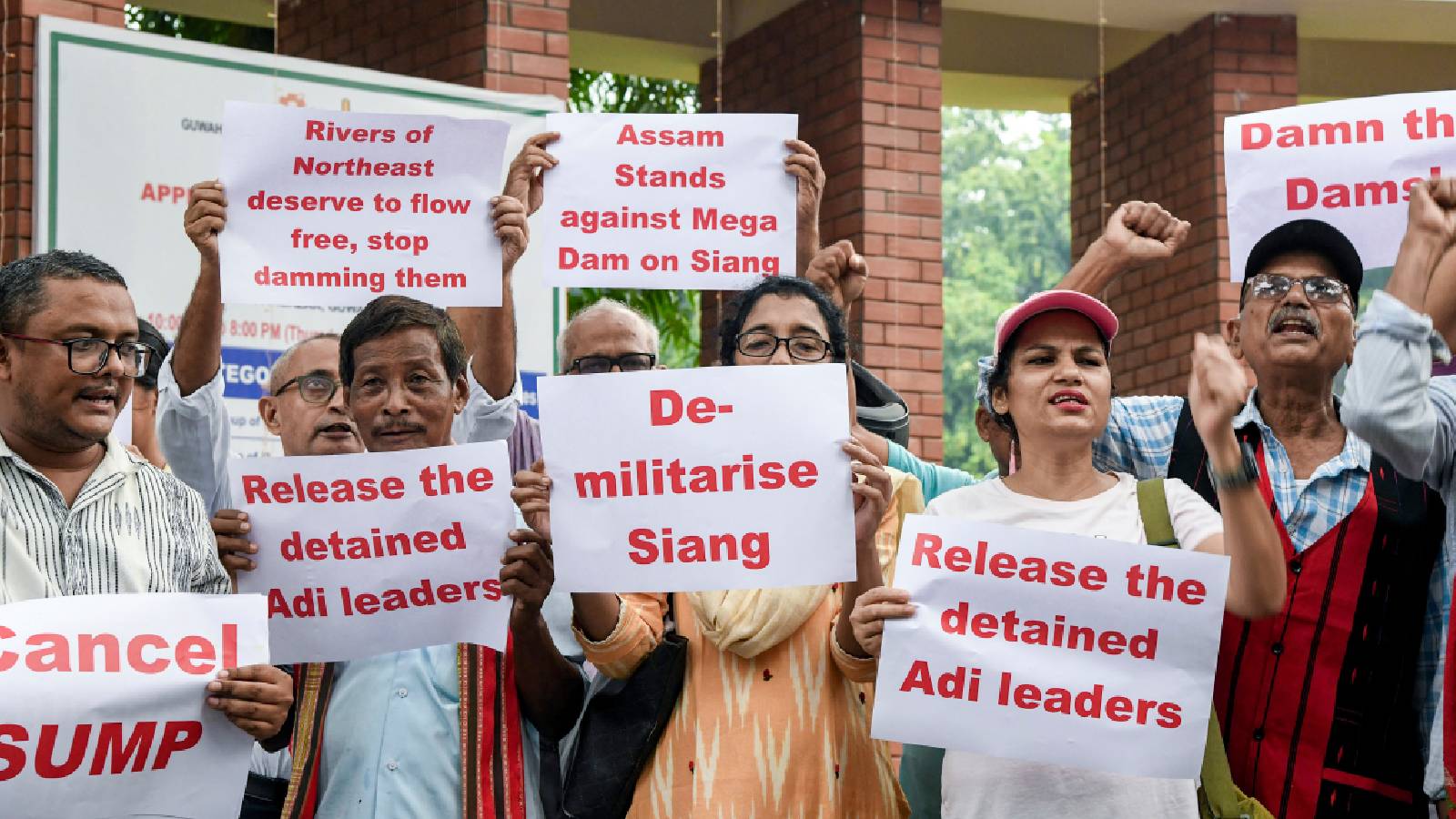


The Siang River has sustained generations of indigenous communities in Arunachal Pradesh. Its fertile banks support agriculture, while its waters and surrounding landscapes are deeply connected to the Adi tribe's history and identity.
Now, the river is at the centre of a confrontation between the government and local communities.
India wants to build a major hydropower project on the Siang, partly to address concerns about China's plans to build an enormous dam upstream in Tibet. The government considers the project important for water security, electricity generation and flood management.
But the Adi communities fear that the proposed dam could submerge their villages, destroy agricultural land and displace families.
Also Read:
Protests against the project have intensified in recent months, leading to arrests, violent confrontations and the deployment of security forces.
The dispute has exposed a growing divide between India's national security priorities and the concerns of communities whose lives depend on the river.
From Yarlung Tsangpo to Siang and Brahmaputra
The river originates in Tibet, where it is known as the Yarlung Tsangpo. After flowing across the Tibetan Plateau, it enters Arunachal Pradesh as the Siang and eventually reaches Assam, where it becomes part of the Brahmaputra River system. This intertwined geography is the major source of the controversy.
The construction of China's massive hydropower project at Medog, near the Great Bend of the Yarlung Tsangpo, began in July 2025. There are five cascading hydropower stations planned along approximately 50 kilometres of the river.
The project is expected to generate around 60,000 megawatts of electricity, approximately three times the capacity of China's Three Gorges Dam.
For India, the concern is that large-scale upstream infrastructure could influence the timing and volume of water reaching downstream regions.
China's project has therefore renewed interest in an Indian dam proposal that has remained under consideration for decades.
Why does India want the Siang dam?
The Siang Upper Multipurpose Project (SUMP) is a proposed 11,200-megawatt hydropower and storage project being pursued through the National Hydroelectric Power Corporation (NHPC).
The idea dates back to 1982–83, when the Brahmaputra Board proposed developing hydropower infrastructure on the river. The Union Government declared it a national project in 2008. China's upstream plans have since given the proposal greater strategic importance.
SUMP is intended to generate electricity, store water, regulate river flows and help manage floods. Its proposed reservoir would have a reported live storage capacity of approximately 9.2 billion cubic metres.
The government also considers the project a means of strengthening India's position on a river shared with China.
Proponents argue that greater storage capacity could improve India's ability to manage water and respond to potential disruptions.
However, the project has not received final construction approval.
Chief Minister Pema Khandu has maintained that it remains at the pre-feasibility stage and that construction would require public consultation and consent.
Why are the Adi communities opposing it?
For the Adi tribe, the Siang is closely connected to ancestral history, agriculture and cultural identity.
According to the community's oral traditions, Riga village was among the earliest Adi settlements in the valley. The river's fertile banks supported paddy cultivation and other agricultural activities, allowing communities to establish settlements across the region.
Today, farming and orange cultivation remain important sources of livelihood.
Residents believe that around 27 villages (20 villages in the Upper Siang district and 7 villages in the Siang district) could be submerged if the proposed dam is constructed. They fear losing homes, agricultural fields, and land associated with generations of their ancestors. However, the precise extent of submergence and displacement has not yet been established.
Environmental concerns have also strengthened opposition, particularly because the proposed project lies in a seismically active and ecologically sensitive Himalayan region.
Environmental engineer and anti-dam activist Katon Moyong has argued that hydropower projects could be developed on tributaries rather than the Siang's main channel.
"It has been 47 years since we have been shouting in the government's ear. From our grandfather's generation to ours, we have been clear: no Siang Dam. We are not against development. You can build dams in the tributaries, but not in the mainstream," he said at a press conference in Itanagar.
The Siang Indigenous Farmers' Forum (SIFF), established around 2012, has become a leading organisation in the movement. Youth groups, including the SUMP Affected Areas Youth Association (SAAYA), have also mobilised against the project.
How did the protests escalate?

The immediate dispute concerns the government's attempts to prepare a Pre-Feasibility Report (PFR).
The report would assess geological, hydrological and technical conditions before determining whether the project could proceed.
Parong, Dite Dime and Uggeng are among the proposed locations for preliminary investigations.
While the government maintains that conducting studies does not amount to approving construction, residents fear the process could advance a project they have consistently opposed.
Protests intensified in September and October, with villagers organising demonstrations, road blockades and resistance to survey teams.
Several activists were detained on October 9 under the Arunachal Pradesh Unlawful Activities (Prevention) Act, 2014.
The confrontation escalated on October 23 when a youth solidarity march in Pasighat was allegedly met with lathi charges and tear-gas firing.
Violence subsequently broke out, with protesters setting fire to NHPC premises and damaging police property.
Additional security personnel were deployed across affected areas, alongside barricades, armoured vehicles and concertina wires.
Security forces have restricted access towards the river, allowing only those with clearance to proceed.
Authorities have defended the deployments as necessary to maintain order. Protesters, however, argue that the presence of armed personnel has increased fear and mistrust.
National security versus local rights
The Siang dispute has unfolded against continuing tensions along the India-China frontier.
On October 22, Indo-Tibetan Border Police Director General Shatrujeet Kapur acknowledged standoffs involving Indian and Chinese forces at multiple locations in Arunachal Pradesh.
Earlier allegations of Chinese incursions had been rejected by the Indian Army. Chief Minister Khandu initially denied signs of encroachment but later acknowledged that transgressions occurred because China did not recognise the McMahon Line.
These developments have strengthened the national security arguments surrounding SUMP.
For the Union Government, the project represents a response to China's growing infrastructure presence upstream. For local communities, however, the security argument does not resolve concerns about displacement and environmental damage.
Some residents have also expressed frustration at suggestions that opposing the dam amounts to supporting China.
The disagreement reflects the difficulty of pursuing strategic infrastructure projects when the communities most directly affected believe their concerns are being overlooked.
Is a dam-for-dam strategy enough?
The government's approach assumes that greater storage and river-management capacity could help India respond to China's upstream activities.
However, researchers have warned against constructing competing mega-dams in the fragile Himalayan region, citing potential consequences for ecosystems, river systems and local populations.
There is also a limitation to the strategy.
Building a dam downstream does not establish how China will operate its upstream project or resolve uncertainty over future water flows.
Addressing these concerns requires diplomatic engagement.
Opening channels of communication with China is essential to understanding the potential downstream implications of the Medog project. Domestic infrastructure alone cannot settle questions involving a river shared by two countries.
Within Arunachal Pradesh, meaningful dialogue with affected communities is equally important.
The Siang project remains at the preliminary assessment stage, with its final location and displacement impacts still undetermined.
For India, the proposed dam is tied to water security and strategic interests. For the Adi communities, it concerns the survival of villages, livelihoods and a cultural history rooted in the river.
The challenge is not simply whether India can construct a dam on the Siang, but whether its security concerns can be addressed without disregarding those who have lived alongside the river for generations.
(In Context looks beyond the headline to understand the story behind the story — the events that led to it, the forces shaping it, the people affected by it and what it tells us about the world around us.)
(With inputs from The Hindu, The Wire, The Print, PTI and ANI)