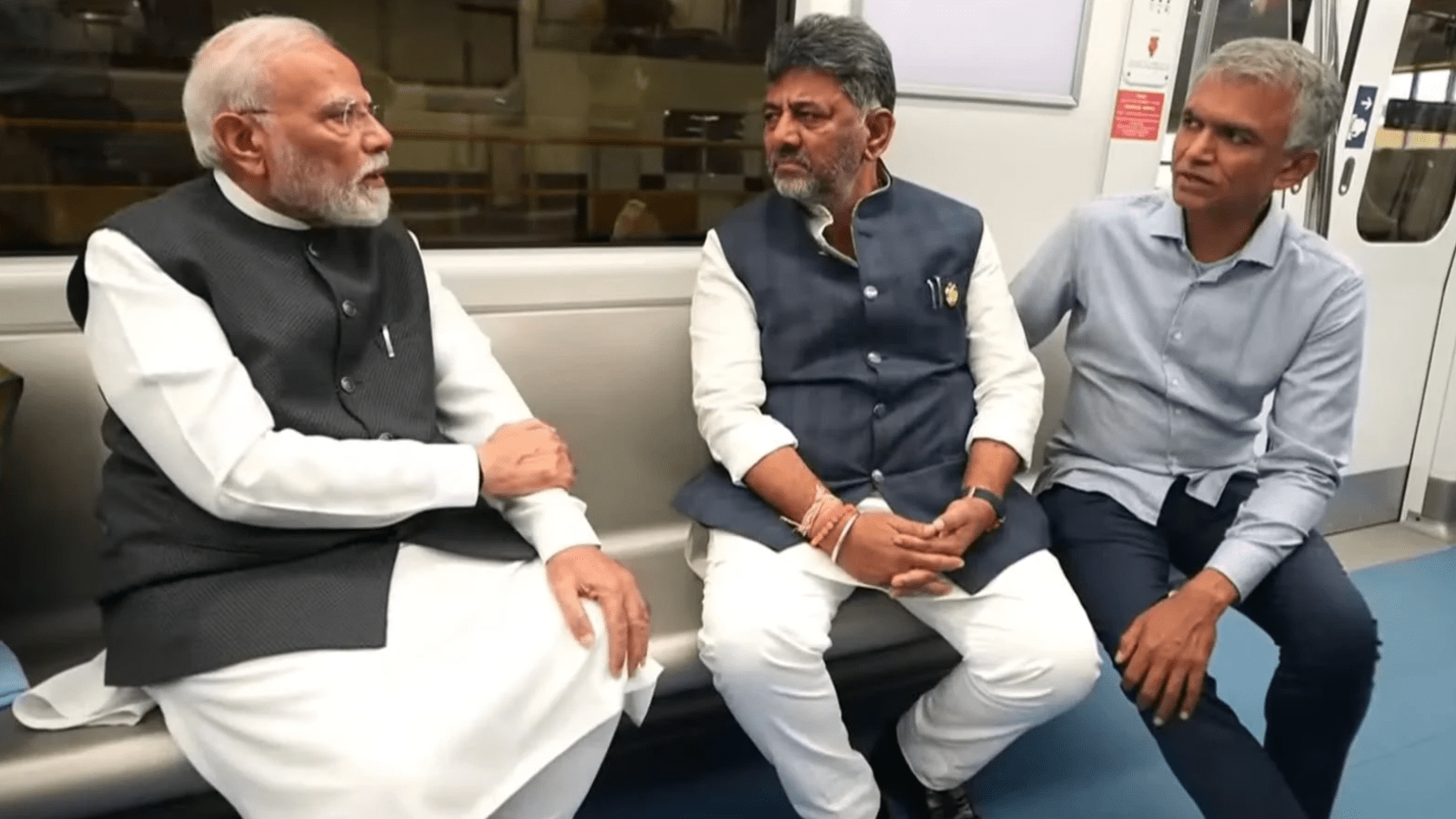


Bengaluru: As Prime Minister Narendra Modi arrived in Bengaluru on Friday, November 13, to inaugurate a 7.5-km elevated stretch of the Namma Metro Pink Line, a political disagreement over who pays for the city's expanding Metro network had taken centre stage.
The Karnataka government, led by the Congress, has accused the Union government of contributing far less than its fair share towards the project, arguing that the state is bearing nearly 84% of the total expenditure. The BJP, meanwhile, has rejected this calculation, with Bengaluru South MP Tejasvi Surya of the BJP claiming that the Centre actually accounts for more than half of the project's funding.
The two sides have presented sharply different figures for the same Metro network. While the state puts its contribution at Rs 65,291 crore against the Centre's Rs 12,600 crore, Surya has calculated the Union government's share at Rs 41,558 crore and Karnataka's at Rs 36,333 crore.
At the heart of the disagreement is a question that is not immediately apparent from these figures: should international loans obtained by Bangalore Metro Rail Corporation Limited (BMRCL) with the Union government's sovereign backing be counted as the Centre's contribution, or should the financial burden of repaying those loans be attributed to Karnataka?
The distinction is important because it determines how much each government is actually contributing to one of Bengaluru's most expensive infrastructure projects.
Why has the funding dispute erupted now?
The disagreement intensified on November 11, when Bengaluru Development Minister Krishna Byre Gowda presented the Karnataka government's assessment of the funding pattern across Namma Metro's various phases.
According to figures compiled by the state's Urban Development Department, the combined approved expenditure for Metro Phases 1, 2, 2A, 2B and 3 is approximately Rs 77,891 crore.
Of this, Karnataka is bearing Rs 65,291 crore, or 83.8% of the expenditure, while the Union government's contribution stands at Rs 12,600 crore, or 16.2%.
"The state is effectively investing nearly five rupees for every rupee contributed by the Centre," Byre Gowda said while arguing that the actual financial arrangement was considerably different from the 50:50 funding model often cited for Metro projects.
The minister said Karnataka's contribution included land acquisition and rehabilitation expenses, repayment of foreign loans, state taxes, grants, value capture financing and construction-period interest.
The state has also pointed to its responsibility for covering BMRCL's operational losses and supporting the corporation's debt repayments.
According to the figures presented by the minister, Karnataka has spent Rs 14,404 crore on land acquisition and rehabilitation, Rs 28,958 crore towards foreign loan repayments, Rs 3,915 crore in state taxes, Rs 4,818 crore through grants and value capture, and Rs 761 crore towards construction-period interest.
The government has argued that these expenses must be considered when assessing the actual financial burden of building and expanding the Metro network.
Byre Gowda also said that the Centre's contribution had declined across successive phases even as the state continued to shoulder a larger share of the expenditure.
He called on the Union government to increase its contribution and expedite approvals for pending Metro corridors. The state intended to make a formal appeal to Modi during his Bengaluru visit.
What is the BJP's counterargument?
Bengaluru South MP Tejasvi Surya rejected the Karnataka government's figures on November 12, accusing it of misleading the public by including international loans under the state's contribution.
In a presentation titled Fact Check on Congress Government's Claims Regarding Namma Metro, Surya cited BMRCL's approved funding plan for Phases 1 to 3.
According to his calculation, the Union government's contribution stands at Rs 41,558 crore, accounting for 53.35% of the total approved expenditure of Rs 77,890.68 crore. Karnataka's contribution, he said, is Rs 36,333 crore, or 46.65%.
The primary difference between the two calculations is the treatment of Rs 28,958 crore in foreign loans.
Surya argued that these loans were obtained by BMRCL through international financial institutions with the Union government's sovereign guarantee. Since the Centre facilitated the borrowing through its sovereign backing, he said, the amount should be accounted for under the Union government's contribution rather than Karnataka's.
He also pointed out that BMRCL is a 50:50 joint venture between the Union and Karnataka governments, with both having contributed Rs 9,164 crore each towards its equity.
Surya maintained that BMRCL and the Karnataka government are separate entities and that loans taken by the corporation cannot automatically be treated as direct expenditure by the state government.
He also questioned why the state was claiming responsibility for repaying the entire foreign loan amount when the loans were obtained by BMRCL through the Centre.
What are sovereign guarantees, and why do they matter?
Understanding this distinction is essential to following the dispute.
A sovereign guarantee is an assurance provided by a government that it will meet specified financial obligations if the borrower defaults. Such guarantees can help public corporations secure loans from international financial institutions on terms that may otherwise be difficult to obtain.
In the case of Bengaluru Metro, BMRCL has borrowed from international lenders including the Japan International Cooperation Agency (JICA), Agence Française de Développement (AFD), the European Investment Bank (EIB) and the Asian Infrastructure Investment Bank (AIIB), with the loans routed through the Union government.
However, providing a sovereign guarantee and actually repaying a loan are two different financial responsibilities.
The guarantee gives lenders confidence that their money is protected. But it does not, by itself, establish that the Union government has directly paid the loan amount or that it will bear the regular repayment instalments.
This is where the Karnataka government's argument comes in. It maintains that the state ultimately bears the repayment burden, and therefore the loans should be considered while calculating its contribution to the project.
Surya, on the other hand, argues that the loans are part of the funding structure facilitated by the Centre and should not be presented as direct state expenditure.
There is an important qualification to the BJP's argument, however. A sovereign guarantee is not the same as an outright grant from the Union government. Equally, a loan taken by BMRCL cannot automatically be equated with money directly spent from the Karnataka government's budget. The actual repayment arrangements and the financial support provided by each government need to be examined separately.
What does the CAG report say about Karnataka's role in loan repayment?
An important document in understanding the issue is the Comptroller and Auditor General's (CAG) Report No. 7 of 2026, which examined the financial management and execution of BMRCL's projects.
The audit report records that BMRCL received international loans through the Union government, including senior-term debt from JICA, AFD, EIB and AIIB.
It also points to the corporation's continued dependence on the Karnataka government for servicing its external debt.
According to the report, BMRCL received Rs 11,807.82 crore in senior-term debt against sanctioned loans of Rs 13,178.01 crore for the phases examined. It had repaid Rs 1,612.21 crore in principal as of March 2023.
The CAG observed that BMRCL had continuously incurred cash losses between 2013-14 and 2021-22 and depended on the Karnataka government for debt repayment under tripartite memorandums of understanding signed between the Union government, the state government and BMRCL.
The report noted that the state government's support was provided for under these agreements.
This is significant because it establishes that Karnataka's financial responsibility is not merely a political claim. There are documented arrangements under which the state is required to support BMRCL's debt obligations when the corporation cannot meet them from its own revenue.
The Union government's role in facilitating international borrowing and the state's role in supporting repayment can therefore coexist. They are different parts of the same financing arrangement.
The CAG report also raises broader questions about the financial sustainability of the Metro corporation, its dependence on government support and the consequences of project delays and cost overruns.
What do official Union government figures reveal?
There is another important piece of information that adds to the complexity of the debate.
In a written reply to a Lok Sabha question on March 12, 2026, the Union Ministry of Housing and Urban Affairs provided details of Karnataka's financial commitment towards Bengaluru Metro.
The ministry said BMRCL had informed it that the Karnataka government had committed Rs 31,534 crore towards various phases of the project, representing 41.73% of the total cost.
The reply also stated that, under the tripartite memorandum of understanding between the Union government, Karnataka and BMRCL, the state government is required to finance cash losses during the operational phase if BMRCL cannot meet them.
More importantly, the ministry said Karnataka had disbursed Rs 5,066.65 crore towards debt repayment and cash-loss reimbursement as of March 5, 2026.
This parliamentary reply offers an additional perspective on the debate. It recognises Karnataka's substantial financial commitments and its responsibility for supporting BMRCL's debt and operational obligations.
However, the Rs 31,534 crore figure is a commitment reported by BMRCL, while the Rs 65,291 crore figure presented by the state includes a wider set of expenditure categories, including its accounting of foreign loan repayments, taxes and other costs. The two figures should not be treated as directly comparable without examining their underlying accounting methods and time periods.
Cost overruns and delayed projects add to the burden
The argument over funding is also taking place against the backdrop of rising project costs.
According to the Karnataka government's assessment, the cost of the first three phases has increased by Rs 24,641 crore over the original sanctioned estimates. For Phases 2, 2A and 2B, the revised estimates indicate an additional expenditure of Rs 19,175 crore, with the state claiming that it is bearing almost the entire additional burden.
The CAG has independently flagged serious shortcomings in project planning and execution.
Its audit identified a Rs 6,603.39-crore increase in land acquisition costs for Phases 1 and 2, attributing the escalation to inadequate assessment of land requirements and delays in acquisition.
The report also observed that BMRCL had incurred avoidable expenditure and continued to depend on the Karnataka government because its revenues were insufficient to meet debt repayment obligations.
The foreign currency component of international borrowing adds another complication. Since several loans are denominated in foreign currencies, fluctuations in the value of the rupee can increase the amount required for repayment.
In June 2026, The New Indian Express reported that BMRCL had begun repayment of a $500-million loan from the Asian Development Bank, even as the rupee's depreciation increased the repayment burden. BMRCL told the newspaper that its loan repayments were backed by state government guarantees and that the state would provide support in case of revenue shortfalls.
These financial pressures have strengthened Karnataka's argument that it is carrying a disproportionate share of the Metro's long-term costs.
The dispute extends beyond funding to pending Metro projects
The disagreement is not limited to the money already spent. Karnataka has also raised concerns about delays in approvals for future Metro corridors.
One of the major projects in question is the proposed 37.8-km Sarjapur-Hebbal corridor, referred to as Phase 3A or the Red Line.
The Karnataka Cabinet approved the project in December 2024 at an estimated cost of Rs 28,405 crore. However, the proposal has been awaiting approval from the Union government since January 2025.
Following concerns raised by the Union Ministry of Housing and Urban Affairs over project costs, a revised detailed project report pegged the estimated expenditure at Rs 25,999 crore.
The state has argued that delays in central approvals are pushing up project costs and affecting Bengaluru's infrastructure expansion plans.
Surya, however, has blamed the Karnataka government for delays in the proposed Orange Line, alleging that changes to its alignment and design, including proposals for a double-decker structure, have affected the project's progress.
He also questioned the cost estimates of the proposed Red Line and said the Centre had sought an independent third-party audit of the project proposal.
The two sides have thus extended their disagreement from the question of who has paid for existing Metro infrastructure to who is responsible for delays and cost escalation in future projects.
Pink Line inauguration becomes another political flashpoint
The funding controversy acquired another political dimension on November 12 when Krishna Byre Gowda alleged that his speaking slot had been removed from the final programme for the Pink Line inauguration.
The minister said his name had appeared in an earlier draft of the programme but was missing from the final schedule. Sharing the two versions on social media, he described the omission as punishment for raising Karnataka's demand for a fairer share of central funding.
Surya, whose address remained on the programme, said he was unaware of the change and suggested that BMRCL may have made the decision in accordance with protocol.
The controversy unfolded ahead of Modi's inauguration of the 7.5-km elevated section of the Pink Line between Kalena Agrahara and Tavarekere, built at an estimated cost of Rs 3,470 crore.
The Prime Minister inaugurated the stretch on November 13. The section is scheduled to open for public services on November 14, taking Bengaluru's operational Metro network to approximately 103 km.