


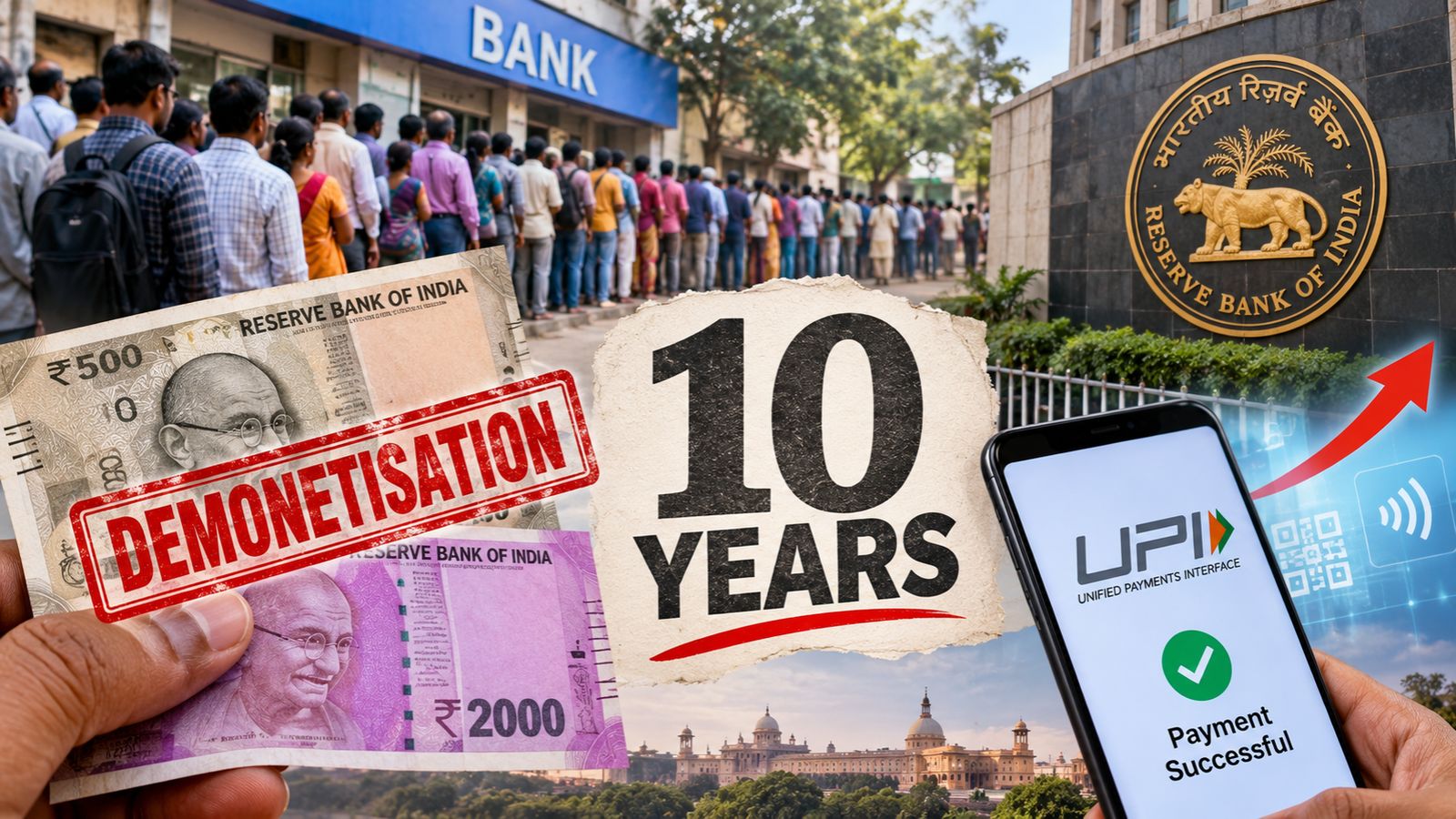


India marks its 10th year of demonetisation by the Modi government today. A historic move that was implemented for some of the same reasons for which they were done in 1946 and 1978: to curb the growth of black money and unaccounted wealth in the financial market.
But as we reach a decade, have we achieved the economic transformation that we intended? Let's discuss.
The History
On November 8, 2016, Prime Minister Narendra Modi announced that existing ₹500 and ₹1,000 currency notes would cease to be legal tender from midnight.
- The announcement came as a surprise, as the government clarified the move was done to tackle:
Black money / undisclosed wealth - Counterfeit currency in the market
- Financial transactions within terror groups
- Corruption, and
- A smart move to switch to digital systems rather than depending on physical notes.
According to the RBI, the move reportedly affected approximately 86.9 per cent of the value of currency in circulation.
Impact on ordinary citizens
While the government argued that demonetisation would deliver long-term economic benefits, its immediate consequences were felt across the country.
The demonetisation drive is reported to have affected ordinary citizens the most. Standing in long queues at banks and ATMs to exchange and withdraw their notes was a hassle for many, with limits even put on the number of transactions per day.
Daily-wage labourers, migrant workers, and farmers, who have little to no understanding of banking, with many not even having bank accounts, struggled to exchange their lifelong savings.
The 2000 rupee note and its short-lived life
Along with the introduction of the new Rs 500 and Rs 1000 notes, the government also introduced a new Rs 2000 note as a temporary fix to the rapid change in the economy.
The new note helped in quick transactions of larger sums. But the RBI officially withdrew the circulation of the notes in 2023, citing that the objective of the note was achieved and that an adequate amount of other denominations was available. But the legal tender status of the note still remains, and one possessing the note can exchange it at any of the 19 RBI Issue offices in person or by sending it through post.
UPI and the change to digital currency
One key point to note is how the demonetisation occurred months after the introduction of the Unified Payments Interface, or UPI payments.
Introduced by the National Payments Corporation of India (NPCI) on April 11, 2016, UPI was launched to digitise payments in India, easing the struggle of carrying physical cash and making it into a digital economy.
On August 25, 2016, UPI was opened to public app stores as banks began releasing their UPI-enabled mobile applications.
According to government figures, UPI recorded approximately 24,162 crore transactions worth ₹314 lakh crore in the financial year 2025-26.
The scale of this growth reflects a fundamental shift in how Indians make payments, from shopping and food purchases to utility bills and money transfers.
As per the latest reports, UPI is now available in 11 countries, namely Singapore, the United Arab Emirates (UAE), Bhutan, Nepal, Sri Lanka, France, Mauritius, Qatar, Cambodia, Greece and Maldives.
But did this reduce the use of cash as a mode of exchange? Not really.
According to the research ‘Cash Persists: Payments Preferences and Currency Holdings in India’ by Anirudh Tagat, Mehmet Ozmen and Pushpa Trivedi in 2026, 94 per cent of transactions are still carried out in physical cash in India.
The legal battle of demonetisation
The Opposition parties have widely criticized the move, stating the exercise was carried out to satisfy certain private entities by the government.
“India's biggest billionaires were the only beneficiaries of demonetisation.Your Money that you deposited in banks was used by the government to waive off the debts of these people”.
said Rahul Gandhi, leader of the Opposition.
Several writ petitions were filed in the Supreme Court and different High Courts after the November 8, 2016 announcement, challenging the legality of the exercise and criticisms mounting, questioning the implementation and constitutionality of the move.
On January 2, 2023, a five-judge Constitution Bench of the Supreme Court upheld the government's 2016 demonetisation decision by a 4:1 majority, with Justice B V Nagarathna dissenting the move holding that the exercise should have been carried out through legislation rather than an executive notification.
The majority held that the decision-making process was not flawed and that the government had consulted the RBI before taking the decision.
To what extent was the objective achieved?
According to the RBI report, currency in Rs 1,000 and Rs 500 denominations in circulation was Rs 15.44 lakh crore.
By June 30, 2017, approximately Rs 15.28 lakh crore had returned to the RBI, that is, around 98.96 per cent of the withdrawn currency.
The final RBI figures subsequently put the amount returned at approximately Rs 15.31 lakh crore, or 99.3 per cent.
This means only a small fraction of the demonetised currency did not return to the banking system.
The figure became a major point of criticism, with questions being raised about whether the exercise had succeeded in flushing out black money.
However, the return of currency does not necessarily establish that all the money was legitimate. Deposits could also help tax authorities identify suspicious transactions and investigate previously undisclosed income.
It is also important to distinguish between black money and cash. Unaccounted wealth can be held in property, gold, benami assets, overseas accounts, and other investments. Consequently, withdrawing currency alone could not eliminate the wider stock of undisclosed wealth.