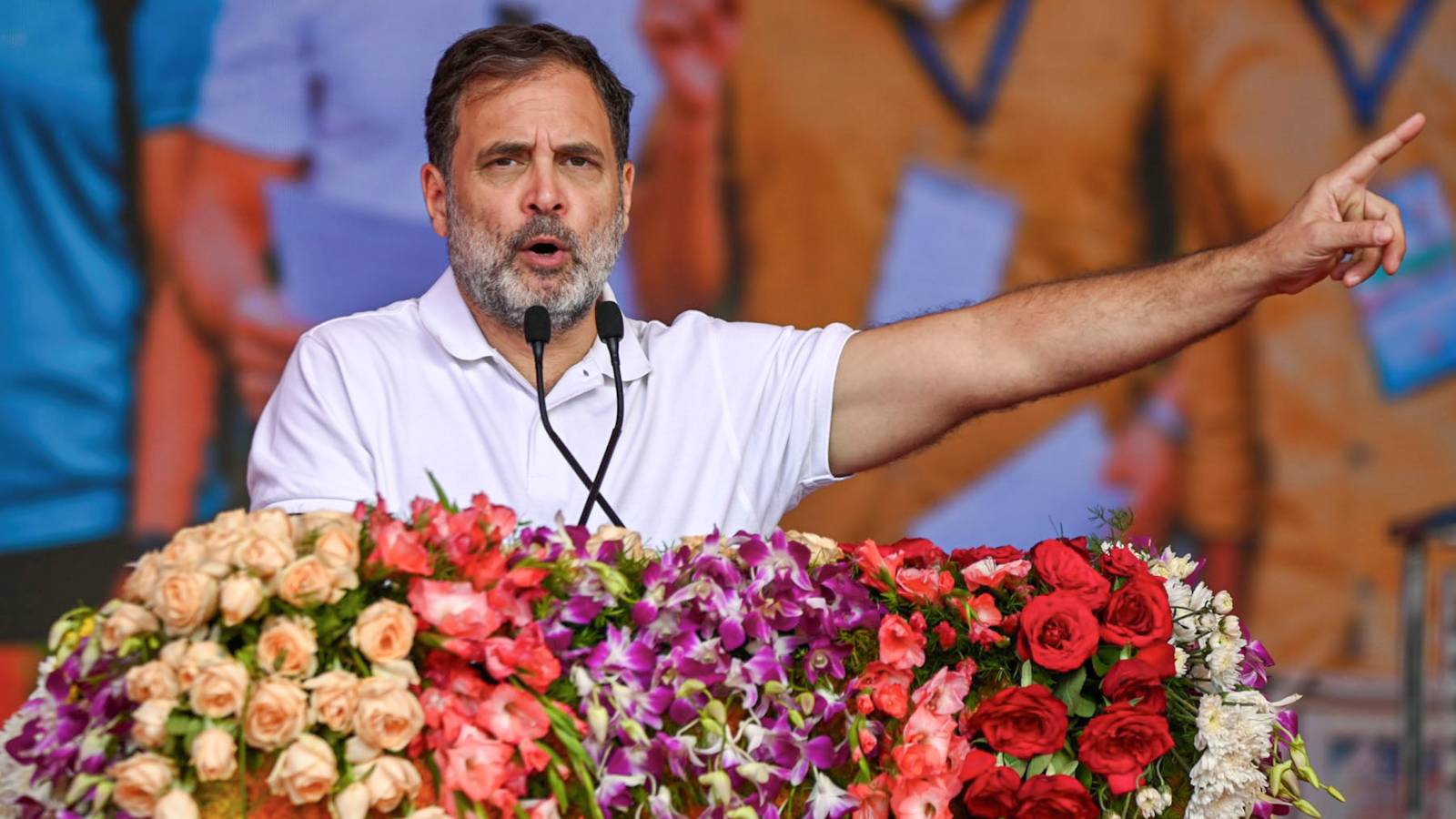


Hyderabad: Congress leader Rahul Gandhi on Saturday questioned the credibility of India's electoral process, alleging large-scale discrepancies in voter rolls and raising doubts over the 2024 election results.
Speaking at the concluding session of the two-day Bharat Summit 2026 in Hyderabad, the Leader of the Opposition in the Lok Sabha challenged the Election Commission of India (ECI) to explain how the 2024 Lok Sabha elections could be considered legitimate if voters who participated in them were subsequently classified as non-existent or non-voters.
"140 million people who voted in the 2024 Lok Sabha election were declared as either non-existent voters or non-voters a few months ago," Gandhi said.
"If the Election Commission has declared 140 million voters illegal non-voters, then how is that election possibly legitimate?" he asked.
His remarks came amid the Opposition's continuing criticism of the ECI's Special Intensive Revision (SIR) of electoral rolls.
Gandhi alleges seven million additions in Maharashtra
Gandhi also questioned the outcome of the Maharashtra Assembly elections held in November 2024, pointing to the contrast with the Lok Sabha results earlier that year.
The Congress-led Maha Vikas Aghadi had performed strongly in the parliamentary elections in the state but suffered a major defeat in the Assembly polls.
Gandhi alleged that the opposition alliance received almost the same number of votes in both elections, while seven million additional voters were registered in the intervening period.
"We find that we get the exact same votes in both the elections. Seven million new voters are added in three months, and every single one of those seven million voters votes for the BJP, and they win the election," he said.
However, the ECI's figures do not match the seven-million figure cited by Gandhi. In a December 2024 response to the Congress, the poll body said Maharashtra's electoral rolls recorded 48.81 lakh additions and 8 lakh deletions, resulting in a net increase of approximately 40.81 lakh electors between the Lok Sabha and Assembly elections.
The Commission said the increase included people who became eligible to register after turning 18, with July 1 and October 1 among the qualifying dates for enrolment in 2024. It also rejected the Congress's allegations of arbitrary additions and deletions.
Dispute over nationwide voter deletions
The 140-million figure cited by Gandhi also needs to be distinguished from the ECI's published data on the SIR exercise.
The Commission's draft-roll figures reported in October 2026 placed 13.39 crore electors in the categories of absent, shifted, dead or duplicate (ASDD). These classifications do not, by themselves, establish that all those individuals had voted in the 2024 Lok Sabha elections or that they were declared illegal voters.
The BJP has defended the revision exercise, arguing that it is intended to identify deceased, permanently shifted, absent and duplicate entries. The party has rejected the Opposition's allegations of vote manipulation.
The Congress, meanwhile, has sought machine-readable electoral rolls and greater transparency from the poll body, arguing that the available information is insufficient to independently examine suspected discrepancies.
Gandhi says democracy was weakened in 2014
Gandhi also accused the poll body of changing India's political and electoral landscape after the BJP came to power in 2014.
He alleged that large sums of money entering the political system altered the nature of election campaigns and disrupted the coalition-based political contest that had existed earlier.
"Millions and millions and millions of dollars injected into the political system," he said, describing the period as a turning point in Indian politics.
He added that the Opposition had taken years to understand the changes, before claiming that "democracy was destroyed in India in 2014".
The Congress leader also alleged a growing concentration of wealth and an overlap between political and business interests, specifically referring to the relationship between Prime Minister Narendra Modi and industrialist Gautam Adani. These were political allegations made during his address.
Calls fascists louder as systems collapse
In another part of his speech, Gandhi criticised what he described as fascist tendencies in business, academia and politics. He argued that people who dominate public discussions often refuse to listen, while the majority remains quieter and more receptive.
"You find people at the head of businesses; you find them in academics, they know it all, and in politics we call them fascists. Fascists tend to scream. They shout, they scream, they don't listen. The majority listens, pays attention, is humble, so the fascists tend to have a louder voice," he said.
He added: "And historically, the fascists jump out of the woodwork when systems collapse... And for the last decade, the fascists have been running, romping, jumping, shouting, screaming."
Gandhi addressed the summit alongside Telangana Chief Minister A Revanth Reddy. His remarks came as BJP leaders criticised the event and Bharatiya Janata Yuva Morcha workers staged protests outside the venue.