

Bengaluru: For thousands of students and young professionals who move to Bengaluru every year in search of education and employment, paying guest accommodation is often the first step towards building a life in the city. It offers something that renting an independent apartment rarely does at a comparable price: a place to sleep, regular meals, electricity, water and, in many cases, housekeeping and other basic amenities, bundled into a monthly payment.
But that arrangement is becoming increasingly difficult to sustain at the prices many residents have come to depend on.
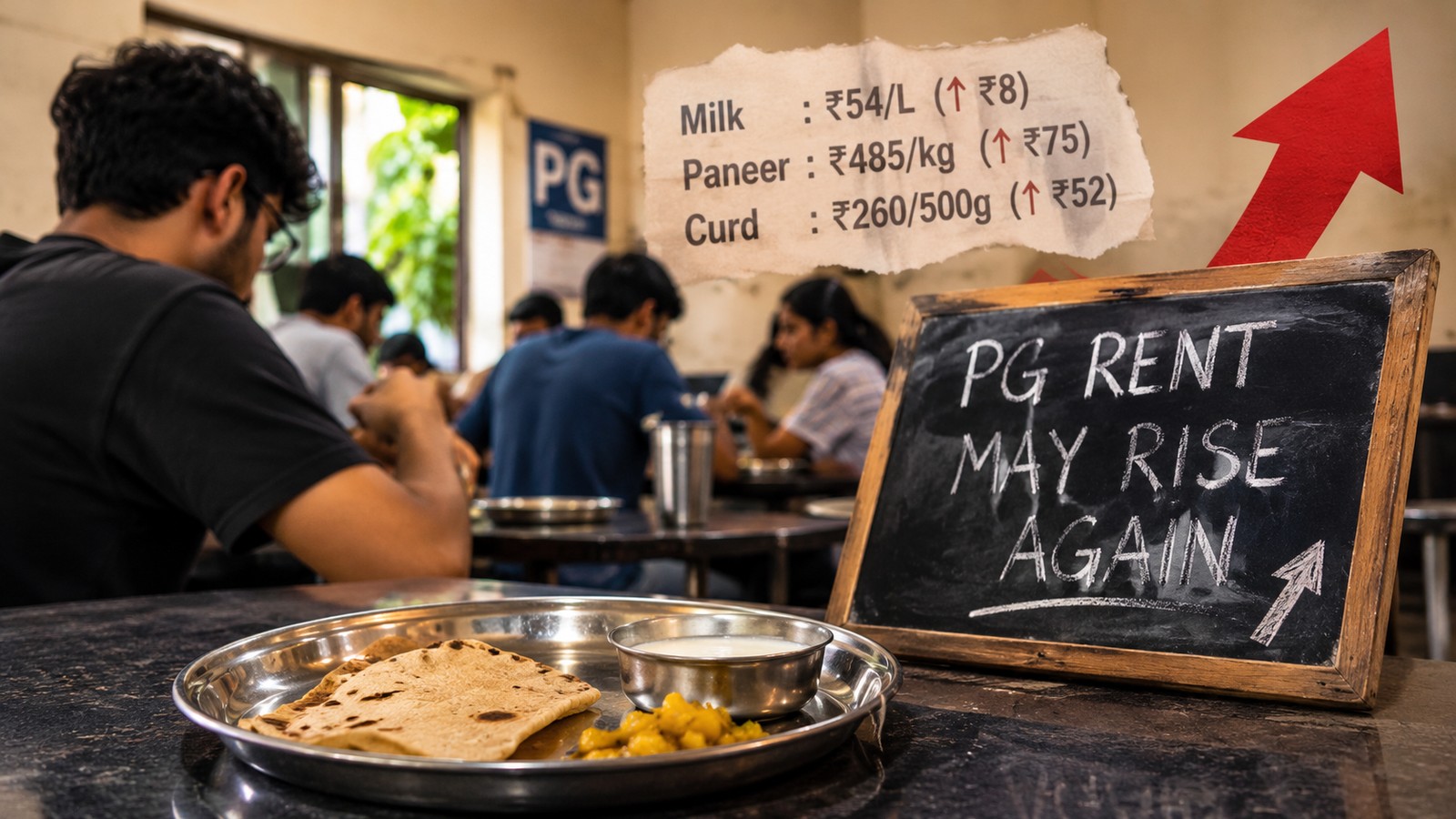
PG owners are considering increasing monthly charges by around Rs 500 per resident following the latest rise in milk and paneer prices, according to a November 14 report in The Times of India. The proposed increase comes just four months after an earlier rent revision in August.
For residents, the concern is not merely another addition to their monthly expenses. It is also about what they receive for the money they already pay. As the cost of running PG kitchens increases, some establishments are considering changes to their menus, including replacing paneer with cheaper alternatives and reducing dairy servings.

When everyday meals become expensive
The latest pressure on PG kitchens follows a series of price revisions in Karnataka's dairy sector.
From November 1, the Karnataka government increased Nandini milk prices by Rs 8 per litre, taking the price of toned milk from Rs 46 to Rs 54. The government said Rs 7 of the increase would go towards improving payments to dairy farmers, with the remaining Re 1 allocated to milk unions.
The increase was followed by a revision in the prices of other Nandini products by the Bengaluru Milk Union (BAMUL), effective November 4.
The price of one kilogram of paneer increased from Rs 410 to Rs 485. A 500-gram packet now costs Rs 260, compared to Rs 208 earlier, while a 200-gram packet has increased from Rs 96 to Rs 115.
For a household buying these products occasionally, the increases may mean a higher grocery bill. For a PG preparing meals for dozens or hundreds of residents, the additional expenditure is multiplied across every day's breakfast, lunch and dinner.
According to The Times of India's report, a PG owner in Shanthinagar said the establishment served paneer three times a week and provided milk and curd daily. The rising prices have prompted owners to consider reducing the frequency of paneer dishes or changing the menu.
The report also quoted a resident, Lalitha R, who stays in a PG in Mahadevapura, as saying that her accommodation was considering replacing paneer with soya chunks. She said another PG had reduced curd servings to once a day.
These changes may appear minor when viewed as individual menu decisions. But for people who choose PG accommodation because meals are included in the rent, they affect an important part of the service they are paying for.
In a city where many young employees work long hours, having regular meals arranged is often as important as having a place to sleep.
Also Read:

Residents already paying for food outside
The problem of food quality in Bengaluru's PGs predates the latest price increases.
A June 2025 investigation by The News Minute into the city's PG accommodation sector found that several residents were dissatisfied with the food provided by their establishments, even when meals were included in their monthly charges.
Sneha, a student staying in a PG in AECS Layout, told TNM: "Every PG here is the same. They offer below-average food, which we cannot eat daily. We have to mostly resort to ordering in or eating out, and we end up shelling out a lot of money."
Her account highlights an additional expense that is often overlooked when comparing PG rents with other accommodation options.
A resident paying for a PG with food included may still have to spend extra money on outside meals if the food is inadequate. If the establishment subsequently reduces food portions or changes its menu to manage rising costs, that additional expenditure could increase.
The affordability of a PG, therefore, cannot be judged by its monthly rent alone. The quality and quantity of food, access to water, sanitation, and basic facilities also determine how much residents eventually spend to live in the city.
Another rent revision after August
The proposed increase of around Rs 500 comes after Bengaluru's PG owners had already revised their charges from August 1.
According to the Paying Guest Accommodation Welfare Association, the earlier revision increased monthly charges by Rs 500 for residents in three- and four-sharing rooms. Those staying in single- and double-sharing rooms faced an increase of Rs 1,000.
The association cited rising prices of essential commodities, cleaning materials, staff salaries, electricity, water, cooking gas and maintenance.
The latest report in The Times of India also highlighted the scale of some of these increases. PG owners reportedly said the cost of a cooking gas refill had increased from Rs 1,800 to Rs 3,300 in two months. Rice had become costlier by Rs 400 per kilo, while cooking oil had increased by Rs 500 per litre.
For residents, the prospect of another increase within four months is significant.
Basic PG accommodation in Bengaluru can cost around Rs 5,000 a month, while average accommodation costs between Rs 8,000 and Rs 9,000. Premium facilities can charge considerably more, according to the same report.
For someone earning an entry-level salary, or a student whose expenses are supported by their family, even an additional Rs 500 every month can affect the money available for transport, savings and other necessities.
PG owners caught between rising expenses and occupancy
The financial difficulties facing PG operators are not limited to food prices.
In May 2026, Bangalore Mirror reported that owners were considering increasing monthly charges by 10% to 15% because of rising LPG prices, electricity bills and water costs.
Arun Kumar DT, president of the PG Owners Welfare Association, told the newspaper that the increase in operating expenses was making it difficult for establishments to maintain existing rates.
The problem is compounded by occupancy levels. Venkateswara Reddy, a PG owner in Bengaluru East, told Bangalore Mirror that establishments operating below 60% occupancy were struggling to make profits. He said an occupancy level of around 80% was necessary to operate without major difficulties.
The Times of India's November 14 report also quoted Arun Kumar as saying that many PGs were operating at around 70% occupancy, partly because work-from-home arrangements continued in some companies.
This creates a difficult calculation for operators. Building rentals, staff salaries, maintenance and other fixed expenses have to be paid regardless of how many beds are occupied. When occupancy falls, the cost of running the establishment is effectively distributed across fewer residents.
The News Minute's June 2025 investigation had also documented these pressures. Arun Kumar told TNM that electricity bills for a PG housing around 150 people, which had earlier ranged between Rs 25,000 and Rs 35,000, had increased by another Rs 8,000 to Rs 10,000.
He also pointed to the expenditure on water tankers in East Bengaluru, where PG owners were paying Rs 2,000 to Rs 2,500 for 6,000 litres and requiring one or two tankers every day.