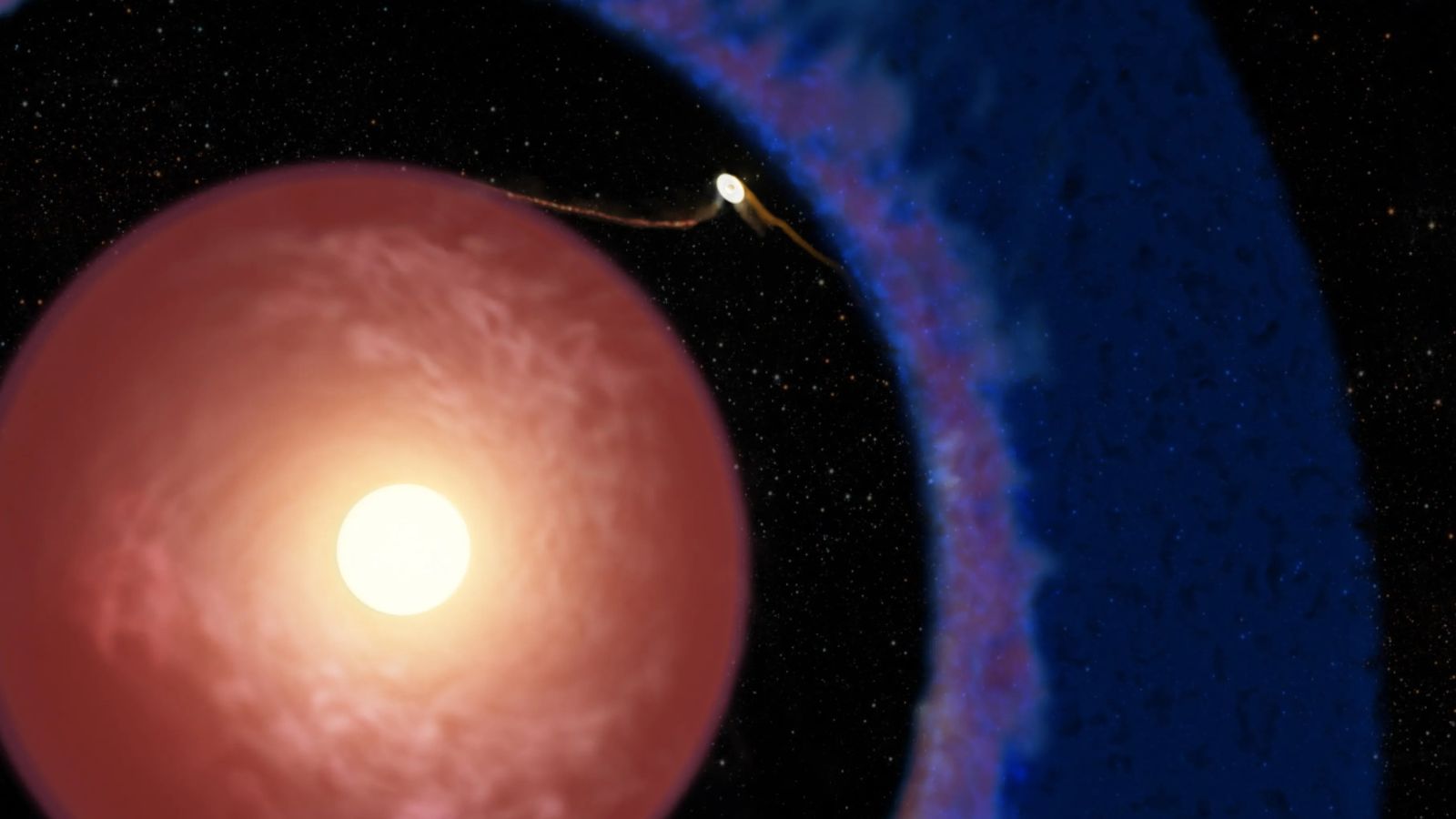


Astronomers have confirmed a Jupiter-sized planet less than one million years old, making Elias 2-24 b the youngest known planet identified so far.
The planet is still embedded in the disc of gas and dust surrounding its young star, allowing scientists to study a giant planet while it is continuing to accumulate material. The finding could help test how quickly giant planets can form, particularly at large distances from their stars.
The study, led by Andrea Bernardi of Universidad Diego Portales in Chile, was published on September 16 in The Astrophysical Journal Letters. NASA reported that the confirmation came from archival observations made with the WM Keck Observatory's instruments, combined with observations from other telescopes.
A planet caught in the process of forming
Elias 2-24 b is roughly as massive as Jupiter and orbits a young star about 450 light-years from Earth, according to NASA. The planet lies within a prominent gap in the star's surrounding protoplanetary disc.
These discs contain the gas, dust, ice and rocky material left over from the formation of a star. Over time, material within them can accumulate into planets. Astronomers have long suspected that some of the gaps visible in such discs are created by planets as they grow.
The Keck Observatory said the new discovery provides evidence connecting one of those gaps directly with a forming planet. The planet is still accreting material from the surrounding disc.
Andrea Bernardi said the team expected forming planets to be located within such gaps because they can carve them out as they develop, according to NASA's account of the research.
That makes Elias 2-24 b unusual not simply because of its age, but because astronomers are observing it during a stage of planetary evolution that is normally difficult to detect.
Why the discovery challenges existing models
The age of Elias 2-24 b is particularly important.
NASA said the previous youngest known planets were more than five million years old. Elias 2-24 b is less than one million years old, meaning astronomers now have evidence of a giant planet at a much earlier stage of development.
The distance from its star adds another difficulty. NASA reported that the planet is about 55 times farther from its star than Earth is from the Sun. Existing models indicate that forming a Jupiter-sized planet at roughly Jupiter's distance from the Sun takes about five million years, with formation expected to take longer at greater distances.
Elias 2-24 b therefore appears to have reached roughly Jupiter's mass much more quickly than those expectations would suggest.
Lucas Cieza, a professor at Chile's Instituto de Estudios Astrofísicos and a co-author of the study, said the discovery indicates that current planet-formation models may still be missing important processes. His comments were quoted by NASA in its report on the study.
The finding does not by itself overturn those models. Instead, it gives astronomers a new observational case against which theories and simulations of giant-planet formation can be tested.
A decade-old puzzle was resolved through archived observations
The object had attracted attention well before it was confirmed as a planet.
According to NASA, observations made with the Atacama Large Millimeter/submillimeter Array (ALMA) about a decade ago revealed a gap in the dusty disc around Elias 2-24. The European Southern Observatory's Very Large Telescope later detected a faint point of light inside that gap.
The problem was determining what that faint source actually was.
Astronomers could not easily reconcile a giant planet at that location with existing formation timescales. Bernardi's team therefore returned to observations stored in the Keck Observatory Archive, a NASA-funded partnership involving Keck Observatory and NASA's Exoplanet Science Institute at Caltech/IPAC.
The researchers found the same faint object in Keck observations from 2018 and 2020. By comparing its position across the observations and measuring its movement, they found that its behaviour was consistent with an object orbiting Elias 2-24 rather than a background star or an imaging artefact, NASA reported.
The Keck Observatory said the confirmation combined the archival Keck observations with independent observations from the Very Large Telescope and supporting evidence from ALMA.
The discovery therefore also highlights another aspect of modern astronomy: observations collected years earlier can yield new discoveries when researchers revisit them with improved techniques and new scientific questions.
Why very young planets are difficult to find
Most known exoplanets are not observed during their formation.
A common detection method is the transit technique, in which a planet passes across the face of its star and causes a small, temporary reduction in the star's brightness. NASA notes that this method is particularly difficult to use when planets are deeply embedded in dusty discs or orbit far from their stars.
That helps explain why most of the roughly 6,000 confirmed exoplanets are much older than Elias 2-24 b and relatively close to their host stars.
Direct imaging offers another possibility, but the light from a young planet can be overwhelmed by the much brighter star beside it. The Keck Observatory's NIRC2 instrument can operate with a coronagraph, which blocks much of the star's light and allows astronomers to search for much fainter objects around it.
Elias 2-24 b was detected using this type of observation.
What comes next
The researchers now want to learn more about the planet's physical properties, including its mass, atmosphere, temperature and continuing accretion.
The discovery could also open the way to finding more planets at similarly early stages. NASA said the Nancy Grace Roman Space Telescope, equipped with a more powerful coronagraph, could make such detections easier.
For now, Elias 2-24 b provides something astronomers rarely get: an opportunity to observe a giant planet not long after its host star formed, while the material surrounding it is still actively shaping the system.
Rather than reconstructing the birth of a planetary system from observations of an ancient one, researchers can use Elias 2-24 b to examine that process while it is still taking place.
(With Inputs from ANI, NASA Science, WM Keck Observatory, The Astrophysical Journal Letters, Keck Observatory — NIRC2)